Medical receptionist: job description, interview questions, and screening workflow
The calmest person in your interview room is not always the calmest person at your front desk. A medical receptionist can have years of experience and a spotless resume and still come apart on a Tuesday at 8:45am, phones ringing, a full waiting room, an insurance mismatch mid-check-in. The role isn't about knowing your EHR. It's about staying composed and accurate when three things happen at once, and about being honest enough to ask a patient to repeat information instead of guessing. Neither trait shows up on a resume, and a quiet interview room hides both. This guide screens for composure under real pressure and clear communication, not for medical-office experience you can train in two weeks.
What a medical receptionist actually does at a small practice
At a hospital system, front-desk work is split across specialists: a scheduler, a check-in clerk, an insurance verifier, a phone team. At a small practice, one person does all of it, often standing up, often mid-conversation with three things happening at once.
The job is real-time triage. A patient is checking in while the phone rings. A pharmacy is calling to verify a prescription while someone at the counter needs to pay a copay. An insurance card doesn't match what's on file. None of it is complicated on its own. All of it happening at the same time, every day, is what makes the role hard to fill and harder to keep filled.
The core responsibilities, in practice:
- Greeting and checking in patients, verifying identity and insurance information
- Scheduling and rescheduling appointments, often across multiple providers and rooms
- Answering and routing phone calls, many of them from anxious or frustrated patients
- Collecting copays and basic billing information
- Keeping patient information confidential and accurate in your EHR or scheduling system
- Flagging urgent situations to clinical staff instead of trying to triage them yourself
If you're a solo or two-provider practice, this person is often also your unofficial office manager: ordering supplies, tracking no-shows, being the first person a new patient ever talks to about your practice. That's worth naming out loud when you post the role, because it's a different job than "answer phones."
Job description you can post today
Copy this, then adjust the specifics (your EHR, your hours, your patient volume) to match your practice.
Medical receptionist
[Practice name] is looking for a medical receptionist to run our front desk. You'll be the first person our patients talk to, in person and on the phone, so we need someone who stays calm when the waiting room fills up and three things are happening at once.What you'll do
Check patients in and out, verify insurance, schedule and reschedule appointments, answer a busy phone line, collect payments, and keep patient records accurate and confidential. You'll work closely with our clinical team to flag anything urgent.What we're looking for
Experience in a fast-paced, customer-facing role (medical office experience is a plus, not a requirement). Clear phone and in-person communication. Comfort with basic office software and the ability to learn our scheduling system quickly. Someone who double-checks details instead of guessing.Schedule
[Insert hours, e.g. Monday-Friday, 8am-5pm, with occasional Saturday coverage][Insert pay range, per your practice's policy and any applicable state salary transparency requirements]
10 interview questions, and what a good answer sounds like
1. Walk me through what a typical Monday morning looks like at your current or most recent front-desk job.
You're checking for specificity. A strong answer names the actual sequence: opening the schedule, prepping charts or files, handling the first rush of calls. A vague answer ("it's busy, I handle it") tells you they haven't actually thought about the mechanics of the job.
2. Two patients are checking in at the same time and the phone is ringing. What do you do?
There's no single right sequence, but a good answer shows judgment: acknowledge both patients so neither feels ignored, let the phone go to voicemail or ask a coworker to grab it, and handle the more time-sensitive check-in first. Watch for candidates who freeze or say they'd try to do all three at once.
3. A patient is upset because they've been waiting 40 minutes past their appointment time. What do you say to them?
Listen for empathy first, information second. "I completely understand, let me check with the back office on timing and get you an update" is a strong answer. Defensiveness, or immediately blaming the provider, is a flag.
4. Tell me about a time you caught a mistake, yours or someone else's, before it became a bigger problem.
This is your attention-to-detail question. You want a specific story: a wrong date, a mismatched insurance ID, a double-booked slot. If they can't come up with an example, that's information too.
5. How comfortable are you asking a patient to repeat or clarify information, even if it means slowing things down?
Good candidates say they'd rather take an extra 15 seconds than guess. Watch for candidates who imply they'd rather move fast and fix it later. In a medical setting, that instinct causes real problems.
6. What would you do if a patient asked you a clinical question you're not qualified to answer?
You're testing scope awareness. The right answer is some version of "I'd let them know I'll have a clinical team member follow up" rather than guessing or offering an opinion.
7. What's your experience with scheduling software, and how quickly do you usually pick up a new system?
Less about the specific tool, more about learning speed and comfort with structured systems. If they've used any scheduling or CRM tool, even outside healthcare, that transfers.
8. How do you handle a day where three people call out and you're covering more than usual?
You're hiring for a role that will have those days. Listen for whether they talk about prioritizing and communicating, versus just "pushing through."
9. What does confidentiality mean to you in a role like this?
You want them to name specifics: not discussing patient information outside work, not leaving screens visible, double-checking who they're speaking to before sharing details. A generic "I'm trustworthy" without specifics is worth a follow-up question.
10. Why are you interested in this role, specifically, and not just healthcare in general?
This surfaces whether they understand what the job actually is. Candidates who talk about wanting to "help people" without mentioning the administrative, repetitive, detail-heavy reality of the job may be picturing a different role than the one you're hiring for.
A scorecard you can score candidates against
Ten questions only help if everyone on your side is listening for the same thing, so score every candidate on the same six signals instead of comparing gut feelings. Copy this into a doc and fill in a row per candidate.
| What you're scoring | Strong signal | Weak signal |
|---|---|---|
| Composure under simultaneous pressure | Acknowledges both patients, lets the phone go to voicemail or delegates it, handles the time-sensitive check-in first | Freezes, or says they'd try to do all three at once, or has no plan for a short-staffed day beyond "push through" |
| Empathy before information | Acknowledges the upset patient's wait first, then offers a concrete update | Gets defensive, or immediately blames the provider or the back office |
| Attention to detail | A specific story of catching a mistake, and would rather take an extra 15 seconds than guess | Can't produce an example, or implies they'd move fast and fix it later |
| Scope awareness | Routes a clinical question to a clinical team member instead of answering it themselves | Guesses at a clinical answer or offers a personal opinion |
| Confidentiality instinct | Names specifics: not discussing patient info outside work, keeping screens out of view, verifying who they're speaking to | A generic "I'm trustworthy" with no specifics behind it |
| Understanding the real job | Describes the actual mechanics of the role, and the administrative, detail-heavy reality of the day | Stays at "it's busy, I handle it," or talks only about "wanting to help people" |
How to screen medical receptionist candidates without losing a week to it
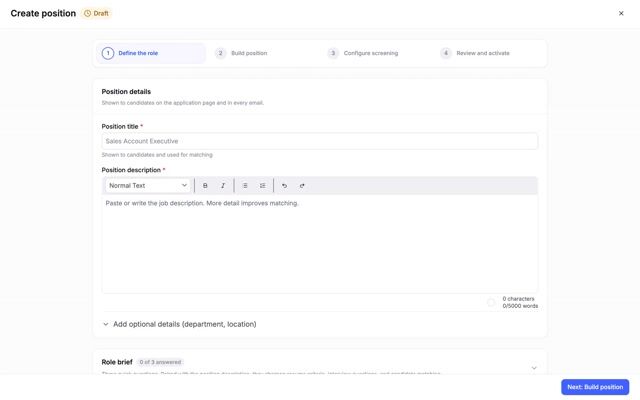
Truffle is an AI screening platform that combines resume screening, one-way video interviews, and talent assessments, so you can mix and match based on what this role actually rewards.
For a front-desk role like this, here's a workflow that fits a small practice:
- Resume screening first. You're not looking for a perfect match. You're filtering out candidates who clearly haven't done fast-paced, customer-facing work before, and flagging the ones worth a closer look.
- A short one-way video interview next. Ask 2-3 of the scenario questions above (the overlapping-patients question and the upset-patient question work well on video) so you can see how someone actually communicates before you spend an in-person slot on them. Tone and pace matter more for this role than for most, and video surfaces that in a way a resume never will.
- A short customer service assessment for your shortlist. Our customer service assessment gives you a structured way to compare candidates on the communication and composure-under-pressure skills that actually drive success in this role, before you commit to an in-person interview. If accuracy and scheduling logistics matter more for your practice, our admin assistant assessment is a strong alternative or add-on.
If you're screening a real applicant pool for this role, our resume screening and one-way video interview tools handle the first two steps in one place, with AI that surfaces your strongest matches against the criteria you set. You review and decide. It doesn't pick for you.
3 questions from the skills check we'd actually run for this role
The front desk is customer service under pressure, so the skills check we'd point you to here is Truffle's customer service assessment. These three situational scenarios come straight from it, and they map to the composure, verification, and triage a busy check-in counter demands every morning.
1. A customer says their order was due yesterday and they're "never buying from you again." Tracking shows a weather delay, now arriving tomorrow. What do you do first? Reveal answer
Best answer: acknowledge the frustration, confirm the details, share the updated timeline, and offer a reasonable option within policy. Explaining that the delay isn't your fault escalates the emotion, and a passive "wait and call back" makes it worse. This is the patient who's been waiting 40 minutes past their appointment: they need to feel heard first, then given a real update, not defended against.
2. A caller demands access to an account but fails a security question. What do you do? Reveal answer
Best answer: calmly explain you can't grant access without verification, and offer the approved reset path. Providing "limited details" because the caller sounds genuine is the exact instinct that leaks protected information. At a medical front desk this is confidentiality in practice: you verify who you're speaking to before you share anything, no matter how convincing the pressure.
3. You have three tickets: a VIP who can't log in (business-critical), a refund request within policy, and a non-urgent feature question. How do you order them? Reveal answer
Best answer: triage by impact and urgency: the login issue first, then the refund, then the feature question. Handling them in the order received, or starting with the easiest to clear backlog, both ignore what's actually at stake. This is the same judgment as two patients checking in while the phone rings: what's time-sensitive comes first, and nothing gets dropped.
The point isn't these three scenarios. It's that a short, structured customer service check shows you how a candidate handles the emotional, high-pressure moments a quiet interview room never puts them in. Truffle's AI scores and surfaces the results against the bar you set. You still decide who's right for your front desk.
Common hiring mistakes for this role
Screening for medical experience over the actual traits that predict success. A candidate with two years at a busy salon front desk or a hotel check-in counter often outperforms a candidate with medical experience who's never worked under real time pressure. Screen for composure and communication first, and treat EHR familiarity as trainable.
Skipping a realistic preview of the job. If your interview process doesn't include a scenario question or a short desk trial, you're hiring on vibes. Candidates who look calm and organized in a quiet interview room can still freeze at a real front desk during a Monday morning rush.
Under-describing the job in the posting. "Front desk, answer phones, schedule appointments" undersells what this role actually involves. Candidates who take the job expecting something lighter tend to leave within the first few months, which means you're back to hiring for the same role again.
Treating this as a one-and-done hire. Front-desk turnover at small practices is common enough that it's worth building a repeatable process, a JD you can reuse, a short set of interview questions, and a screening workflow, rather than starting from scratch every time the role opens up.
Hiring the person this role reports to? A medical office manager supervises the front desk and billing, owns compliance, and handles what's beyond a receptionist's authority to resolve. Different hiring bar for a different job.
What should your screening process look like?
Answer six quick questions about how you hire. We'll point you to the screening steps that fit, so you spend your time on the candidates worth a conversation.
What each result looks like
Start with resume screening
You're working through real volume, and the resume still carries signal. Score every resume against your criteria first, so a shortlist surfaces before you spend time on anyone.
- Resume screeningScore every resume against your criteria and surface your strongest matches first.
- One-way interviewsHear how candidates think on a recorded prompt, on their schedule and yours.
7-day free trial. No credit card required.
Lead with one-way interviews
Resumes look interchangeable and phone screens are eating your week. Let candidates answer a recorded prompt on their own time. You watch the moments that matter and decide who's worth a live round.
- One-way interviewsHear how candidates think on a recorded prompt, on their schedule and yours.
- Resume screeningScore every resume against your criteria and surface your strongest matches first.
7-day free trial. No credit card required.
Anchor on talent assessments
For these roles the work matters more than the paper. Put a role-calibrated assessment up front, so you see real, comparable evidence before you book a calendar slot.
- Talent assessmentsSee role-calibrated work before you spend a calendar slot on a live round.
- One-way interviewsHear how candidates think on a recorded prompt, on their schedule and yours.
7-day free trial. No credit card required.
Layer all three signals
Your hiring spans high volume and high stakes, so no single step covers it. Layer all three: score resumes first, hear candidates on a one-way interview, then confirm with an assessment. Each step narrows the field, and you make the call at every stage.
- Resume screeningScore every resume against your criteria and surface your strongest matches first.
- One-way interviewsHear how candidates think on a recorded prompt, on their schedule and yours.
- Talent assessmentsSee role-calibrated work before you spend a calendar slot on a live round.
7-day free trial. No credit card required.