Loan processor: job description, interview questions, and screening workflow
The resume line that says "loan processor, 4 years" is the least useful thing in the file. This role doesn't fail on knowledge. It fails on volume. The candidate who interviews well and knows every document type can still start dropping conditions the moment their file count climbs past what they can hold in their head, because they never built a real system for tracking detail. That system, not the years or the title, is what decides whether a closing slips. A resume can't show it and an interview can fake it, so this guide screens for accuracy under pressure directly, before you spend a single interview slot.
What a loan processor actually does at a small lender
At a small mortgage brokerage or community lender, a loan processor is the person standing between a submitted application and a closed loan. Every file that's late, incomplete, or wrong is a closing that slips, a borrower who gets frustrated, and a loan officer who ends up doing the processor's job on top of their own.
The job is less about financial analysis and more about relentless, accurate follow-through across dozens of files at once, each at a different stage, each with its own missing document or open condition. The core responsibilities:
- Collecting and reviewing borrower documentation (income, assets, credit, property) against what underwriting requires
- Ordering and tracking third-party items: appraisals, title work, verifications of employment
- Catching inconsistencies, an address that doesn't match, income that doesn't add up, a missing signature, before they become underwriting conditions
- Communicating with borrowers and loan officers to close out open items without letting files stall
- Keeping every file organized and audit-ready in your loan origination system
None of this is intellectually complex. All of it requires someone who can hold a lot of moving pieces in their head (or, better, in a system) without letting any of them drop. That's a specific, testable skill, and it's worth screening for directly instead of assuming it from a resume that lists "loan processing" as a past title.
Job description you can post today
Copy this, then adjust the specifics (your loan types, your LOS, your typical file volume) to match your shop.
Loan processor
[Company name] is hiring a loan processor to manage our loan files from submission to closing. This role is a fit for someone who's genuinely energized by getting a checklist to zero, not someone who finds detail work tedious.What you'll do
Review and collect borrower documentation, order and track appraisals and title work, identify and resolve discrepancies before they become underwriting conditions, communicate with loan officers and borrowers on outstanding items, and keep files organized in [your LOS] from submission through closing.What we're looking for
A track record of managing a high volume of detail-heavy work accurately, whether that's loan processing, title, escrow, claims, or a similarly document-intensive role. Comfort with ambiguity, since not every file follows the same path. Clear written communication for chasing down documents without being pushy. Familiarity with [your LOS] is a plus but not required if you're a fast learner on new systems.Schedule
[Insert hours and remote/in-office policy][Insert pay range, per your company's policy and any applicable state salary transparency requirements]
10 interview questions, and what a good answer sounds like
1. Walk me through how you currently track which files need what, and by when.
You want a specific system, a spreadsheet, a task list inside your LOS, color-coded folders, anything concrete. "I just keep it in my head" is a real answer from an experienced processor with a small file load, but it's a risk signal once volume grows. Push for specifics.
2. You're reviewing a file and the borrower's stated income doesn't quite line up with their pay stubs. What do you do?
Good answers involve verifying before escalating: checking for a reasonable explanation (overtime, a recent raise, a pay period mismatch) and documenting it, rather than either ignoring the discrepancy or immediately assuming fraud.
3. Tell me about a time you caught an error that someone else, a borrower, a loan officer, a third party, had missed.
This is your core competency question. You want a specific, concrete story. If they can only speak in generalities ("I'm very detail-oriented"), ask a direct follow-up: "Can you give me one specific example?"
4. How do you prioritize when you have 20 open files and three of them have closings this week?
Listen for a clear framework: closing-date urgency first, then anything blocking another party's progress, then routine follow-ups. Candidates who can't articulate a prioritization method at all are likely to prioritize by whoever emailed most recently, which doesn't scale.
5. Describe a time a file fell behind schedule. What happened, and what did you do?
You're checking for ownership. Strong candidates describe what they did to get it back on track and what they changed afterward. Weak answers blame the borrower or a third party with no mention of their own response.
6. How do you follow up with a borrower who isn't sending documents back quickly?
You want persistence without being either passive or abrasive. A good answer includes a cadence (checking in every few days, escalating the method or the message if there's no response) rather than "I just wait."
7. What's your experience with [your specific LOS or a comparable system], and how do you typically ramp up on new software?
Less about whether they know your exact system, more about how they approach learning a new one. Ask for a specific example of a system they picked up quickly.
8. Tell me about a time you had to tell a loan officer or manager that a file wasn't going to close on time. How did you handle that conversation?
This tests both honesty and communication. You want someone who surfaces bad news early and clearly, not someone who hopes it resolves itself before anyone notices.
9. What questions do you ask yourself when you're double-checking a file before it moves to the next stage?
Strong candidates have an actual mental checklist: does every number match across documents, are all required signatures present, does anything look inconsistent with what's already on file. Vague answers here often mean an underdeveloped review process.
10. Why loan processing, specifically, and not another detail-heavy role?
This surfaces whether they understand the job's realities: repetitive review work, frequent interruptions, and real deadline pressure around closings. Candidates who talk mainly about interest in real estate or finance broadly, without mentioning the actual day-to-day, may be picturing a different role.
A scorecard you can score candidates against
Ten questions only help if everyone on your side is listening for the same thing, so score every candidate on the same six signals instead of comparing gut feelings. Copy this into a doc and fill in a row per candidate.
| What you're scoring | Strong signal | Weak signal |
|---|---|---|
| A real tracking system | Names a concrete system: a spreadsheet, an LOS task list, color-coded folders, plus a habit that survives volume | "I just keep it in my head" with no system that holds up once the file count climbs |
| Verifying before escalating | Checks for a reasonable explanation and documents it before assuming fraud or ignoring the discrepancy | Ignores the mismatch, or jumps straight to assuming fraud |
| Catching errors others miss | A specific story of catching an error, and an actual mental checklist for reviewing a file before it moves | Only speaks in generalities like "I'm very detail-oriented," can't produce one concrete example |
| Prioritization under load | A clear framework: closing dates first, then anything blocking another party, then routine follow-ups | Prioritizes by whoever emailed most recently, which doesn't scale past a few files |
| Ownership when a file slips | Describes what they did to get it back on track and surfaces bad news early and clearly | Blames the borrower or a third party, or hopes it resolves itself before anyone notices |
| Persistent, non-abrasive follow-up | A real cadence for chasing documents: checking in on a schedule, escalating the message without being pushy | "I just wait" for the borrower to respond |
How to screen loan processor candidates before you commit an interview slot
Truffle is an AI screening platform that combines resume screening, one-way video interviews, and talent assessments, and for a role this detail-dependent, the assessment step is doing more work than it does for most roles.
A workflow that fits a small lending shop:
- Resume screening first. Filter for document-intensive, high-volume work history, loan processing, title, escrow, claims, complex bookkeeping, rather than requiring an exact title match. The underlying skill transfers across those roles more than the industry does.
- An attention-to-detail assessment before you interview anyone. This is the single highest-leverage step for this role. Our attention to detail assessment gives every candidate the same structured, timed exercise, so you're comparing actual accuracy under pressure instead of a resume claim. Pair it with our clerical assessment or Excel skills test if document handling or spreadsheet accuracy matters more for your specific workflow.
- A one-way video interview for your shortlist. Ask the prioritization and file-tracking questions above on video. You'll hear whether someone actually has a system, or whether they're describing one on the fly.
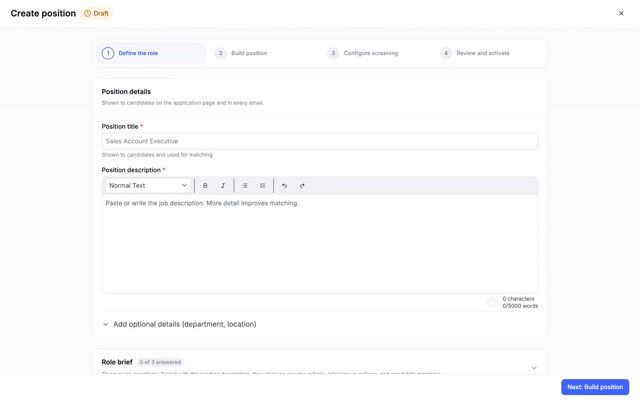
If you're processing a real applicant pool, our talent assessment and resume screening tools run this workflow in one Position Link, with AI that analyzes every response against the criteria you define and surfaces your strongest matches. You still make every hiring decision. The tool does the reading, not the deciding.
3 questions from the skills check we'd actually run for this role
For a role where one transposed digit holds up a closing, the skills check does more work than it does anywhere else. These three come straight from Truffle's attention to detail assessment, and they mirror what a loan file demands: numbers that match across documents, rules applied without exception, and small mismatches caught before underwriting catches them.
1. Two records should be duplicates. Name and email match. The phone reads 415-019-8821 on one and 415-019-8281 on the other. What's the issue? Reveal answer
Best answer: the phone numbers don't match, a transposition. The 21 and 81 at the end are swapped, and it's easy to skim right past. This is the exact skill a processor uses to catch an address or an account number that doesn't line up across a borrower's documents before it becomes an underwriting condition.
2. Flag any entry over $1,000 that has no approval code. Entries: (1) $1,250, no code; (2) $1,040, code APR-77; (3) $980, no code; (4) $1,005, no code. Which get flagged? Reveal answer
Best answer: entries 1 and 4. Both clear $1,000 and lack a code. Entry 2 has a code, so it's exempt, and entry 3 is under the threshold. Applying a two-part rule consistently, without flagging the exceptions, is the same discipline as checking a file against underwriting conditions.
3. A PO and an invoice should match on vendor and total. Both read "RedFern Supply." The PO total is $2,418.60 and the invoice is $2,481.60. What's the discrepancy? Reveal answer
Best answer: the totals don't match. $2,418.60 versus $2,481.60 is another transposition, the kind that's easy to approve on autopilot. Reconciling figures across two documents is most of what a processor does when the income on a pay stub has to match what's stated on the application.
The point isn't these three items. It's that a short, timed accuracy check tells you in fifteen minutes what a confident interview can hide: whether someone actually catches the small mismatch under pressure, or waves it through. Truffle's AI scores and surfaces the results against the bar you set. You still decide who clears it.
Common hiring mistakes for this role
Requiring an exact "loan processor" title when the applicant pool is thin. The skill you actually need, sustained accuracy across a high volume of detail, shows up in title work, escrow, insurance claims, and complex bookkeeping too. Widening your search to those backgrounds usually beats waiting for a perfect title match.
Interviewing before testing. A confident, well-spoken candidate can still be a weak processor. Put the attention-to-detail assessment before the interview, not after, so you're not spending interview time on candidates who wouldn't have passed a basic accuracy check.
Underestimating how much this role depends on personal organization systems. Two candidates with identical resumes can perform completely differently once their file count climbs. Ask directly about their tracking system in the interview instead of assuming competence from past job titles.
Skipping the conversation about pace. If your shop runs lean and file volume swings seasonally, say so in the interview. Candidates who've only worked in steady, predictable environments may struggle with the volume spikes small lenders deal with around rate changes or local market swings.
What should your screening process look like?
Answer six quick questions about how you hire. We'll point you to the screening steps that fit, so you spend your time on the candidates worth a conversation.
What each result looks like
Start with resume screening
You're working through real volume, and the resume still carries signal. Score every resume against your criteria first, so a shortlist surfaces before you spend time on anyone.
- Resume screeningScore every resume against your criteria and surface your strongest matches first.
- One-way interviewsHear how candidates think on a recorded prompt, on their schedule and yours.
7-day free trial. No credit card required.
Lead with one-way interviews
Resumes look interchangeable and phone screens are eating your week. Let candidates answer a recorded prompt on their own time. You watch the moments that matter and decide who's worth a live round.
- One-way interviewsHear how candidates think on a recorded prompt, on their schedule and yours.
- Resume screeningScore every resume against your criteria and surface your strongest matches first.
7-day free trial. No credit card required.
Anchor on talent assessments
For these roles the work matters more than the paper. Put a role-calibrated assessment up front, so you see real, comparable evidence before you book a calendar slot.
- Talent assessmentsSee role-calibrated work before you spend a calendar slot on a live round.
- One-way interviewsHear how candidates think on a recorded prompt, on their schedule and yours.
7-day free trial. No credit card required.
Layer all three signals
Your hiring spans high volume and high stakes, so no single step covers it. Layer all three: score resumes first, hear candidates on a one-way interview, then confirm with an assessment. Each step narrows the field, and you make the call at every stage.
- Resume screeningScore every resume against your criteria and surface your strongest matches first.
- One-way interviewsHear how candidates think on a recorded prompt, on their schedule and yours.
- Talent assessmentsSee role-calibrated work before you spend a calendar slot on a live round.
7-day free trial. No credit card required.