Accounts payable clerk: job description, interview questions, and screening workflow
The usual advice is to hire an accounts payable clerk with "three-plus years of AP experience." At a small business, that filter barely tells you the one thing that matters. You don't have a controller quietly catching a duplicate invoice before the check goes out, and no second set of eyes on the payment run. The thing that sinks this hire is almost never a thin resume. It's a tolerance for "close enough" on work where a single transposed invoice number means a vendor doesn't get paid, or gets paid twice. This guide is built to screen for that one trait, genuine and consistent accuracy on repetitive work, because it's what actually predicts whether this hire saves you money or quietly costs it, and it's exactly what a resume that lists "accounts payable" as a past duty can't show.
What an accounts payable clerk actually does at a small business
At a small business, an accounts payable clerk is the person who makes sure vendors get paid the right amount, at the right time, for something you actually ordered and received. When this role is done well, you don't think about it. When it's done poorly, you find out from an angry vendor call, a late fee, or a duplicate payment nobody caught.
This isn't a bookkeeping role and it isn't an accounting role. It's narrower than both. The job is processing: taking an invoice in, checking it against what was ordered and what arrived, entering it accurately, and moving it through approval to payment without losing track of where it stands. The core responsibilities:
- Receiving vendor invoices and entering them into your accounting software accurately
- Matching invoices to purchase orders and receiving documents (the classic three-way match)
- Flagging discrepancies: wrong quantities, wrong pricing, duplicate invoices, before they get paid
- Routing invoices for approval and keeping payments on schedule to avoid late fees and preserve vendor relationships
- Responding to vendor questions about payment status without letting them go unanswered for days
- Keeping the AP ledger and vendor files organized and easy to audit
None of this requires a finance degree. It requires someone who is genuinely careful with numbers and genuinely bothered by things not matching up. That's a specific, testable trait, and it's worth screening for directly instead of assuming it from a resume that lists "accounts payable" as a past duty.
Job description you can post today
Copy this, then adjust the specifics (your accounting software, your invoice volume, your approval chain) to match your shop.
Accounts payable clerk
[Company name] is hiring an accounts payable clerk to process vendor invoices and keep our bills paid accurately and on time. This role is a fit for someone who double-checks their own work without being told to, not someone who finds repetitive detail work draining.What you'll do
Enter vendor invoices into [your accounting software], match them against purchase orders and receiving documents, flag discrepancies before they become payment errors, route invoices for approval, and keep vendor files organized and current. You'll also be a first point of contact for vendors asking about payment status.What we're looking for
A track record of accurate, high-volume data entry or invoice processing, whether that's from AP, order processing, retail back-office, or a similarly detail-heavy role. Comfort asking questions when something doesn't add up, rather than guessing or letting it slide. Basic comfort with spreadsheets. Familiarity with [your accounting software] is a plus but not required if you're a fast learner on new systems.Schedule
[Insert hours and remote/in-office policy][Insert pay range, per your company's policy and any applicable state salary transparency requirements]
10 interview questions, and what a good answer sounds like
1. Walk me through how you'd process an invoice from the moment it lands in your inbox to the moment it's paid.
You're checking whether they actually have a process or are describing the concept of one. A good answer names concrete steps in order: log it, match it to the PO and receipt, flag anything off, route for approval, schedule payment, file it. A vague answer ("I'd just enter it and pay it") is a warning sign.
2. You receive an invoice for $4,200, but the purchase order says $3,800. What do you do?
Strong candidates hold the payment and investigate before entering anything: check for a partial shipment, a pricing update, or a data entry error, then go back to the vendor or the requester for clarification. Weak answers either pay the invoice as-is or flag it but don't describe any next step.
3. Tell me about a time you caught a billing error before it caused a problem.
This is your core competency question. Push for a specific example: what the error was, how they noticed it, what they did about it. "I'm very detail-oriented" with no story behind it usually means they haven't actually had to catch much.
4. How do you keep track of which invoices are pending, approved, or paid when you're handling a lot of them at once?
Listen for a real system: a spreadsheet, a queue inside your accounting software, a status field they update religiously. "I just remember" might be true for five invoices a week. It falls apart at fifty.
5. What accounting or invoicing software have you used, and how do you usually pick it up when it's new to you?
Less about whether they've used your exact tool, more about how they learn one. Ask for a specific example of software they picked up quickly on the job.
6. A vendor calls, upset that they haven't been paid. You check and the invoice is stuck waiting on an approval that hasn't come through. How do you handle the call, and what do you do after?
You want calm, honest communication with the vendor, followed by a concrete next step, chasing down the approver, not just hoping it resolves itself. Candidates who only describe the apology and not the follow-through are giving you half an answer.
7. How comfortable are you with spreadsheets? Walk me through how you'd use one to track something like outstanding invoices.
You're listening for basic fluency: sorting, filtering, maybe a simple formula, not advanced Excel wizardry. If they can describe a simple tracker off the top of their head, that's a good sign for how they'll organize the actual job.
8. Tell me about a time you had a high volume of work land on you at once. How did you decide what to do first?
Good answers describe a real prioritization logic: payment due dates, avoiding late fees, anything blocking someone else's work. Weak answers describe just working faster with no actual ordering logic, which tends to break down under real volume.
9. What would you do if you noticed the same invoice had already been entered and paid once before?
This tests for both attention and follow-through. A strong answer catches the duplicate before or during entry, flags it, and confirms with the vendor or manager rather than letting a second payment go out. Candidates who don't mention actively checking for duplicates may not think to look for them on the job.
10. Why AP or invoice processing, specifically, and not another admin or data-entry role?
This surfaces whether they understand what the day-to-day actually looks like: repetitive entry, frequent small discrepancies, and the responsibility of handling money accurately. Candidates who talk mostly about wanting to "get into finance" without mentioning the actual work may be picturing a different, more analytical role.
A scorecard you can score candidates against
Ten questions only help if everyone on your side is listening for the same things. Score every candidate on the same six signals, so you're comparing evidence instead of six different gut feelings from six conversations. Copy this into a doc and fill in a row per candidate.
| What you're scoring | Strong signal | Weak signal |
|---|---|---|
| Process discipline | Names concrete steps in order: log the invoice, match it to the PO and receipt, flag anything off, route for approval, schedule payment, file it | "I'd just enter it and pay it," with no real sequence behind it |
| Discrepancy handling | Holds payment and investigates a price or quantity gap before entering anything, then goes back to the vendor or requester | Pays the invoice as-is, or flags it but describes no next step |
| Error-catching instinct | A real story of catching a billing error: what it was, how they noticed, what they did about it | "I'm very detail-oriented," with no example behind the claim |
| Tracking at volume | A real system for what's pending, approved, or paid: a tracker, a queue, a status field they update religiously | "I just remember." True for five invoices a week, gone at fifty |
| Duplicate-payment vigilance | Actively checks for duplicates, catches a second entry, confirms with the vendor or manager before a second payment goes out | Doesn't mention looking for duplicates at all, so a double payment slips through |
| Vendor follow-through | Handles an upset vendor calmly, then chases the stuck approval to done rather than hoping it resolves | Describes the apology but not the follow-up, so the invoice stays stuck |
How to screen accounts payable clerk candidates without losing a week to it
Truffle is an AI screening platform that combines resume screening, one-way video interviews, and talent assessments, and for a role this dependent on accuracy, testing that accuracy directly matters more than reading another resume.
A workflow that fits a small business hiring this role:
- Resume screening first. Filter for high-volume, detail-heavy work history: AP, order processing, retail or restaurant back-office, data entry, rather than requiring an exact "accounts payable" title. The underlying skill, sustained accuracy on repetitive work, shows up in plenty of places an exact title match would miss. Our resume screening tool can do this filtering for you against the criteria you set.
- A skill-based accounting assessment before you interview anyone. This is the highest-leverage step for this role. Our skill-based accounting assessment gives every candidate the same structured exercise, so you're comparing actual accuracy on real work-sample tasks instead of a resume claim. You don't need the full assessment; the reconciliation and data-accuracy sections alone will tell you what you need to know for this role.
- A one-way video interview for your shortlist. Ask the discrepancy and prioritization questions above on video. You'll hear whether someone has a real process, or is improvising one in the moment.
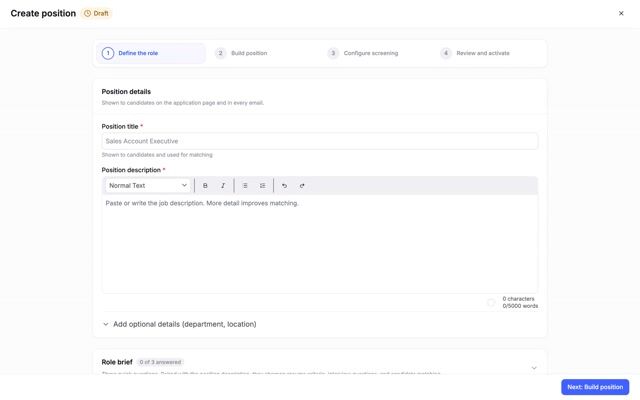
If you're working through a real applicant pool, our one-way video interview tool runs this workflow in one Position Link, with AI that analyzes every response against the criteria you define and surfaces your strongest matches. You still make every hiring decision. The tool does the reading, not the deciding.
3 questions from the skills check we'd actually run for this role
A skills check only helps if it tests the judgment the job needs, not accounting trivia. These three are pulled straight from Truffle's skill-based accounting assessment, the assessment we'd point you to for this role. They separate someone who can talk about AP from someone who can do it. Try them yourself before you decide what "job-ready" means for your opening.
1. In your AP process, one person can create vendors, enter invoices, and approve payments up to $10,000. The owner says "we're lean, it's fine." What's the risk, and what would you change? Reveal answer
Best answer: name the segregation-of-duties gap and split the steps. One person who can both set up a vendor and approve its payments is how duplicate payments and fraud slip through with nobody to catch them. Strong candidates separate vendor setup from payment approval, add a review of the payment run, and turn on exception reporting, sized for a small team. A candidate who shrugs the risk off is the one who'll let a bad payment through.
2. Review three journal entries. (1) Dr Accounts Receivable 15,000 / Cr Cash 15,000. (2) Dr Depreciation Expense 4,000 / Cr Accumulated Depreciation 4,000. (3) Dr Cash 2,500 / Cr Unearned Revenue 2,500. Which is wrong or suspicious? Reveal answer
Best answer: flag entry 1 and verify what it was meant to record. Entries 2 and 3 are standard. Entry 1 increases receivables while decreasing cash, which isn't a normal sale or a normal collection, so it needs a second look before anyone trusts it. This is the exact sense-check an AP clerk runs all day: catching an entry that doesn't add up before it turns into a payment error.
3. A bank statement shows $112,450. Your GL cash balance shows $105,730. You find outstanding checks of $9,600, deposits in transit of $14,500, an unrecorded bank fee of $120, and a customer wire of $2,440 received but not posted. Which items do you actually need to record? Reveal answer
Best answer: record the bank fee and the customer wire in the GL. The outstanding checks and deposits in transit are timing items on the bank side. The skill here is knowing which discrepancies need an entry from you and which will clear on their own. A candidate who sorts those two piles cleanly is one who'll keep your books tying out instead of quietly drifting.
The point isn't these three questions. It's that a short, job-relevant skills check like this tells you in an hour what a resume and a friendly interview can hide: whether someone actually catches what doesn't add up under a little pressure. Truffle's AI scores and surfaces the results against the bar you set. You still decide who clears it.
Common hiring mistakes for this role
Treating years of experience as a proxy for accuracy. A candidate who's processed invoices for five years isn't automatically more careful than one who's done it for one. Accuracy is a trait, not a byproduct of tenure. Test for it directly instead of filtering on years worked.
Not testing real data-entry accuracy before hiring. A confident interview doesn't tell you whether someone catches a mismatched invoice number. Put a real accuracy check earlier in your process, not after you've already invested an interview slot.
Treating this as interchangeable with bookkeeping. The two roles share a topic, not a skill set. A bookkeeper needs judgment across the full books. An AP clerk needs precision on one narrow, repeatable process. Hiring a generalist bookkeeper for a high-volume AP role (or vice versa) usually leaves one set of skills underused and the other under-tested.
Leaving pay range vague in the posting. Finance-adjacent roles draw candidates who are actively comparing several similar postings, and a missing or vague range reads as evasive before they've even applied. A clear, honest range up front tends to bring in better-matched applicants and fewer wasted conversations.
Letting the process drag while a senior stakeholder weighs in late. If an owner or manager wants final sign-off on this hire, get them involved at the start, not after you've already run three interview rounds. Good AP candidates, especially ones with in-demand accuracy skills, don't wait around for a slow decision. A process that stalls at the finish line loses the candidates you actually wanted.
What should your screening process look like?
Answer six quick questions about how you hire. We'll point you to the screening steps that fit, so you spend your time on the candidates worth a conversation.
What each result looks like
Start with resume screening
You're working through real volume, and the resume still carries signal. Score every resume against your criteria first, so a shortlist surfaces before you spend time on anyone.
- Resume screeningScore every resume against your criteria and surface your strongest matches first.
- One-way interviewsHear how candidates think on a recorded prompt, on their schedule and yours.
7-day free trial. No credit card required.
Lead with one-way interviews
Resumes look interchangeable and phone screens are eating your week. Let candidates answer a recorded prompt on their own time. You watch the moments that matter and decide who's worth a live round.
- One-way interviewsHear how candidates think on a recorded prompt, on their schedule and yours.
- Resume screeningScore every resume against your criteria and surface your strongest matches first.
7-day free trial. No credit card required.
Anchor on talent assessments
For these roles the work matters more than the paper. Put a role-calibrated assessment up front, so you see real, comparable evidence before you book a calendar slot.
- Talent assessmentsSee role-calibrated work before you spend a calendar slot on a live round.
- One-way interviewsHear how candidates think on a recorded prompt, on their schedule and yours.
7-day free trial. No credit card required.
Layer all three signals
Your hiring spans high volume and high stakes, so no single step covers it. Layer all three: score resumes first, hear candidates on a one-way interview, then confirm with an assessment. Each step narrows the field, and you make the call at every stage.
- Resume screeningScore every resume against your criteria and surface your strongest matches first.
- One-way interviewsHear how candidates think on a recorded prompt, on their schedule and yours.
- Talent assessmentsSee role-calibrated work before you spend a calendar slot on a live round.
7-day free trial. No credit card required.