Bank teller: job description, interview questions, and screening workflow
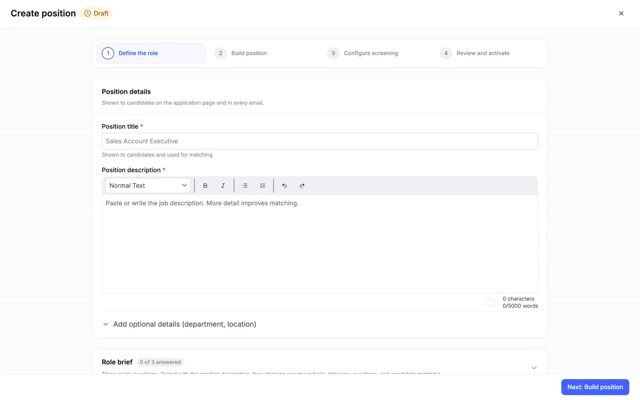
The default is to test a teller candidate for friendliness in the interview and call it a day. That's how you end up with a warm hire whose drawer keeps coming up short. There's no back office to quietly fix a miscount later. The drawer balances at the end of the day or it doesn't, and everyone in the branch knows which one happened. The thing that sinks a teller hire is rarely a math problem or a cold personality. It's the moment a line forms and the candidate starts skipping a verification step to keep it moving. This guide is built to screen for the one trait a resume that lists "cash handling" and a friendly interview both hide: precision that holds under a time constraint, in front of a member, all day.
What a bank teller actually does at a small bank or credit union
At a community bank or credit union, the teller line is the branch. It's the first person a member sees when they walk in and the person who has to get every transaction right, in front of that member, with a line sometimes forming behind them. There's no back office to quietly fix a mistake later. The drawer either balances at the end of the day or it doesn't, and everyone in the branch knows which one happened.
The job blends two things that don't always come in the same person: real-time cash accuracy and steady, friendly member service. A teller who's great with people but sloppy with a drawer creates a compliance problem. A teller who's precise with cash but cold with members creates a retention problem, in a branch where members often know the staff by name. The core responsibilities:
- Processing deposits, withdrawals, transfers, and cashed checks accurately, transaction by transaction
- Counting and balancing a cash drawer at the start and end of every shift
- Verifying identification and following the bank's or credit union's procedures for every transaction, without shortcuts
- Spotting and reporting anything that looks off: a mismatched signature, an unusual request, a possible fraud pattern
- Answering member questions about their accounts and referring more complex needs (loans, new accounts) to the right person
- Staying composed and courteous during busy stretches, paydays, holidays, lines out the door
None of this requires a finance degree. It requires someone who can be precise under a time constraint and warm under a time constraint, at the same time, all day. That combination is testable, and it's worth screening for directly instead of assuming it from a resume that lists "cash handling" as a skill.
Job description you can post today
Copy this, then adjust the specifics (your core system, your hours, your branch volume) to match your institution.
Bank teller
[Institution name] is hiring a bank teller to work our member-facing counter. This role is a fit for someone who takes real pride in a drawer that balances and a member who leaves feeling helped, not rushed.What you'll do
Process deposits, withdrawals, transfers, and check cashing accurately for every member. Count and balance your cash drawer at the start and end of each shift. Verify identification and follow our procedures on every transaction. Spot and report anything unusual. Answer member questions and refer bigger needs to the right team member.What we're looking for
A track record of handling cash or money-equivalent transactions accurately, whether that's banking, retail, or hospitality. Comfort following a defined procedure exactly, every time, even when it's the 200th transaction of the day. Clear, friendly communication with people of all ages and backgrounds. Comfort with basic computer systems and the ability to learn our core banking platform.Schedule
[Insert hours and branch coverage needs, including any Saturday rotation][Insert pay range, per your institution's policy and any applicable state salary transparency requirements]
10 interview questions, and what a good answer sounds like
1. Walk me through how you'd count and balance a cash drawer at the end of a shift.
You want a specific method, not a vague "I count it carefully." Strong candidates describe counting in a consistent order, recounting when a total looks off before assuming a mistake elsewhere, and documenting discrepancies rather than quietly adjusting them. A candidate who can't describe any method at all is a real flag for a role built around this exact task.
2. A member hands you a large cash deposit and seems oddly nervous about it. What do you do?
This tests judgment and honesty under ambiguity, not paranoia. A good answer processes the transaction professionally while following your institution's procedure for anything unusual, reporting it through the right channel rather than confronting the member or ignoring the discomfort entirely.
3. Tell me about a time you caught your own mistake before anyone else noticed. What did you do next?
This is your honesty question, disguised as a competence question. You want someone who says they flagged it and fixed it through the proper process, not someone who describes quietly correcting it themselves. In cash handling, self-correcting outside procedure is its own problem, even when the intent is good.
4. How do you stay accurate when there's a long line and people are getting impatient?
Listen for a specific coping method: slowing down internally even while moving efficiently, not skipping verification steps to save time. Candidates who say some version of "I'd speed up the checks to keep the line moving" are describing exactly the failure mode that causes drawer shortages.
5. Describe a time you had to tell someone no, or explain a policy they didn't like. How did that go?
You're checking for composure and clarity, not conflict avoidance or aggression. Good answers show the candidate holding the line on policy while staying respectful, and they can describe roughly how the person reacted.
6. What would you do if your drawer came up short at the end of a shift?
You want ownership and process, not panic or defensiveness. A strong answer includes recounting first, retracing the day's larger or unusual transactions, and reporting it accurately rather than covering the gap personally or hoping it evens out tomorrow.
7. How comfortable are you asking a supervisor or coworker a question in the middle of a busy line, if you're not sure a transaction is right?
You're testing whether procedure beats ego under pressure. The right instinct is to ask rather than guess, even if it means a member waits an extra minute. Candidates who imply they'd rather push through and sort it out later are telling you something important.
8. Tell me about a time you had to learn a new system or process quickly. How did you approach it?
Less about your specific core banking platform, more about how someone ramps on structured systems generally. Ask for a concrete example, not a general claim of being a fast learner.
9. What does confidentiality mean to you in a role where you can see someone's full financial picture?
You want specifics: not discussing a member's balance or transactions outside work, not commenting on what you notice in someone's account, being careful about who's within earshot at the counter. A generic "I'm trustworthy" without a concrete example is worth a direct follow-up.
10. Why teller work, specifically, and not another customer-facing role?
This surfaces whether the candidate understands the actual job: standing for a full shift, repetitive transactions, real accountability for cash, and real interruptions from members with questions. Candidates who talk mainly about liking banking or wanting career growth into lending, without mentioning the day-to-day counter work, may be picturing a different role than the one you're hiring for.
A scorecard you can score candidates against
Ten questions only help if everyone on your side is listening for the same things. Score every candidate on the same six signals, so you're comparing evidence instead of six different gut feelings from six conversations. Copy this into a doc and fill in a row per candidate.
| What you're scoring | Strong signal | Weak signal |
|---|---|---|
| Balancing method | Describes a specific method: counting in a consistent order, recounting before assuming a mistake elsewhere, documenting a discrepancy | "I just count it carefully," with no actual method to describe |
| Procedure over speed | Slows down internally even while moving efficiently, never skips a verification step to shorten a line | "I'd speed up the checks to keep the line moving," the exact instinct behind a drawer shortage |
| Honesty and self-correction | Flags and fixes a mistake through the proper process, even a small one they could have quietly corrected | Describes quietly self-correcting outside procedure, which is its own problem in cash handling |
| Judgment on the unusual | Processes an odd or nervous transaction professionally while following procedure and reporting through the right channel | Confronts the member, or ignores something that clearly warranted a flag |
| Confidentiality instinct | Names specifics: not discussing a member's balance, watching who's within earshot at the counter | A generic "I'm trustworthy" with no concrete example of what that looks like |
| Composure on a policy line | Holds the line on policy while staying respectful, and can describe how the member reacted | Avoids the conflict entirely, or gets defensive and turns it into an argument |
How to screen bank teller candidates without losing a week to it
Truffle is an AI screening platform that combines resume screening, one-way video interviews, and talent assessments, and for a role that lives at the intersection of accuracy and member service, combining more than one of those catches signal a single method misses.
A workflow that fits a small bank or credit union:
- Resume screening first. Filter for cash-handling or transaction-heavy work history, banking, retail, hospitality, rather than requiring bank experience specifically. The underlying skill, accurate work under a time constraint, transfers across those roles more than the industry does. Our resume screening tool applies your criteria consistently across every applicant instead of you reading each one by hand.
- An attention-to-detail assessment before you interview anyone. This is the highest-leverage step for a role where an accuracy gap shows up as a drawer that doesn't balance. Our attention to detail assessment gives every candidate the same structured, timed exercise, so you're comparing actual accuracy under pressure instead of a resume claim. Our clerical assessment is a reasonable add-on if your role leans more heavily into data entry and documentation alongside the counter work.
- A one-way video interview for your shortlist. Ask the drawer-shortage and impatient-line questions above on video. You'll hear whether someone actually has a calm, procedural instinct under pressure, or whether they're constructing an answer they think you want.
If you're processing a real applicant pool, our one-way video interview tool runs alongside resume screening and assessments in one Position Link, with AI that analyzes every response against the criteria you define and surfaces your strongest matches. You still make every hiring decision. The tool does the reading, not the deciding.
3 questions from the skills check we'd actually run for this role
A skills check only helps if it tests the accuracy the job needs, not trivia. These three are pulled straight from Truffle's attention to detail assessment, the assessment we'd point you to for this role. They separate someone who says they're careful from someone who catches a transposed digit under a little pressure. Try them yourself before you decide what "job-ready" means for your counter.
1. Which pair is an exact match? (A) X7K-19Q / X7K-19O. (B) INV-30491 / INV-34091. (C) A2Z-771B / A2Z-771B. (D) MRN-58013 / MRN-58031. Reveal answer
Best answer: C. Every other pair hides a swap: Q for O, 30491 for 34091, 58013 for 58031. Only C matches character for character. A teller who can't spot a transposed digit in an account or reference number is one whose postings and drawer won't reconcile at the end of the day.
2. A PO and an invoice should match on vendor and total. PO: RedFern Supply, $2,418.60. Invoice: RedFern Supply, $2,481.60. What's the discrepancy? (A) Vendor mismatch. (B) Total mismatch. (C) Both. (D) None. Reveal answer
Best answer: B. The vendor matches. The total is off by a transposed pair of digits, $2,418.60 against $2,481.60. Catching a transposed dollar amount at a glance is the whole job when you're counting a deposit or balancing a drawer, where a number that looks almost right is the number that costs you.
3. Flag entries that are over $1,000 and do not include an approval code. If a code is present, do not flag. (1) $1,250, code blank. (2) $1,040, code APR-77. (3) $980, code blank. (4) $1,005, code blank. Which should be flagged? (A) 1 and 4. (B) 1, 3, and 4. (C) 2 and 4. (D) 1 only. Reveal answer
Best answer: A. Entry 2 has a code, so it's clear. Entry 3 is under $1,000. Only 1 and 4 meet both conditions. This tests whether someone follows a two-part rule with an exception exactly, which is what applying a verification threshold or a hold procedure asks of a teller every transaction.
The point isn't these three questions. It's that a short, job-relevant accuracy check like this tells you in fifteen minutes what a warm interview can hide: whether someone actually holds their precision when the clock is running. Truffle's AI scores and surfaces the results against the bar you set. You still decide who clears it.
Common hiring mistakes for this role
Leaving pay off the posting entirely. Financial institutions sometimes hold pay ranges back out of habit or policy, but a listing with no range loses candidates before they ever apply, and a growing number of states require the disclosure anyway. Put a range in, even a wide one, and let the interview narrow it.
Letting a late-stage reviewer overrule an already-approved candidate. A hiring manager and a branch manager sign off, then a senior stakeholder who wasn't in the loop steps in at the last minute and reopens the decision. The candidate feels the whiplash, good people walk away from the uncertainty, and the role stays open longer than it needed to. Get every approver looking at the candidate before the offer stage, not after.
Posting a role externally that's already spoken for internally. If an internal transfer or a strong internal referral is the real plan, don't run a public posting alongside it. Candidates who apply, interview, and hear nothing because the seat was never really open lose trust fast, and that reputation follows a small institution in a local labor market where word travels.
Testing for friendliness in the interview and never testing for accuracy at all. A warm, personable candidate can still be a weak match for a role where a single missed step creates a real shortage. Put the attention-to-detail assessment before the interview, not after, so you're not spending interview time on candidates who wouldn't have passed a basic accuracy check.
What should your screening process look like?
Answer six quick questions about how you hire. We'll point you to the screening steps that fit, so you spend your time on the candidates worth a conversation.
What each result looks like
Start with resume screening
You're working through real volume, and the resume still carries signal. Score every resume against your criteria first, so a shortlist surfaces before you spend time on anyone.
- Resume screeningScore every resume against your criteria and surface your strongest matches first.
- One-way interviewsHear how candidates think on a recorded prompt, on their schedule and yours.
7-day free trial. No credit card required.
Lead with one-way interviews
Resumes look interchangeable and phone screens are eating your week. Let candidates answer a recorded prompt on their own time. You watch the moments that matter and decide who's worth a live round.
- One-way interviewsHear how candidates think on a recorded prompt, on their schedule and yours.
- Resume screeningScore every resume against your criteria and surface your strongest matches first.
7-day free trial. No credit card required.
Anchor on talent assessments
For these roles the work matters more than the paper. Put a role-calibrated assessment up front, so you see real, comparable evidence before you book a calendar slot.
- Talent assessmentsSee role-calibrated work before you spend a calendar slot on a live round.
- One-way interviewsHear how candidates think on a recorded prompt, on their schedule and yours.
7-day free trial. No credit card required.
Layer all three signals
Your hiring spans high volume and high stakes, so no single step covers it. Layer all three: score resumes first, hear candidates on a one-way interview, then confirm with an assessment. Each step narrows the field, and you make the call at every stage.
- Resume screeningScore every resume against your criteria and surface your strongest matches first.
- One-way interviewsHear how candidates think on a recorded prompt, on their schedule and yours.
- Talent assessmentsSee role-calibrated work before you spend a calendar slot on a live round.
7-day free trial. No credit card required.