Virtual assistant: job description, interview questions, and screening workflow
A bad virtual assistant hire doesn't just waste money, it hands someone you've never met in person real access to your inbox, your calendar, and sometimes your financial tools. You're the owner, the founder, the GM, without an HR department to run a background process for you. You're reading applications after the real work is done, deciding on your own whether a stranger on another continent, or three states away, is someone you can hand your calendar keys to. A resume can list the tools someone's used. It can't show you whether they'll flag the email they shouldn't have opened, or whether they'll go quiet for two days right when you need them most. This guide is built to screen for that, because trust and follow-through are the two things that actually determine whether this hire gives you your time back or becomes one more thing you have to manage.
What a virtual assistant actually does at a small business
An in-house admin sits down the hall. You can glance over, ask a quick question, and see with your own eyes whether they're keeping up. A virtual assistant works remotely, often part-time or on a fractional basis, sometimes overseas, and almost always across at least a small time-zone gap. You don't get the hallway check-in. You get whatever they send you, on whatever schedule you agreed to, and you have to trust the gaps in between.
That changes what the hire actually depends on. An in-house admin's reliability shows up in the room. A VA's reliability shows up in how clearly they write, how well they work without you watching, and how they handle the access you give them. The work itself often looks similar on paper (inbox, calendar, data entry, some light bookkeeping support, sometimes customer-facing replies), but the way you have to evaluate the person is different, because you're trusting written communication and self-management instead of physical presence.
The core responsibilities, in practice:
- Managing an inbox: triaging what needs your attention today, what can wait, and what they can just handle
- Owning a calendar across time zones, including the awkward scheduling that comes with it
- Light bookkeeping or expense support: categorizing receipts, tracking invoices, flagging anything that looks off
- Data entry and document prep, done accurately and without constant check-ins
- Sometimes customer-facing work: replying to routine emails, DMs, or support tickets in your voice
- Working with a defined set of tools (a shared inbox, a project tracker, a password manager) instead of walking over to ask
- Flagging problems and ambiguity clearly in writing, rather than guessing silently or going quiet
- Handling access to sensitive systems (email, calendar, sometimes a payment or accounting tool) responsibly, without oversharing or overreaching
If you're hiring an in-office admin instead of a remote one, our administrative assistant hiring guide covers that version of the role. If the hire is really about high-trust judgment calls on one person's behalf rather than task throughput, see our executive assistant hiring guide. This page is built around what's specific to a remote, tool-dependent VA: the async communication, the time-zone gap, and the access you're handing over without being in the room to watch how it's used.
Job description you can post today
Copy this, then adjust the specifics (your tools, your hours, your pay) to match your business.
Virtual assistant
[Company name] is looking for a virtual assistant to handle inbox management, calendar coordination, and recurring admin work remotely. You'll work independently most of the time, communicate clearly in writing, and handle sensitive information (email, scheduling, sometimes billing) with real discretion.What you'll do
Triage and manage an inbox, flagging what needs immediate attention and handling what you can directly. Own calendar scheduling across time zones, resolving conflicts without constant back-and-forth. Support light bookkeeping tasks like expense tracking or invoice follow-up. Handle data entry and document prep accurately. Respond to routine customer or client messages in a professional, on-brand tone. Communicate proactively in writing when something is unclear, delayed, or needs a decision from us.What we're looking for
Clear, professional written communication, since most of our working relationship happens async. Comfort working independently with minimal oversight, across a time-zone gap. A track record of handling sensitive information (email, calendars, financial tools) with discretion. Familiarity with common tools like Google Workspace, a shared calendar, and a project tracker, or the ability to pick them up fast. Reliable, on-time delivery without needing frequent reminders.Schedule
[Insert hours per week, expected overlap window, and part-time or full-time status][Insert pay range or hourly rate]
10 interview questions, and what a good answer sounds like
1. Send me a written update, right now, on how you'd approach your first week in this role.
This is really a writing test disguised as a question. A strong response is organized, specific, and easy to skim, which is exactly what you need from someone managing your inbox. A response that's rambling, full of filler, or vague about what they'd actually do in week one is telling you something important before you've even asked a "real" question.
2. Tell me about a time you had to make progress on something without live access to the person who assigned it.
You're testing whether they can actually work async, not just claim they can. A strong answer describes documenting their assumptions, flagging what they weren't sure about, and moving forward on the parts they could handle instead of stalling. A weak answer describes waiting for a reply, or admits they've only ever worked with someone available in real time.
3. Describe the most sensitive piece of information or access you've handled in a past role. How did you make sure you didn't misuse it?
Listen for a real example: what they had access to, what they didn't share even when asked, and how they thought about who actually needed to know. A vague "I'm very trustworthy" with no specifics is a flag. Discretion under real pressure is the whole point of this question, and it's hard to fake with a concrete story.
4. How do you keep yourself accountable when nobody's checking in on you day to day?
Good answers name a real system: a task list they maintain themselves, a habit of sending a daily or weekly written recap, or a way of flagging their own progress before being asked. A candidate who says "I just get it done" with no described process may do fine on easy weeks and disappear on hard ones.
5. What tools have you used for [the specific stack you use], and how do you usually pick up a new one you haven't touched before?
You want both the specific answer and the general pattern. A strong candidate names concrete tools they've actually used and describes a real approach to learning something new (documentation first, a short trial task, asking a specific clarifying question) rather than just "I'm a fast learner" with nothing behind it.
6. I'm going to give you a vague, underspecified instruction on purpose. Walk me through what you'd do with it.
Give them something genuinely ambiguous, like "clean up my calendar for next week." A strong answer asks a smart clarifying question or two, states the assumptions they'd make if they couldn't ask, and describes checking in before finalizing anything risky. A weak answer either freezes without more detail or barrels ahead without flagging the guesses they made.
7. You've got five small tasks due today and time for three. Walk me through how you'd decide what gets done.
This is the reality of the role: a lot of small, low-drama tasks competing for the same hour. A strong answer names a real method (what's time-sensitive, what blocks someone else, what actually matters to the business) rather than just "I'd do them in the order they came in." Listen for whether they'd flag the two that slipped, rather than letting them quietly disappear.
8. Tell me about a real mistake you made in a past remote or admin role. What happened, and what changed afterward?
Every VA who's actually done the work has a story here: a missed email, a double-booked meeting, a miscategorized expense. A strong answer owns it plainly, explains how it surfaced, and names a specific change they made afterward. A candidate who claims a perfect record, or blames a client or a bad brief, is either inexperienced or not being straight with you.
9. How quickly do you typically respond during your working hours, and how do you handle it when something urgent comes in outside them?
You're checking both the baseline and the edge case. A strong answer gives you a realistic response window and describes a sensible way of flagging genuine urgency (a specific channel, a clear escalation habit) without implying they're glued to their phone at all hours. Vague reassurance ("I'm always responsive") with no specifics is a weak signal.
10. Why are you looking for fractional or remote work specifically, rather than a single full-time in-house role?
This is a churn-risk question as much as anything else. A strong answer names a real, specific reason (they run their own client roster deliberately, they value the flexibility for a concrete reason, they're building toward a specific kind of work) that sounds durable. A vague or unconvincing answer may mean they're using this role as a placeholder until something better comes along, which matters a lot for a hire you don't want to keep repeating.
A scorecard you can score candidates against
Ten questions only help if everyone reviewing candidates is scoring the same signals. Use this instead of comparing gut feelings about who seemed most polished on the call.
| What you're scoring | Strong signal | Weak signal |
|---|---|---|
| Written communication | Clear, organized, easy-to-skim writing in their own responses, unprompted | Rambling, vague, or hard to follow, even when asked to be specific |
| Async self-management | Real story of making progress without live access to whoever assigned the work | Describes waiting for a reply, or has only worked with constant live availability |
| Trustworthiness with sensitive access | Concrete example of protecting sensitive information under real pressure to share it | Vague assurance of trustworthiness with no specific example |
| Handling ambiguity | Asks a smart clarifying question, states assumptions, checks in before anything risky | Freezes without more detail, or moves ahead without flagging guesses made |
| Prioritization | Names a real method for choosing what gets done first, and flags what didn't get to | "I just do them in order," with no reasoning and no follow-up on what slipped |
| Reliability and churn risk | Specific, durable reason for wanting fractional or remote work | Vague or unconvincing answer that suggests this is a placeholder role |
How to screen virtual assistant candidates without losing a week to it
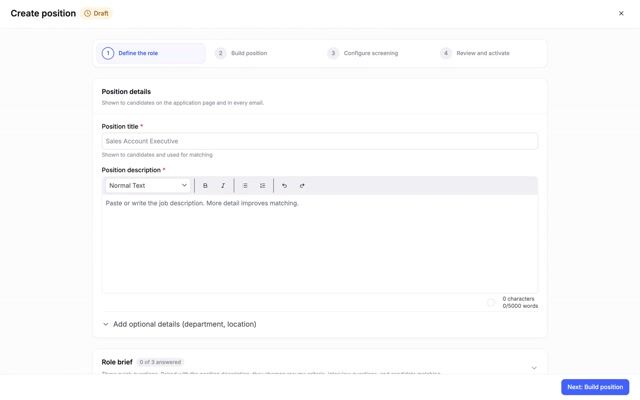
Truffle is an AI screening platform that combines resume screening, one-way video interviews, and talent assessments. That combination matters here because VA postings pull a real flood of candidates from marketplaces, referrals, and word of mouth, and a resume alone tells you almost nothing about the two things that actually predict success in this role: how someone writes and how much you can trust them with access.
A workflow sized for a small business hiring one or two VAs, not a staffing desk:
- Resume and application review first. Look past a polished-looking profile for actual signal: relevant tools, tenure at past clients, and whether their written application itself is clear and error-free. Recruitment software built for small businesses is sized for exactly this volume, so you're not reading every application by hand.
- A one-way video interview before you schedule a live call. Ask 2-3 of the scenario questions above, especially the ambiguous-instruction question and the sensitive-access question. A one-way interview gives you a real read on written and verbal communication on the candidate's own time, before you spend an evening on a live conversation.
- A skills check for the baseline. Our admin assistant assessment confirms real accuracy, prioritization, and confidentiality judgment, so you're not taking someone's word for it on a resume.
- A short paid trial task for finalists. Give them a real, small piece of your actual work (an inbox to triage, a calendar to untangle) and see the output directly. This is where everything you saw on video and in the assessment gets confirmed against your real workflow.
- A live call only for candidates who clear the first three steps. By this point you already know they can write clearly and handle a real task. The call is for chemistry and any remaining questions about access and boundaries.
AI surfaces the resume matches, video responses, and assessment scores side by side, ranked against the criteria you set. It doesn't decide who gets the job. You watch the responses that matter and make the call. For the fuller argument, see our guide on how to hire a virtual assistant.
3 questions from the skills check we'd actually run for this role
A skills check for this role only means something if it tests the same judgment a VA actually needs day to day: accuracy, prioritization, and knowing when to escalate instead of guessing. These three are adapted from Truffle's admin assistant assessment. Try them yourself before you decide what "qualified" looks like for your opening.
1. You receive an email that looks like it was meant for someone else, an attachment with what appears to be financial or personnel data, but it was addressed to you. What do you do first? Reveal answer
Best answer: don't open or share it, and confirm with the sender first. A strong response replies to check whether it was actually intended for them, and holds off on opening the attachment or forwarding it to anyone until that's confirmed. A candidate who opens it "just to check if it's relevant" or forwards it to a manager without asking first is showing you exactly the kind of access risk this question is built to catch.
2. It's 9am. Your employer messages that a client call moved up to 10am and the deck needs one number updated. At the same time, a second, less important email is asking for a quick reply. What's your first move? Reveal answer
Best answer: fix the deck first, and send a short note that the other email will follow shortly. A strong answer prioritizes the time-sensitive, higher-stakes task and proactively flags the delay on the smaller one instead of letting it go silent. A candidate who tries to do both at once, or handles them in the order they arrived without weighing the stakes, is showing you a prioritization gap that gets worse under real pressure, not better.
3. You're asked to schedule a 30-minute call with people in three different time zones, and two of the three have only sent partial availability. What do you do? Reveal answer
Best answer: work out what's confirmed, flag the gaps clearly, and ask a specific follow-up rather than guessing. A strong response identifies the actual overlap in what's known, states plainly what's still missing, and asks a targeted question to fill the gap instead of picking a time and hoping it works. A candidate who books a time based on incomplete information without flagging the guess is setting up a reschedule you'll have to clean up later.
The point isn't these three scenarios specifically. It's that a structured skills check like this surfaces real judgment under the kind of small, ambiguous pressure this role runs into constantly, which is a lot harder to fake than a resume line about "detail-oriented." Truffle's AI scores and surfaces the results against the bar you set for the role. You still make the call on who clears it.
Common hiring mistakes for this role
Not testing async communication before hiring. A candidate can be warm and articulate on a live call and still write confusing, disorganized messages when there's no back-and-forth to smooth it over. Since most of the actual working relationship happens in writing, test writing directly, with a one-way interview or a real written task, instead of assuming a good conversation means a good async communicator.
Treating a polished cover letter as a proxy for actual skill. A well-written application increasingly tells you someone had help writing it, not that they can do the job. Weight the interview questions and the skills check more heavily than how impressive the application itself reads, especially the questions that ask for a specific story rather than a general claim.
Not verifying they can handle sensitive access responsibly. It's easy to assume discretion because someone seems professional. Ask directly about a time they handled real sensitive information, and start any new hire's access narrower than feels efficient, expanding it as they prove out judgment on smaller things first.
Hiring on price alone from an overseas marketplace without a real screen. The lowest hourly rate on a marketplace profile looks like the obvious choice until the third missed handoff or the first mishandled email. Run the same interview questions and skills check regardless of where the candidate is based or how cheap the rate looks, since the cost of cleanup after a bad hire is almost always higher than the difference in hourly pay.
What should your screening process look like?
Answer six quick questions about how you hire. We'll point you to the screening steps that fit, so you spend your time on the candidates worth a conversation.
What each result looks like
Start with resume screening
You're working through real volume, and the resume still carries signal. Score every resume against your criteria first, so a shortlist surfaces before you spend time on anyone.
- Resume screeningScore every resume against your criteria and surface your strongest matches first.
- One-way interviewsHear how candidates think on a recorded prompt, on their schedule and yours.
7-day free trial. No credit card required.
Lead with one-way interviews
Resumes look interchangeable and phone screens are eating your week. Let candidates answer a recorded prompt on their own time. You watch the moments that matter and decide who's worth a live round.
- One-way interviewsHear how candidates think on a recorded prompt, on their schedule and yours.
- Resume screeningScore every resume against your criteria and surface your strongest matches first.
7-day free trial. No credit card required.
Anchor on talent assessments
For these roles the work matters more than the paper. Put a role-calibrated assessment up front, so you see real, comparable evidence before you book a calendar slot.
- Talent assessmentsSee role-calibrated work before you spend a calendar slot on a live round.
- One-way interviewsHear how candidates think on a recorded prompt, on their schedule and yours.
7-day free trial. No credit card required.
Layer all three signals
Your hiring spans high volume and high stakes, so no single step covers it. Layer all three: score resumes first, hear candidates on a one-way interview, then confirm with an assessment. Each step narrows the field, and you make the call at every stage.
- Resume screeningScore every resume against your criteria and surface your strongest matches first.
- One-way interviewsHear how candidates think on a recorded prompt, on their schedule and yours.
- Talent assessmentsSee role-calibrated work before you spend a calendar slot on a live round.
7-day free trial. No credit card required.