Nail technician: job description, interview questions, and screening workflow
A nail technician who's fast but sloppy on sanitation is a health-board complaint and a reputation problem waiting to happen, and one who's technically sharp but never builds a rebooking relationship is a slower, quieter kind of revenue leak. At a small, independently run salon, there's rarely a sanitation director doing spot checks or a clinical lead reviewing every station between clients. The person you hire either sterilizes tools properly and knows when a condition needs a referral out instead of a service, or they don't, and you often won't hear about it directly. You'll just get a call from your state board, or notice a client who quietly stops booking.
A license and a portfolio of nail art confirm someone can perform a manicure or a set of gel extensions. They tell you almost nothing about whether that person holds a sanitation standard with nobody checking, recognizes a nail or skin condition that's outside their scope, and turns a good service into a client who rebooks six weeks out instead of trying a different salon next time. That combination, real technical skill, sanitation discipline, and client-building instinct, is what makes this hire hard to get right from a resume alone. This guide is built to screen for all three.
What a nail technician actually does at a small business
At a large chain or franchise, a nail technician usually works off a set service menu, follows a sanitation protocol written and audited by someone else, and has a manager who periodically checks stations and reviews client complaints. At a small, independently run salon, most of that structure doesn't exist. The owner does a walkthrough of the station and the booking system, maybe observes a service or two, and then this person is on their own with every client, choosing the right service, sterilizing their own tools, and representing the business with nobody else in the room.
That gap is what this hire is really about. There's no sanitation director signing off on tool handling, and at a genuinely small operation there's often no separate front desk buffering the client relationship either. The technician you hire is frequently the only one on the schedule for a given client's entire visit, which means their sanitation habits, their judgment about when to say no to a service, and their ability to build a rebooking habit all rest on one person with no backstop.
The core responsibilities, in practice:
- Performing manicures, pedicures, gel, and acrylic or dip services within their licensed scope, calibrated to each client's actual nails and skin, not just what they asked for
- Sterilizing and disinfecting tools, foot baths, and workstations consistently, on every client, with no one checking
- Recognizing a nail or skin condition, a fungal infection, an ingrown nail, a wound, that needs a referral out to a doctor or podiatrist rather than a service performed over it
- Delivering an honest, professional read when a requested service or shape isn't the right call for a client's actual nails that day
- Building the kind of rapport and follow-through that gets a client to rebook before they leave the chair
- Recommending home-care and retail product, cuticle oil, strengtheners, polish, that genuinely fits the client, a real revenue line for a small salon, not an afterthought
- Keeping accurate client notes, especially for clients with a recurring nail condition or an ongoing enhancement fill schedule
- Maintaining an active state license and any continuing education their state requires
Nail technicians work on hands and feet, a distinct license and skill set from hair services or skincare. If you're hiring across the rest of the floor, our hair stylist hiring guide and esthetician hiring guide cover those roles in the same depth. This guide is built specifically around the sanitation judgment and rebooking instinct a nail technician's job depends on.
Job description you can post today
Copy this, then adjust the specifics (your service menu, your hours, your pay) to fit your salon.
Nail technician
[Salon name] is hiring a licensed nail technician to join our team. You'll perform manicure, pedicure, and enhancement services to a high standard, hold a real sanitation discipline on every client, and play a direct role in building the repeat clientele that keeps our chairs full.What you'll do
Perform manicures, pedicures, gel, and acrylic or dip services within your licensed scope. Sterilize and disinfect tools, foot baths, and your station between every client, no exceptions. Recognize when a nail or skin condition needs a referral out rather than a service, and communicate that clearly and professionally to the client. Recommend home-care and retail product that genuinely fits the client. Build the kind of client relationships that lead to rebooking. Keep accurate client and service notes.What we're looking for
An active, valid state nail technician or cosmetology license in good standing (license requirements vary by state, so confirm what applies where you'll be practicing). Real hands-on service experience, not just a certificate. A genuine sanitation discipline you hold on a slow day and a slammed one alike. The judgment to recognize a condition outside your scope and the professionalism to say so. Comfort recommending retail product without turning it into a hard sell. Reliable and organized with client scheduling.Schedule
[Insert hours, and note whether the role is employee, contractor, or booth/chair rent, since that changes the working relationship][Insert pay structure, hourly, per-service commission, or chair rent, per your business's model and any applicable state wage transparency requirements]
10 interview questions, and what a good answer sounds like
1. Walk me through your tool sterilization process between clients, start to finish.
You're checking for a real routine, not a vibe. A strong answer names actual steps: cleaning and disinfecting metal implements, how they handle foot baths, how they treat single-use versus reusable files and buffers, tied to their state board's requirements. A weak answer stays at "I keep everything clean" with no specifics, which is a real liability for your business, not just an interview-day nitpick.
2. You notice discoloration and a foul smell under a client's nail that looks like it could be a fungal infection. What do you do?
This is the referral-judgment question, and it's the one that separates a technically fine technician from one you can actually trust unsupervised. A strong answer names the specific signs they're watching for, describes declining the service or adjusting it, and explains, clearly and kindly, why the client should see a doctor or podiatrist instead. A weak answer proceeds with the service anyway because the client is already in the chair, or can't name what they'd actually be looking for.
3. A client is unhappy with a shape, length, or color once you're finished. Walk me through exactly what you do.
This is the recovery-under-pressure question. A strong answer acknowledges the client's concern without getting defensive, asks specific questions to find the gap between what was asked for and what was delivered, and offers a concrete fix, adjust it now, or a plan for the next visit. A weak answer gets defensive, blames the client's reference photo, or rushes them out insisting the result is fine.
4. Walk me through how you decide between gel and acrylic for a client, and how you'd handle a client who wants acrylic but you think their natural nail can't support it right now.
This is your technical-judgment check, and it should go beyond a definitional answer. A strong candidate explains the actual tradeoffs, nail health, thickness, lifestyle, how long they need it to last, and can describe how they'd have that conversation honestly with a client who's set on the wrong option for their nails. A weak candidate gives a one-sentence answer or just does whatever the client asks without any professional pushback.
5. Tell me about how you get a client to rebook before they leave your chair.
This tests the retention instinct this role depends on. A strong answer names something concrete: suggesting a fill or refresh timeline based on the service just done, a specific next appointment offered at checkout, a habit of following up. A weak answer has no real process, or assumes rebooking is the front desk's job entirely.
6. How do you stay current on technique and product, given how fast nail trends and product lines change?
Listen for a real habit, not just "I'd figure it out." A strong answer names something specific: following technique accounts or educators, attending a class or trade show, practicing a new method before offering it to clients. A candidate with no real answer here may fall behind quickly in a service category where client expectations shift often.
7. You're fully booked for the day and a walk-in comes in asking for an urgent fix, a broken nail before an event tonight. How do you handle it?
This checks judgment under real scheduling pressure. A strong answer describes a real process: assessing how long the fix actually takes, communicating honestly with both the walk-in and the clients already on the books, and not letting one urgent request derail the rest of the day. A weak answer either turns the walk-in away with no thought, or squeezes them in without considering what that does to everyone else's appointment.
8. How do you approach recommending retail product, cuticle oil, strengtheners, polish, to a client?
You're listening for whether the recommendation is tied to the client's actual nails and the service just performed, or whether it's a scripted upsell. A strong answer sounds specific: "her cuticles were dry and cracking, so I explained why a cuticle oil would help between fills, and she bought it." A weak answer describes pushing whatever's on the counter regardless of fit, which reads as commission-chasing rather than client care.
9. Tell me about a mistake you made on the job, a service, a sanitation step, a scheduling call, and how it got caught.
Every technician who's actually worked a real salon has a story here. A strong answer owns the mistake specifically, explains how it surfaced, and names what changed afterward. A candidate who claims a perfect record, or immediately blames a client or a busy day, is either inexperienced or not being straight with you, and neither is a great sign for a role built on trust and repeat business.
10. This role depends on clients being able to count on seeing you regularly. How do you think about reliability and schedule commitment?
Rebooking only works if the client can actually get back on your chair, so schedule consistency is part of the job, not separate from it. A strong answer takes this seriously and speaks honestly about their availability and what they're looking for long-term. A vague or noncommittal answer here is worth resolving before you invest in someone whose schedule doesn't actually match what the role needs.
A scorecard you can score candidates against
Ten questions only help if everyone interviewing is listening for the same thing. Score every candidate on the same six signals instead of comparing gut feelings about who seemed most polished. Keep it to one page and fill in a row per candidate.
| What you're scoring | Strong signal | Weak signal |
|---|---|---|
| Sanitation discipline | Names an actual routine tied to the state board, and holds it even under time pressure | "I keep things clean" with no specifics, or hints a busy day means shortcuts |
| Referral judgment | Names specific signs of a condition outside their scope and declines or adjusts the service, explained clearly | Proceeds with the service anyway, or can't describe what they'd actually be looking for |
| Recovering an unhappy client | Acknowledges the concern without defensiveness, asks what the gap was, offers a concrete fix | Gets defensive, blames the reference photo, or rushes the client out insisting the result is fine |
| Technical judgment | Explains real tradeoffs between service options and will push back when a client's request doesn't fit their nails | A one-sentence answer, or just does whatever's requested with no professional opinion |
| Rebooking and retention skill | Names a specific habit or moment where they secure the next appointment | No real process, or assumes it's someone else's job |
| Ownership of mistakes | Names a real mistake, how it surfaced, and what changed afterward | Claims a perfect record or shifts blame to a client or a busy day |
How to screen nail technician candidates without losing a week to it
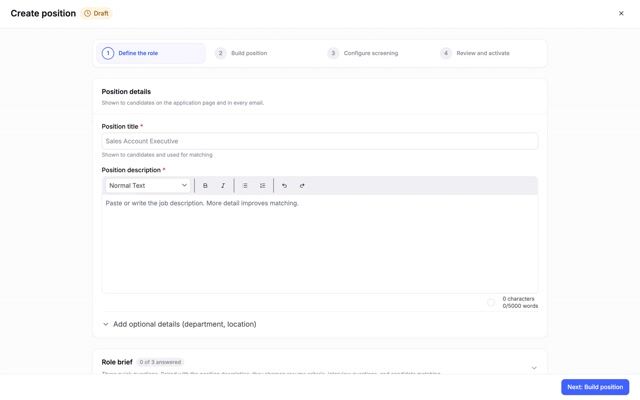
Truffle is a candidate screening platform that combines resume screening, one-way video interviews, and talent assessments, built for a small salon or spa hiring one or two nail technicians at a time without a sanitation director or HR team to lean on.
A workflow that fits an independently run salon:
- Resume and license review first. Confirm the license is active directly with your state's board before you invest any interview time. Look past certificate badges on a resume for actual service volume and the specific techniques a candidate has performed.
- A one-way video interview for judgment and communication. Ask two or three of the scenario questions above on video, especially the fungal-infection question and the unhappy-client question. One-way video interview software built for salons and spas shows you how someone actually talks through a sanitation call or a hard conversation before you commit an in-person or working interview slot.
- A customer service assessment for finalists. This role depends on someone reading a client and rebooking them, not just performing a service well. Our customer service assessment gives you a structured, scored read on that instead of guessing from a friendly interview.
- A reference check that asks specifically about sanitation habits and client retention, not just "would you rehire them." Ask a past manager whether clients asked for this person by name, and whether they've seen them hold a sanitation or referral standard when it would have been easier not to.
- A short, paid trial service for finalists, on a real client who's comfortable with it or a willing staff member, before you make the offer. This is the step that actually confirms the tool handling, the sanitation habits, and the client rapport you've been screening for on paper.
AI surfaces the evidence, resume matches, video responses, assessment scores, side by side, so you're not piecing it together from memory. It doesn't decide who's right for your chair. You review it and make the call, and for this role, license verification and the trial service remain steps only you can do.
3 questions from the skills check we'd actually run for this role
A nail technician's job comes down to sanitation judgment and client communication, sometimes in the same appointment. These three scenarios are adapted from Truffle's customer service assessment, scaled to the exact moments that decide whether a client trusts this person again.
1. A client sits down for a pedicure and you notice discoloration and a foul smell under one toenail that looks like it could be a fungal infection. She's not shy about wanting the polish on today regardless. What do you say? Reveal answer
Best answer: decline the service on that nail, explain the specific concern in plain terms, and recommend she see a doctor or podiatrist. Something close to "I want to take care of you, but I'm seeing some signs here I'm not able to service, this looks like something a doctor should take a look at first. Let's do the rest of your pedicure and hold off on that nail." Doing the service anyway to avoid an awkward moment, or refusing with no explanation at all, both fail. The strong answer protects the client's health and keeps the relationship intact.
2. A client is visibly unhappy that her gel color chipped two days after her appointment, and she wants it redone for free. What's your first move? Reveal answer
Best answer: acknowledge the frustration directly, look at the actual nail before assuming anything, and offer a fair resolution within the salon's policy. Getting defensive, or immediately assuming she damaged it herself without checking, both leave the client feeling dismissed. A candidate who names looking at the nail first, then offering a concrete next step, is showing you the instinct that actually protects a client relationship.
3. You're fully booked through the afternoon and a regular walks in asking for an emergency fix on a broken nail before a wedding she's in tonight. What do you do? Reveal answer
Best answer: assess honestly how long the fix would actually take, then communicate clearly with both her and the clients already scheduled before committing to anything. Something like "let me see what this actually needs, and let me check with my next client before I promise you a time." Squeezing her in without a plan, or turning her away without even looking, both miss the mark. The strong answer treats it as a real scheduling decision, not an automatic yes or no.
The point isn't these three scenarios specifically. It's that a short, structured skills check tells you how a candidate handles the moments a friendly interview never puts them in. Truffle's AI scores and surfaces the results against the bar you set. You still decide who's right for your chair.
Common hiring mistakes for this role
Hiring on speed or volume alone without testing sanitation discipline. A technician who can turn out a fast set is appealing when your chairs are full, but speed without a real sanitation habit is a health-board risk and a reputation risk at the same time. Ask the pressure-tested version of the sanitation question directly, not just "do you keep things clean."
Not verifying the license before investing interview time. Taking a certificate or a verbal claim at face value is a real liability, and license requirements, including whether a separate nail-specific license even exists, vary by state. Check your state board's public lookup every time, even for a candidate who seems clearly experienced.
Skipping a real client-communication scenario in favor of only technical questions. A candidate can describe a flawless gel application and still not know how to tell a client their nail can't support the service they're asking for, or how to recover when a color chips two days later. Screen for that judgment as deliberately as you screen for technique.
Underestimating how much revenue depends on rebooking versus one-off technical quality. At a small salon, repeat bookings are a real part of the revenue, not a nice-to-have. A technician who's technically excellent but never builds a client following is a quiet drain on the business that won't show up as an obvious performance problem until months later, when the chair's utilization tells the real story.
What should your screening process look like?
Answer six quick questions about how you hire. We'll point you to the screening steps that fit, so you spend your time on the candidates worth a conversation.
What each result looks like
Start with resume screening
You're working through real volume, and the resume still carries signal. Score every resume against your criteria first, so a shortlist surfaces before you spend time on anyone.
- Resume screeningScore every resume against your criteria and surface your strongest matches first.
- One-way interviewsHear how candidates think on a recorded prompt, on their schedule and yours.
7-day free trial. No credit card required.
Lead with one-way interviews
Resumes look interchangeable and phone screens are eating your week. Let candidates answer a recorded prompt on their own time. You watch the moments that matter and decide who's worth a live round.
- One-way interviewsHear how candidates think on a recorded prompt, on their schedule and yours.
- Resume screeningScore every resume against your criteria and surface your strongest matches first.
7-day free trial. No credit card required.
Anchor on talent assessments
For these roles the work matters more than the paper. Put a role-calibrated assessment up front, so you see real, comparable evidence before you book a calendar slot.
- Talent assessmentsSee role-calibrated work before you spend a calendar slot on a live round.
- One-way interviewsHear how candidates think on a recorded prompt, on their schedule and yours.
7-day free trial. No credit card required.
Layer all three signals
Your hiring spans high volume and high stakes, so no single step covers it. Layer all three: score resumes first, hear candidates on a one-way interview, then confirm with an assessment. Each step narrows the field, and you make the call at every stage.
- Resume screeningScore every resume against your criteria and surface your strongest matches first.
- One-way interviewsHear how candidates think on a recorded prompt, on their schedule and yours.
- Talent assessmentsSee role-calibrated work before you spend a calendar slot on a live round.
7-day free trial. No credit card required.