Talent assessment software
Pre-employment assessments AI doesn't know the answer to
AI has made most hiring tests useless, because now anyone can just look up the answers. Truffle's assessments show you how a person actually works and thinks, based on what your job really needs, then hand you the exact questions to ask them next.
7 days · 30 credits · no card required
I prefer when things move quickly and I'm responding to time-sensitive requests throughout the day.
I do my best work when I can focus on deep progress without constant interruptions or changing priorities.
“You mentioned preferring focus time—can you share an example of when you've had to switch gears rapidly and how you managed it?”







ChatGPT just aced your skills test
Skills assessments worked when knowledge wasn't free. That assumption died when ChatGPT launched. Now the answer to almost any static question is available and instant.
Everyone has the answer
A knowledge test only sorts people if knowing the answer is scarce. Now it's just a sign they have wifi.
Better proctoring won't save you
More surveillance? Now you're testing someone without AI on a task they'll always do with it.
The assessment score means nothing
A test that used to sort your candidates now just returns a stack of 95s. It stopped telling you anything.
Your first assessment goes live in 5 minutes
Paste a job description, tweak what Truffle drafts, share one link. That's the whole setup.
Know how they work before day one
See the stable stuff a resume hides: how organized they are, how they handle pressure, how they deal with people. Built on the Big Five, the personality research that's been validated for decades. There are no good or bad scores here, just an honest read on how someone naturally works, so month two doesn't surprise you.
See how they'd handle the messy stuff
Real workplace situations with four reasonable ways to respond. The candidate picks their approach. You see how it lines up with how your team actually handles the same moment. It's the gray-area judgment a resume never shows and an interview is too polished to reveal.
Catch the mismatch before they do
Every job has a reality: the pace, the structure, how much you're on your own. This surfaces where a candidate's preferences line up with that reality and where they don't. Both sides are valid. You just want to know before the offer, not three weeks after they start.
Each assessment, set up end to end
Real walkthroughs of the actual product, not slideware. About a minute each.
-
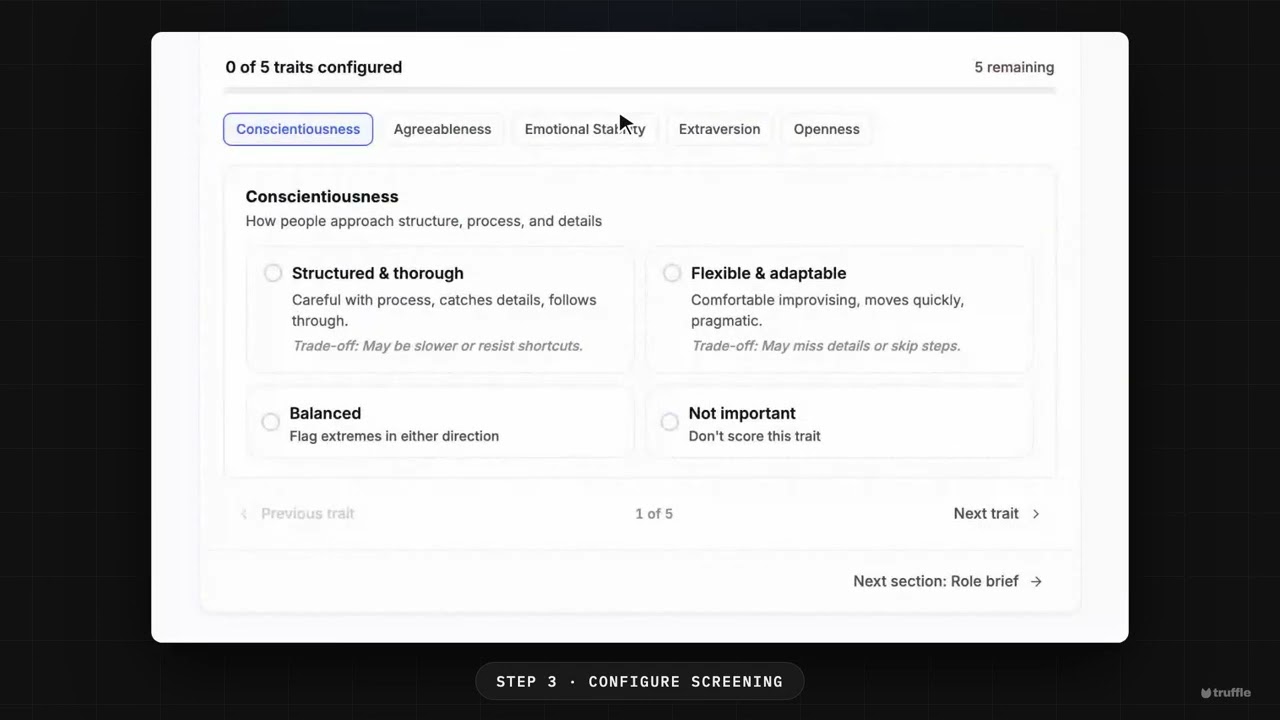
Switch on Personality, then set what the role needs on five traits. Each option shows its trade-off. There is no profile marked best.
-

Truffle drafts scenarios for the role, each with four responses. You pick the one you would want, and candidates are compared with your picks.
-

Truffle drafts questions about how the role really runs. You set the side the job needs, and each candidate shows as Aligned or a Gap, with a question to ask.
Comparing talent assessment software? Let's make it easy.
There's plenty of great assessment software out there. As long as you don't mind an hour-long test, pages of percentile charts, and a report you need a psychology degree to read.
Alternatives are expensive
7 day free trial, no credit card required. You can actually test out Truffle, and when you're ready you don't need the Brink's truck with plans starting at just $49.
Alternatives can be gamed
A test with a right answer is one ChatGPT already aced. Truffle scores how someone actually works against your role, not an answer key. Nothing to look up, nothing to fake, so the score in front of you is real.
Alternatives only do one thing
Video interviews, assessments, and resume screening on one platform. Use any one on its own. Stack all three when you want the full picture.
Not sure where to start? We've got you.
You can build your first assessment in the next few minutes. Here's how it works.
Sign up free
Start your free trial. 30 credits, no credit card.
Build the assessment
Pick your assessments: Personality, Situational Judgment, Environment Fit, or all three. Set what good looks like for the role. Then hit publish.
Share it and review
Drop the link wherever you post the role. Candidates finish in under 12 minutes on any device.
Yes, our talent assessments do all this (and more)
Wait until we tell you about our one-way interviews and resume screening.
Build it in minutes
- Three assessments: Personality, Situational Judgment, Environment Fit
- No job description needed
- Set what "good" looks like per role, or reuse a role-family template
- Standard and Express versions for high-volume roles
Reach every candidate
Effortless to take
- Works in any browser, on any phone
- No app, no account, no login
- Practice question before it counts
- All three together in under 12 minutes
Scored against your standard
- Alignment measured against the criteria you set
- A plain-language summary, no jargon
- A breakdown for every trait and scenario
- An interview prompt for every gap
Review in one sitting
Fair and hard to game
- No universal right answer to look up
- Both ends of every trait are valid
- No webcam or tab surveillance
- Native ATS, Zapier, API, and webhooks
FAQs about talent assessment software
What is talent assessment software?
Talent assessment software measures how a candidate works, thinks, and fits a role, giving you signal a resume and interview can't. Truffle runs three: a Personality test for how someone naturally works, a Situational Judgment test for how they make tough calls, and an Environment Fit check for whether they'll like the day-to-day. Use one, two, or all three. They sit in the same place as your resume screening and video interviews, so you're not jumping between tools.
Is a talent assessment the same as a personality test?
A personality test is one part of talent assessment software, not the whole thing. On its own, a personality test just gives you trait scores. Truffle adds two more reads: a Situational Judgment test for how someone handles a hard call, and an Environment Fit check for whether the job's reality matches what they want. Together they give you a fuller picture than any single test. Pick the ones that fit the role.
When should I use Personality, Situational Judgment, or Environment Fit?
Use the Personality test when you care about how someone naturally works: how organized, how outgoing, how they handle stress. Use the Situational Judgment test for roles full of judgment calls, like customer service or team leads. Use the Environment Fit check when people quit early because the job wasn't what they expected. Run all three, or just the one that matters most for the role.
Can I customize a talent assessment for a specific role?
Yes. You set what a good fit looks like before anyone takes it. You choose which traits matter, how you'd rank each situation, and what the real working conditions are. Truffle scores every candidate against that, not a generic benchmark. Save it once and the next hire for the same role takes a minute to set up.
Can I use talent assessment results after hiring?
Yes, as a conversation starter, not a report card. The results stay on the candidate's profile after they're hired, so you can use them in the first one-on-one and early check-ins. They're good for spotting where the role might push against how someone naturally works. Don't use them to grade performance. Work style is steady, but it isn't a prediction of how someone will do the job.
How do hiring managers see the assessment results?
Results show up on the same candidate profile as the resume, video interview, and scorecards. You can share a read-only link, so a hiring manager sees the alignment and suggested interview questions without making an account. Everything lives in one place. The score doesn't get buried in a separate tool nobody opens.
How long does a talent assessment take?
All three together take a candidate about 13 minutes. The Personality test is around 4 minutes, or 2 on the short version. Situational Judgment is around 5 minutes. Environment Fit is around 4. That's far shorter than the hour-long tests most tools use, and shorter tests mean more candidates actually finish.
Does talent assessment software integrate with my ATS?
Yes. Truffle connects natively to Ashby, Workable, Breezy HR, Bullhorn, JazzHR, Pinpoint, Recruitee, and Teamtailor, and writes results straight back into them. For anything else, there's Zapier and a webhook API. The scores land where your team already works, not in another login.
Can candidates cheat on the assessment with ChatGPT?
Not really, because there's no right answer to look up. ChatGPT can only help if it knows the correct answer ahead of time, and here there isn't one. Both ends of every personality trait are real strengths. Every situation has four fair ways to respond. Every fit question has two valid sides. And you scored it against your own role, which no AI can see. There's nothing to Google.
How much does talent assessment software cost?
Plans start at $49 a month. You get credits to spend across resume screening, assessments, and video interviews, and an assessed candidate costs 2 credits. Every feature is on every plan, and unused credits roll over on Core and up. There's a 7-day free trial with 30 credits and no credit card.
Your first assessment goes live in 5 minutes
Video interviews, assessments, and resume screening on one platform. Use any one on its own. Stack all three when you want the full picture.
Start free trial7 days · 30 credits · no card required