Sales representative: job description, interview questions, and screening workflow
A sales representative is often the first hire a small business makes who isn't doing the owner's own job for them. This is the person who picks up the lead the owner used to call themselves, gets a stranger on the phone, and either turns that conversation into revenue or lets it go quiet. A confident interview and a resume that says "consistently exceeded quota" tell you almost nothing about whether someone can actually do that, or whether they'll be answering leads three weeks from now instead of ghosting you the way the last one did. This guide screens for what a resume can't show: whether someone can carry a stranger from "no" to a signed deal, and whether they'll do the unglamorous follow-up work in between.
What a sales representative actually does at a small business
At a company with a built sales org, the work is split up. An SDR qualifies the lead. An account executive runs the pitch and closes. A customer success person keeps the account happy after that. Sales ops watches the numbers and fixes the process when something's broken.
At a business with one small sales team, or one sales hire, none of that division exists. The rep owns the whole thing: the lead comes in, they follow up, they run the conversation, they handle the pushback on price, and they close it, or they don't. Nobody hands them a qualified lead. Nobody reviews their calls before a customer hears them. The number they post each month is one of the plainest signals the owner has for whether the business is growing or stalling.
The core responsibilities, in practice:
- Answering and following up on inbound leads (calls, web forms, walk-ins, referrals) before they go cold, which for most small businesses is a matter of hours, not days
- Prospecting a share of their own pipeline when inbound slows down, whether that's outbound calls, emails, or in-person visits depending on the business
- Qualifying who's an actual buyer versus someone kicking tires, so the owner's limited sales hours go to the right conversations
- Running the pitch, demo, or walkthrough and answering product or service questions on the spot, without a script written by someone else
- Handling price objections and negotiating within whatever limits the owner sets, without needing a manager on every call
- Keeping the pipeline and follow-up cadence organized in whatever CRM, spreadsheet, or notebook the business actually uses today
- Closing the deal, which might mean a signature, a deposit, a purchase order, or a handshake, depending on what "closed" means in this business
- Reporting back to the owner on what's working, what's stuck, and what the pipeline looks like for the month ahead
That last point matters more at a small business than almost anywhere else. There's no sales manager reading a dashboard. The owner finds out the pipeline is thin when the rep tells them, or when the revenue doesn't show up. That's what makes this hire as much about honesty and follow-through as it is about charm on a call. For the fuller story on sourcing candidates and setting comp for this role, see our guide to hiring a sales rep. This page assumes you're ready to post the role and screen the pile.
Job description you can post today
Copy this, then adjust the specifics (what you sell, your territory or lead source, your pay structure) to match your business.
Sales representative
[Company name] is looking for a sales representative to own our pipeline from first contact to close. You'll work the leads that come in, build your own pipeline when they don't, and be the voice of our business to every prospect you talk to.What you'll do
Respond to inbound leads quickly and follow up until you get a real answer, not just a first no. Build and work your own pipeline through outbound calls, emails, or in-person outreach when inbound alone isn't enough. Run the pitch, demo, or walkthrough and answer the questions a prospect actually has, on the spot. Handle price objections and negotiate within the limits we set, without needing a manager on every call. Keep your pipeline and follow-up cadence organized so nothing slips through. Close the deal and hand off cleanly to whoever supports the account after the sale. Report back on what's working and what's stuck so we can fix the process together, not just the number.What we're looking for
A track record you can speak to in specifics: your quota, your attainment, your average deal size, not just "I hit my numbers." Comfort prospecting and building pipeline, not just working leads someone else generated. A real system for following up, so leads don't die from neglect. The ability to handle a "no" without taking it personally and without giving up on the relationship.Schedule
[Insert hours, e.g. full-time, in-office or field-based, or a hybrid split between calls and site visits][Insert base + commission structure, per your company's policy and any applicable state salary transparency requirements]
10 interview questions, and what a good answer sounds like
1. Walk me through the last deal you closed, from the first conversation to the signature.
You're checking for a real sequence, not a highlight reel. A strong answer moves through stages: how the lead came in, what qualifying looked like, where the conversation almost stalled, and what actually got the signature. A candidate who jumps straight to "and then they signed" without describing the middle probably didn't do much of the middle themselves.
2. Tell me about a deal you lost that you thought you'd win. What happened?
Everyone who's actually sold has lost a deal they expected to close. A strong answer names the real reason, a competitor's pricing, a stakeholder who never got looped in, a need that turned out to be smaller than it first looked, and what they'd try differently. A candidate who blames the market, the product, or the prospect's budget every time, with no mention of their own role, is telling you how they'll talk about your losses too.
3. What's your exact quota and attainment in your last two roles?
This is the single most direct test of the inflated-numbers problem that shows up constantly in sales hiring. A strong candidate answers with real figures, not "I consistently exceeded expectations." If someone hedges, rounds, or can't separate their number from the team's, ask again, more specifically. A rep who's genuinely hit their number knows it cold.
4. Tell me about a lead who went quiet for weeks and then came back. What did you do in between?
Follow-up discipline is where deals actually get won or lost at a small business, because there's no marketing team re-engaging cold leads for you. A strong answer describes a real cadence, a specific touchpoint, a useful piece of information sent, a well-timed check-in, not just "I kept reaching out." "I probably would've moved on" is an honest answer, but it's also a signal about how much revenue slips away on this person's watch.
5. Walk me through how you'd handle a prospect who says "just send me some info."
This is one of the most common brush-offs in sales, and how someone responds tells you a lot. A strong answer reframes rather than complying outright: asking one clarifying question to understand what "info" would actually be useful, or proposing a short call instead of disappearing into an inbox nobody reads. A candidate who just says "I'd send them a brochure" is telling you they'll let a soft no end the conversation.
6. Tell me about a time you had to sell something outside your comfort zone or product knowledge quickly.
Most small businesses can't give a new hire months of ramp time before they're in front of real prospects. A strong answer describes how they got up to speed fast, what they asked, who they leaned on, and how they handled a question they didn't know the answer to yet. "I just winged it and it worked out" is a weaker answer than one that shows a real learning process, because winging it works until it costs you a deal.
7. How do you decide who gets your time when you have more leads than hours in the day?
Prioritization under volume is a daily reality for a small sales team with no SDR pre-qualifying anything. A strong answer names real criteria: budget signals, urgency, decision-making authority, deal size, and describes a system for triaging rather than working leads in whatever order they arrived. "I try to get to everyone" sounds good but isn't a system, and it usually means the highest-value leads aren't getting the attention they need.
8. Tell me about feedback from a manager that was hard to hear. What did you do with it?
Coachability matters more at a small business, where there's often no formal sales training and the owner is the only person giving feedback at all. A strong answer names specific feedback, what changed afterward, and evidence that the change stuck. A candidate who can't produce a real example, or who reframes every piece of feedback as unfair, will be hard to develop once they're on your team.
9. If a prospect pushes back on price, walk me through what you actually say.
Listen for a real approach, not a platitude. A strong answer might explore what's driving the pushback, tie the price back to a specific outcome the prospect cares about, or offer a concrete tradeoff within the limits they're given, rather than immediately discounting. "I'd just try to create urgency" is not an answer. A candidate who can't get specific here probably hasn't handled many real objections.
10. Why are you leaving, or why did you leave, your last sales role?
The answer matters less than how directly it's given. A strong candidate can explain a real reason, comp structure, territory changes, a role that stopped matching their strengths, without dressing it up or bad-mouthing a former employer in a way that feels personal. Someone who's cagey or contradicts themselves on this question, especially after a short stint, is worth a direct follow-up before you move forward.
A scorecard you can score candidates against
Ten questions only help if everyone interviewing is listening for the same signals. Score every candidate on the same set, instead of comparing gut feelings about who sounded most confident on the call.
| What you're scoring | Strong signal | Weak signal |
|---|---|---|
| Specificity about numbers | Gives exact quota, attainment, and deal size without hesitation | Rounds, hedges, or answers in team terms instead of personal numbers |
| Ownership of losses | Names a specific reason a deal was lost, including their own role in it | Blames the market, the product, or the prospect every time |
| Follow-up discipline | Describes a concrete re-engagement cadence with a real example | "I just kept reaching out" with no specifics, or admits leads go cold |
| Objection handling | Reframes or asks a clarifying question instead of complying or discounting immediately | Sends a brochure and moves on, or jumps straight to a discount |
| Coachability | Names specific feedback and what changed afterward | No real example, or treats all feedback as unfair |
| Prioritization under volume | Names real triage criteria: budget, urgency, authority, deal size | "I try to get to everyone," with no actual system |
| Honesty about fit and departures | Gives a direct, coherent reason for leaving past roles | Vague, contradictory, or unusually negative about past employers |
How to screen sales representative candidates without losing a week to it
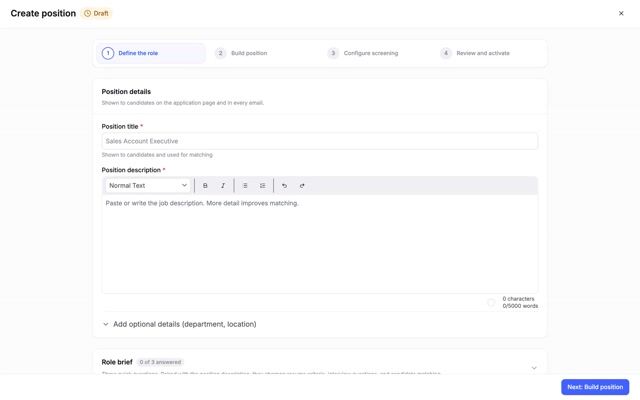
Truffle is an AI screening platform that combines resume screening, one-way video interviews, and talent assessments, so you can build a workflow that matches how this role actually gets tested: not by resume polish, but by how someone handles a real conversation and a real objection.
A sales posting at a small business can pull a few hundred applicants fast, plenty of them listing "sales experience" that turns out to be a few months of retail or a title with no real quota behind it. A workflow that fits a small team:
- Resume review, weighted toward quota ownership over job titles. Look past the title for signals of actual pipeline ownership: did they carry a number, or support someone who did? Resume screening software surfaces the candidates whose experience actually matches what you're hiring for, so you're not reading every application in the order it arrived.
- A one-way video interview before you spend a single live call. Ask 2-3 of the scenario questions above on video, the price objection question and the lead follow-up question both work well here, so you can hear how someone actually thinks under a real prompt before you book time. A one-way video interview shows you communication and composure in a way a resume never will, and it doubles as an early look at how a candidate would sound on a real call with your customers.
- A sales assessment before the live interview, not after. A resume can claim quota attainment. A structured assessment tests how someone actually approaches prospecting, objection handling, and pipeline discipline. Our sales assessment blueprint lays out role-based scenarios and scoring you can run before you commit to a live round.
- A short, unscripted role-play for finalists. Give them a scenario based on your actual product and customer, and don't script it. You're watching how someone adjusts in real time, not how well they deliver a rehearsed pitch.
- A reference check that asks specifically about numbers and follow-through. Ask a past manager to confirm the quota and attainment the candidate gave you, and ask directly whether leads got worked consistently or went cold. This is the step that catches the gap between what someone says in an interview and what they actually did.
AI surfaces the evidence, resume matches, video responses, assessment scores, side by side, so you're not piecing it together from memory across a few hundred applications. It doesn't decide who gets the job. You review it and make the call, especially on a hire whose number becomes your business's number too.
Common hiring mistakes for this role
Hiring on charisma alone. A great interview is the environment a good salesperson is best prepared for. It's also the one place they're most likely to perform rather than demonstrate. If your process ends at "they seemed really good on the call," you've tested exactly one skill: interviewing.
Accepting vague numbers without pushing for specifics. "I consistently exceeded quota" is not a number. If a candidate can't give you their actual quota and attainment when asked directly, that's information, not a formality to skip past because the conversation was going well.
Posting "competitive pay" instead of a real comp structure. A vague pay line filters out exactly the candidates who are disciplined enough to want clarity before they commit, and attracts the ones who'll take anything. Publish what you can, base, commission structure, and what OTE realistically looks like at plan.
Skipping the reference check because the interview went well. This is the step most likely to catch an inflated number or a follow-up habit that never existed. Given that this hire directly drives revenue, it's worth the extra day before an offer goes out.
Assuming a rep from a bigger company will thrive without the system they're used to. Someone who's only ever worked warm leads inside a built CRM with a manager feeding them talk tracks may struggle when the job is "build the process as you go." Test for that directly instead of assuming experience transfers cleanly.
What should your screening process look like?
Answer six quick questions about how you hire. We'll point you to the screening steps that fit, so you spend your time on the candidates worth a conversation.
What each result looks like
Start with resume screening
You're working through real volume, and the resume still carries signal. Score every resume against your criteria first, so a shortlist surfaces before you spend time on anyone.
- Resume screeningScore every resume against your criteria and surface your strongest matches first.
- One-way interviewsHear how candidates think on a recorded prompt, on their schedule and yours.
7-day free trial. No credit card required.
Lead with one-way interviews
Resumes look interchangeable and phone screens are eating your week. Let candidates answer a recorded prompt on their own time. You watch the moments that matter and decide who's worth a live round.
- One-way interviewsHear how candidates think on a recorded prompt, on their schedule and yours.
- Resume screeningScore every resume against your criteria and surface your strongest matches first.
7-day free trial. No credit card required.
Anchor on talent assessments
For these roles the work matters more than the paper. Put a role-calibrated assessment up front, so you see real, comparable evidence before you book a calendar slot.
- Talent assessmentsSee role-calibrated work before you spend a calendar slot on a live round.
- One-way interviewsHear how candidates think on a recorded prompt, on their schedule and yours.
7-day free trial. No credit card required.
Layer all three signals
Your hiring spans high volume and high stakes, so no single step covers it. Layer all three: score resumes first, hear candidates on a one-way interview, then confirm with an assessment. Each step narrows the field, and you make the call at every stage.
- Resume screeningScore every resume against your criteria and surface your strongest matches first.
- One-way interviewsHear how candidates think on a recorded prompt, on their schedule and yours.
- Talent assessmentsSee role-calibrated work before you spend a calendar slot on a live round.
7-day free trial. No credit card required.