Veterinary receptionist: job description, interview questions, and screening workflow
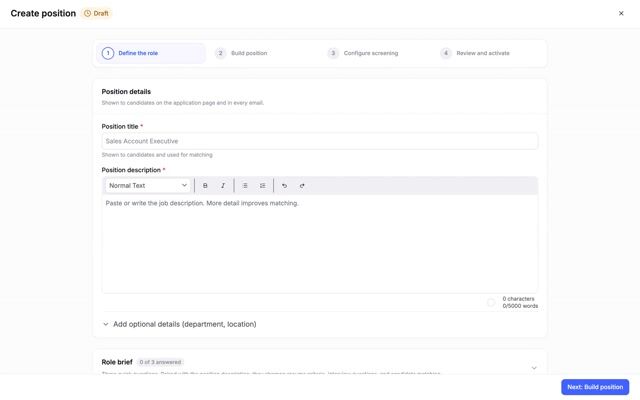
Most clinics hire a veterinary receptionist like they're filling any front-desk job: friendly voice, decent typing, can work a phone system. That's the wrong bar. This is one of the highest emotional-labor jobs in a small clinic, and a resume can't show you whether someone can do it. In the same ten minutes, this person might have to tell a client their dog's biopsy came back malignant, calm down an owner who's panicking because their cat ate a lily, juggle three ringing lines with a waiting room that's also full, and walk someone through a $1,800 estimate without the clinic eating the cost or the client walking out angry. None of that shows up on a resume that says "2 years front desk experience." This guide is built to screen for that, the composure and judgment under pressure that actually predicts whether this hire works out, not for polish in a five-minute chat.
What a veterinary receptionist actually does at a small clinic
At a corporate hospital group, front-of-house work is often split across a scheduler, a check-in person, a billing specialist, and a client care coordinator. At a 1-3 doctor independent practice, one person, sometimes two, is doing all of it, usually with no practice manager standing between them and the owner. There's no one to hand the hard calls to. They are the hard calls.
That compresses a lot into one seat at the front desk. The core responsibilities, in practice:
- Answering a phone that rings constantly, from routine scheduling to a panicked owner describing a possible emergency
- Checking clients in and out while managing a waiting room that's sometimes over capacity
- Presenting cost estimates and processing payment, including conversations about declined or deferred treatment
- Delivering or relaying bad news: a diagnosis, a euthanasia conversation, a treatment that didn't work
- De-escalating an upset or grieving client without escalating the situation further
- Scheduling and triaging appointments, including deciding what counts as urgent enough to work in same-day
- Keeping accurate notes in the practice management system so nothing gets lost between a phone call, a vet, and a follow-up
- Handling routine admin: faxing records, filling prescriptions, coordinating with pharmacies and insurers
This is distinct from the clinical side of the practice. A veterinary technician or veterinary assistant is trained to handle the animal directly: restraint, vitals, assisting in exams and procedures. A receptionist typically doesn't touch a patient at all. Their job is entirely about the humans on the other side of the counter, at the exact moments those humans are most stressed. If you're also hiring on the clinical side, see our breakdown of veterinary technician vs veterinary assistant for how those two roles differ from each other and from front-of-house work.
The technical bar for this role is genuinely low. Most practice management software can be learned in a couple of weeks. The hard part is almost entirely interpersonal: staying steady with a grieving client, holding a boundary on a money conversation without sounding cold, and doing all of it while the phone doesn't stop and the lobby is full. A resume that lists "front desk experience" tells you nothing about any of that.
Job description you can post today
Copy this, then adjust the specifics (your hours, your software, your client volume) to match your clinic.
Veterinary receptionist
[Clinic name] is looking for a veterinary receptionist to be the first and last voice our clients hear. You'll manage a busy front desk, handle scheduling and check-in/check-out, and support clients through some of the hardest and happiest moments they'll have with their pets.What you'll do
Answer phones and schedule appointments, including triaging what needs to be seen same-day. Check clients in and out, and manage a waiting room that's sometimes at capacity. Present cost estimates clearly and process payment, including conversations about what a client can and can't afford. Communicate with compassion during difficult moments, including delivering news from the doctor and supporting clients through end-of-life conversations. De-escalate frustrated or upset clients without letting a tense moment spiral. Keep accurate, useful notes in our practice management system so nothing falls through the cracks between shifts.What we're looking for
Genuine composure under pressure, not just a friendly phone voice. Comfort having direct money conversations with clients, including saying no within clinic policy. Clear, calm communication with people who are scared, grieving, or angry. Prior veterinary or medical front-desk experience is a plus but not required if you can demonstrate the judgment and composure this role needs.Schedule
[Insert hours, e.g. Tuesday-Saturday, 8am-5pm, with occasional coverage for early drop-offs][Insert pay range, per your clinic's policy and any applicable state salary transparency requirements]
10 interview questions, and what a good answer sounds like
1. A client is sobbing at the counter because the vet just told them their dog's diagnosis is terminal. The phone is also ringing. What do you actually do, in order?
You're checking whether they can sequence a real response under competing pressure, not just describe empathy in the abstract. A strong answer stays with the person in front of them first: acknowledges the moment, doesn't rush them, offers a tissue or a quieter spot if one exists, and only then deals with the phone, likely by letting it go to voicemail or having a coworker grab it. A weak answer either ignores the crying client to answer the phone, or freezes and doesn't do anything for either.
2. Walk me through exactly what you'd say to an owner who's panicking because their dog just ate something toxic.
Listen for actual language, not a description of an approach. Someone who's handled this before will produce something close to real phrases: get the owner to slow down, confirm what and how much was ingested, get them to the doctor or triage line immediately, keep their tone calm and directive rather than alarmed. A candidate who can only say "I'd stay calm and reassure them," with no specifics about what they'd actually ask or say, likely hasn't done this under real pressure.
3. You've got an emergency walk-in with a dog that's struggling to breathe, a client at the counter trying to check out, and a phone ringing about a routine appointment. What do you handle first, and why?
Good answers triage by urgency and physical presence, not by order of arrival: the emergency gets a doctor's attention immediately, even if that means interrupting someone, the checkout client (who is physically there and waiting) comes next, and the phone call about a routine matter can go to voicemail or a callback. Watch for candidates who say they'd just take things "in the order they came in," which suggests they haven't had to actually triage competing demands before.
4. A client has been waiting 40 minutes past their appointment time because an emergency surgery came in, and they're getting angry at you about it. What do you do?
This tests de-escalation, not apology reflex. A strong answer acknowledges the frustration directly, explains what happened without over-explaining or throwing the clinic under the bus, gives a realistic updated wait time, and offers something concrete within your clinic's policy, like having a tech check on their pet in the meantime. A weak answer either gets defensive ("that's not our fault, it was an emergency") or over-promises just to make the tension stop ("I'll have someone see you in five minutes" when that isn't true).
5. How would you explain a $2,000 estimate to a client who wasn't expecting anything close to that number?
Money conversations are one of the most avoided parts of this job, and candidates who haven't done it will speak vaguely. A good answer walks through the estimate item by item so the client understands what they're paying for, stays matter-of-fact rather than apologetic about the cost, and is ready to talk through options (payment plans, care credit, a reduced treatment plan) if the clinic offers them. A candidate who says they'd "let the vet handle that part" may be avoiding the part of the job that's actually theirs at most small clinics.
6. Tell me about a time you had to hold a boundary with a customer or client who wanted something you couldn't give them.
You want a real story, not a hypothetical: what they were asked for, why they couldn't say yes, and how they said no without the interaction turning hostile. A candidate who can't produce a real example, or whose story is really about eventually giving in, is a flag for a role that requires saying no on cost, on scheduling, and on clinic policy multiple times a week.
7. A client asks you to just confirm their pet's vaccines are current for a boarding facility, but you're not actually sure the record is up to date. What do you do?
This is an integrity question wearing a customer-service costume. A strong answer checks the actual record before saying anything, and if it's unclear, tells the client honestly rather than guessing to make the interaction faster. A candidate who says they'd "probably just say yes since it's usually fine" is telling you they'll take shortcuts under social pressure, which is a real liability with medical records.
8. Walk me through how you'd end a call where you just told a client their pet needs a procedure they said they can't afford right now.
Listen for what they do after the hard part of the conversation is over: do they document it, offer a next step (a callback date, a lower-cost option, information on financing), or just end the call once the awkward part is done. A candidate who has no plan for documentation or follow-up risks losing that client's context the next time anyone at the clinic talks to them.
9. How do you keep track of what's already been discussed with a client, so the vet or a coworker isn't caught off guard or repeating a hard conversation from scratch?
Good answers describe an actual habit: detailed notes in the practice management system, flagging a chart, or a quick heads-up to whoever's seeing that client next. This matters more at a small clinic than it might seem, since there's no team layer to catch a dropped detail if this person doesn't write it down. A candidate who says they just remember things, with no system at all, is a continuity risk.
10. Why front desk work at a veterinary clinic specifically, rather than a general customer service or medical office role?
This surfaces whether they understand what they're signing up for. A strong answer names something real about the emotional weight of the job, animals, grief, high-stakes money conversations, and shows they've thought about that, not avoided it. A candidate who can't articulate a reason beyond "I like animals" may not have considered how much of this job is actually about people.
A scorecard you can score candidates against
Ten questions only help if everyone involved in hiring is listening for the same thing. Score every candidate on the same six signals, so you're comparing evidence instead of comparing gut feelings from one conversation. Copy this into a doc and fill in a row per candidate.
| What you're scoring | Strong signal | Weak signal |
|---|---|---|
| Composure under emotional pressure | Stays with a grieving or panicking client first, handles competing demands (phone, lobby) in a clear order after | Freezes, rushes the person in front of them, or ignores the crying client to answer the phone |
| Real de-escalation language | Produces specific phrases and steps for calming an angry or panicked person, drawn from real experience | Speaks only in generalities like "I'd stay calm and be empathetic," with no concrete example |
| Triage judgment | Prioritizes by urgency and who's physically present, not by order of arrival | Would handle everything "in the order it came in," with no sense of relative urgency |
| Comfort with money conversations | Walks through a cost estimate directly and matter-of-factly, ready to discuss options within policy | Avoids the topic, over-apologizes for the cost, or wants to hand it off to the vet |
| Integrity under social pressure | Verifies a record before confirming it, even when a client is pushing for a fast yes | Would guess or confirm something uncertain just to move the interaction along |
| Documentation and handoff | Has a real habit of logging what was discussed so a coworker or vet isn't caught off guard later | "I just remember things." No system, so context is lost between shifts |
How to screen veterinary receptionist candidates without losing a week to it
Truffle is an AI screening platform that combines resume screening, one-way video interviews, and talent assessments, so you can build a screening process around what actually matters for this role, composure and judgment under pressure, without spending your own limited hours reading every resume that comes in.
A vet clinic opening for a front-desk role tends to pull a wide range of candidates, from experienced vet-hospital staff to people with general customer service backgrounds trying to break in because they love animals. That range is a feature, not a problem, but it means resumes alone won't tell you much. Someone with the exact right instincts might have no vet-specific experience at all, and someone with years at a hospital front desk might not be able to hold a boundary with an upset client. You need a step that actually tests the behavior, not just the resume line.
A workflow that fits a 1-3 doctor independent clinic with no practice manager doing the hiring:
- Resume screening first. Cut for basics: reliability, relevant experience if they have it, and any obvious mismatch on availability or location. Don't over-weight vet-specific experience here. It's a plus, not a requirement.
- A short one-way video interview for your first real look. Ask 2-3 of the scenario questions above, like the panicking-owner question or the 40-minute-wait question, so you can hear how someone actually talks through pressure before you spend any live interview time on them. Our candidate screening software for veterinary clinics is built around exactly this kind of front-desk, high-emotional-labor screening.
- A short, scenario-based skills check instead of a long trial shift. A trial shift costs you a real day of front-desk coverage and puts an untested person in front of grieving clients. A short skills check built around real customer service scenarios, like our customer service assessment, tells you how someone reasons through pressure and money conversations before they ever answer your phone.
- A real, live conversation only for the candidates who clear the first two steps. By the time you're on a call or in person with them, you already know they can communicate clearly and think through pressure scenarios. The live conversation is for fit and chemistry with your team, not for finding out for the first time whether they can handle the job.
Our resume screening and one-way video interview tools handle the first two steps in one place, with AI that surfaces your strongest matches against the criteria you set. You review the evidence and decide. It doesn't pick for you.
3 questions from the skills check we'd actually run for this role
A skills check only helps if it tests the judgment the job actually needs, not generic customer service trivia. These three are adapted from Truffle's customer service assessment, reframed for a vet clinic front desk. They're the kind of scenario that separates someone who says they're good with people from someone who actually is. Try them yourself before you decide what "ready for the front desk" means for your clinic.
1. A client says: "I've been waiting 40 minutes past my appointment and my dog is clearly in pain. This is unacceptable." The vet is running behind because an emergency surgery came in. What do you do first? Reveal answer
Best answer: acknowledge the frustration, check in on the dog directly, and give a realistic updated wait time with an option within policy. That might mean having a tech check the dog's pain level while they wait, or offering to move them up if the situation looks urgent. This balances empathy with clarity while staying inside what the clinic can actually offer. Blaming the emergency ("that's not our fault") escalates the tension, and passively telling them to keep waiting with no acknowledgment does nothing to defuse it.
2. You've got an emergency walk-in with a dog struggling to breathe, a client at the counter trying to check out, and a phone ringing about a routine appointment. What order do you handle these in? Reveal answer
Best answer: the emergency gets a doctor's attention immediately, then the checkout client, then the phone. Triage by medical urgency and physical presence, not by order of arrival. Handling things strictly in the order they came in, or starting with whichever task is easiest to clear, are both signs someone hasn't had to actually triage competing demands under pressure before.
3. You just told a client their pet needs a procedure they said they can't afford right now, and the call is ending. What do you note before moving on? Reveal answer
Best answer: full notes on what was discussed, the client's response, and any agreed next step, like a callback date or a lower-cost option to revisit. A one-line note like "talked to client, declined" leaves the next person, whether that's you in a week or the vet at the next visit, with no context and a real risk of repeating a hard conversation from scratch or misreading where things stand.
The point isn't these three questions specifically. It's that a short, scenario-based skills check like this tells you in twenty minutes what a resume and a friendly interview can hide: whether someone actually reaches for the right move when a client is upset, the lobby is full, and money is on the table. Truffle's AI scores and surfaces the results against the bar you set. You still make the call on who clears it.
Common hiring mistakes for this role
Treating it like a generic front-desk job. A friendly voice and decent typing speed tell you nothing about whether someone can deliver bad news to a grieving client or hold a boundary on a $2,000 estimate. Weight the interview toward real scenario questions, not general customer service chat.
Not testing money conversations directly. This is one of the most avoided and most necessary parts of the job at a small clinic, where the receptionist, not the vet, is usually the one presenting estimates and collecting payment. A candidate who can't talk through cost clearly in the interview won't suddenly find that skill on day one.
Over-weighting prior veterinary experience. It shortens the learning curve on software and terminology, but it doesn't predict composure under pressure. Some of the strongest hires for this role come from general customer service backgrounds with real de-escalation experience and no vet-specific history at all.
Putting an untested person straight into a trial shift. A trial shift costs a real day of front-desk coverage and puts someone you haven't actually screened in front of clients at their most stressed. A short scenario-based skills check before that shift tells you more, for less risk.
Skipping documentation and integrity questions. A receptionist who doesn't log what's discussed, or who'll confirm a record they haven't actually checked just to keep an interaction moving, creates real risk for the clinic. Ask for both directly instead of assuming they'll figure it out on the job.
Hiring the vet this receptionist will be scheduling around, too? That's a clinical hire with its own license-verification and judgment questions, not a front-desk one. See our veterinarian hiring guide for that role specifically.
What should your screening process look like?
Answer six quick questions about how you hire. We'll point you to the screening steps that fit, so you spend your time on the candidates worth a conversation.
What each result looks like
Start with resume screening
You're working through real volume, and the resume still carries signal. Score every resume against your criteria first, so a shortlist surfaces before you spend time on anyone.
- Resume screeningScore every resume against your criteria and surface your strongest matches first.
- One-way interviewsHear how candidates think on a recorded prompt, on their schedule and yours.
7-day free trial. No credit card required.
Lead with one-way interviews
Resumes look interchangeable and phone screens are eating your week. Let candidates answer a recorded prompt on their own time. You watch the moments that matter and decide who's worth a live round.
- One-way interviewsHear how candidates think on a recorded prompt, on their schedule and yours.
- Resume screeningScore every resume against your criteria and surface your strongest matches first.
7-day free trial. No credit card required.
Anchor on talent assessments
For these roles the work matters more than the paper. Put a role-calibrated assessment up front, so you see real, comparable evidence before you book a calendar slot.
- Talent assessmentsSee role-calibrated work before you spend a calendar slot on a live round.
- One-way interviewsHear how candidates think on a recorded prompt, on their schedule and yours.
7-day free trial. No credit card required.
Layer all three signals
Your hiring spans high volume and high stakes, so no single step covers it. Layer all three: score resumes first, hear candidates on a one-way interview, then confirm with an assessment. Each step narrows the field, and you make the call at every stage.
- Resume screeningScore every resume against your criteria and surface your strongest matches first.
- One-way interviewsHear how candidates think on a recorded prompt, on their schedule and yours.
- Talent assessmentsSee role-calibrated work before you spend a calendar slot on a live round.
7-day free trial. No credit card required.