Candidate screening software for veterinary clinics
Candidate screening software built for vet clinics doing their own hiring
Truffle is an AI screening platform that combines resume screening, one-way video interviews, and talent assessments in one workflow, built for the practice owner hiring a vet tech or front-desk role on their own. AI scores every candidate against the criteria you set with the reasoning attached. You still make every call.
7 days · 30 credits · no card required
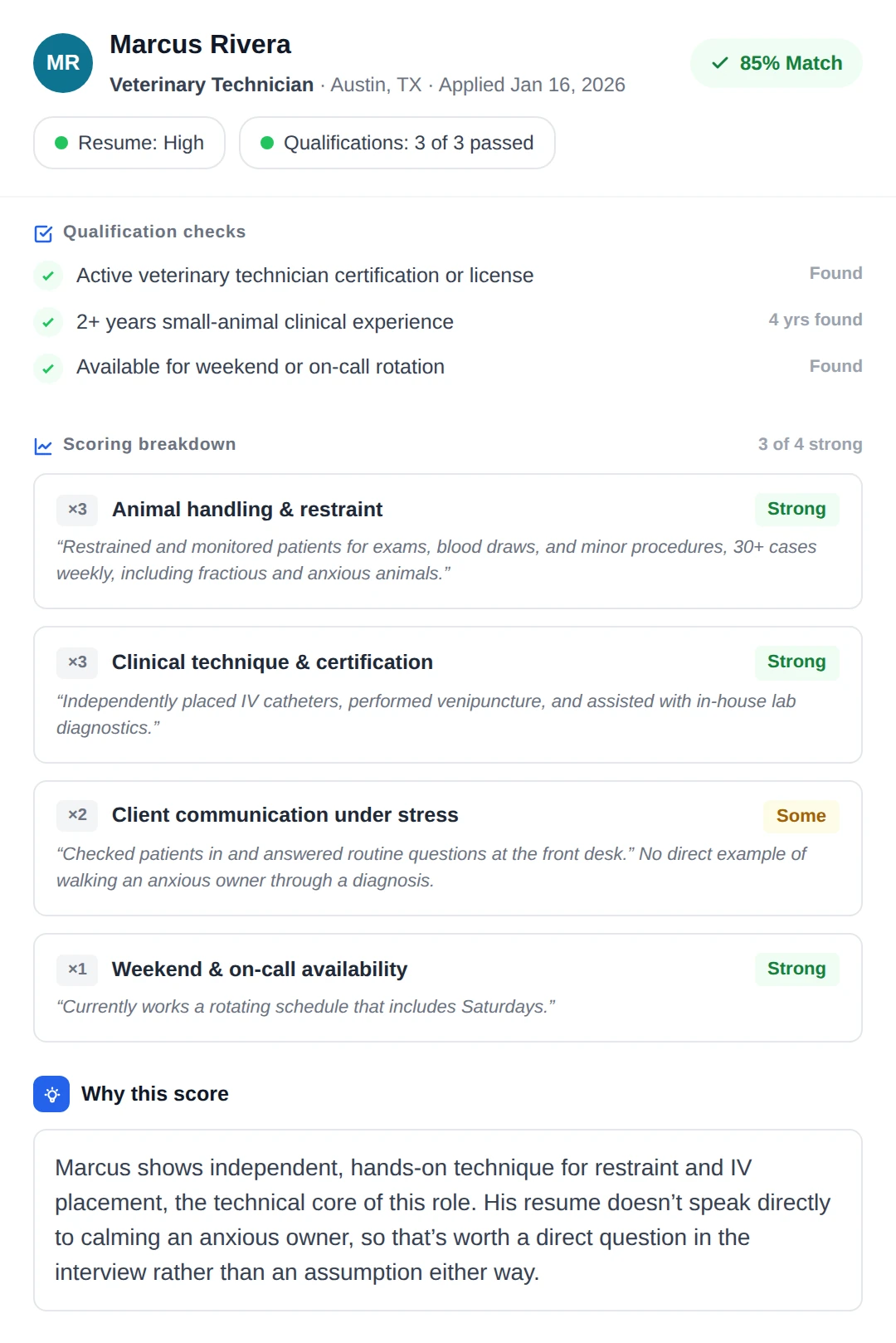







You post a vet tech role and the resumes pile up overnight
Your clinic runs on a handful of people. There's nobody else to read the applications, and a resume can't tell you who's actually good with animals and stressed owners.
You post a role and the resumes pile up overnight
Easy-apply means dozens of people apply to a role that pays hourly, most without the license or experience you need. You're the one reading through the applications between appointments and after close.
A resume can't tell you if someone's good with animals and owners
Anyone can list a certification or 'two years experience.' You won't know how someone actually handles a scared dog or an anxious pet owner until they're already on your floor.
You're the practice owner. Hiring landed on you anyway.
On a team of six or eight, one wrong vet tech or front-desk hire means months of retraining and a frustrated team. There's nobody to hand this to and no budget for an agency.
Three screening methods. One workflow. You design the process.
Screen for the license and experience a role needs, see how a candidate actually shows up, and add an assessment when you want more to go on. You choose what applies per role.
Cut the obvious mismatches before you open a profile
Upload resumes from Indeed or your careers page, one at a time or in bulk. Qualification Questions flag who has the license or certification your role needs, and Truffle ranks the rest against your requirements.
Tell us about a time you turned an unhappy customer around.
 REC 0:42
 See how a candidate handles a real scenario before you meet them
Ask how they'd calm a scared dog or handle a frustrated client, and candidates record their answer from any device, no app, no scheduling. You review a shortlist in the time one phone screen used to take.
Add evidence a resume and interview can't give you
Personality, Situational Judgment, and Environment Fit surface work style and judgment under real scenarios. No universal right answer, alignment is measured against your criteria, and gaps become questions for the interview.
Loop in your lead tech or office manager without paying per seat
Bring in whoever helps you decide, a lead tech, a partner, the practice manager. Structured scorecards and notes come standard, and unlimited team members are included on every plan.
What no job board or spreadsheet does for you
Most clinics are stuck between reading every resume themselves and an agency fee that costs more than the role pays. Here's what changes with a screening layer built for this.
Reading every resume yourself, after the clinic closes
Truffle reads and ranks every resume against the license, experience, and requirements you set for the role. You open a shortlist, not a stack of forty unsorted applications.
An agency fee that costs more than the role pays
A staffing agency fee can run a fifth of the role's salary, and most agencies don't want a single vet tech req. Truffle is self-serve from $49/month, no contract, no sales call.
A job board or ATS that stores applications but doesn't screen them
A job board collects resumes. An ATS files them. Neither tells you who's worth a call. Truffle scores every candidate against your criteria, with the reasoning behind every score.
One hour of best behavior tells you less than you think
A resume and a single interview are easy to get wrong on a small team. Stack a one-way interview and an assessment on top of the resume read, and the evidence compounds before you ever schedule a trial shift.
Everything included for screening vet clinic hires
One flat price, every feature, every screening method. No per-seat fees, no quote process, nothing sized for a hospital system.
Screen for what the role needs
See how they show up
Go beyond the resume
Built for a small team
Candidate screening for veterinary clinics, answered
What is candidate screening software for veterinary clinics?
It's software that reads and ranks your candidates for you, so you're not the one reading every resume between appointments. Truffle combines resume screening, one-way video interviews, and talent assessments in one workflow, built for a practice owner or office manager doing their own hiring.
How does Truffle help me screen vet techs and vet assistants on a small team?
You set the criteria for the role once (license or certification, years of experience, availability) and Truffle scores every candidate against it. You get a ranked shortlist with the reasoning attached instead of a stack of resumes to read one by one.
Can I screen for a license or certification like RVT or CVT?
Yes. Qualification Questions ask upfront whether a candidate holds the license or certification you require, and Resume review reads work history and claimed experience against your role. Set a check to flag for review instead of rejecting automatically, and a candidate close to your bar still shows up for you to review.
Will candidates for a vet tech or front-desk role actually complete a one-way video interview?
Most do when the interview is short. A well-configured Truffle interview runs about 10 minutes, and Candidate Reminders after 1, 3 and 7 days lift completion. For a thin-pool role like an experienced RVT, you can skip video and screen on resumes and an assessment instead.
How does AI score candidates for a vet clinic role?
You define what matters for the role at intake: certifications, experience, temperament, whatever you'd ask a recruiter to look for. AI analyzes each resume and response against that and produces a match score with the reasoning shown. AI surfaces the evidence. You decide who moves forward.
What roles can I screen with Truffle at my clinic?
Veterinary technicians and assistants, client care coordinators and front-desk staff, kennel and patient care roles, and practice managers. Any role you hire for more than once is a good fit, since that's where a ranked, repeatable process saves the most time.
Can talent assessments tell me how someone handles a stressed pet owner?
It gives you a structured read. A Situational Judgment assessment shows how a candidate says they'd approach a real work scenario, which gives you something concrete to ask about in the interview instead of guessing from a resume.
Does Truffle replace a working interview or trial shift?
No. Most vet clinics still want a trial shift before an offer, and that's a good instinct on a small team. Truffle gets you to the few candidates worth a trial shift faster, with a resume read, a recorded response, and an assessment already in hand.
How is this different from just posting on Indeed and reading resumes myself?
Indeed collects applications. It doesn't screen them. Truffle reads every resume against your role, flags who meets your must-haves, and ranks the pool, so you open a shortlist instead of forty unsorted resumes at 9pm.
Do I need a full ATS to use Truffle at a small clinic?
No. Most clinics this size don't have one and don't need one for this. Share your Position Link on your job boards or careers page, and Truffle handles the screening layer on its own. If you add an ATS later, Truffle connects through Zapier or the API.
How fast can I get a role live?
Usually about 10 minutes from a job description. Paste it in, accept or edit the AI-suggested questions, add your clinic's branding, and share the link.
Can I use resume screening on its own, without video interviews or assessments?
Yes. Each method stands alone and you choose what applies per role. Many clinics start with resume screening for licensed roles and add a one-way interview or assessment for front-desk and client-facing roles.
What does Truffle cost for a small clinic?
Plans start at $49/month (Starter), credit-based: a resume screened is 1 credit, an assessed candidate is 2, a completed one-way interview is 5, all from one shared monthly pool. Every feature is on every plan, and credits roll over on Core and up. See <a href="/pricing">pricing</a> for exact plans and roughly how many roles each covers. 7-day free trial, 30 credits, no card.
Screen your next vet tech hire without reading every resume yourself
Resume screening, one-way video interviews, and talent assessments on one platform. Use any one on its own. Stack all three when the role warrants it.
Start free trial7 days · 30 credits · no card required