The complete guide to Paradox AI
Thinking about using Paradox AI to speed up hiring? This guide breaks down what it does, how much it costs now that Workday owns it, and whether it's worth it if you're not a 500-location franchise.


AI summary
- Paradox is now part of Workday. The deal closed October 1, 2025 for a reported $1 billion in cash, and Olivia is being folded into Workday's talent acquisition suite as the Workday Paradox Candidate Experience Agent.
- Paradox still doesn't publish pricing. Independent review sites put the starting point around $1,000 a month. Mid-size deployments are estimated at $30,000-$95,000 a year plus $15,000-$35,000 in setup and integration costs. Nobody publishes a number for the largest franchise deals, so plan on a sales call.
- Paradox also has a real trust problem to weigh alongside the price. In June 2025, security researchers accessed applicant chat data through a Paradox test account secured with the password "123456." Paradox says the confirmed exposure was five candidates and the fix took hours, but outside reporting put up to 64 million applicant records at theoretical risk through the same flaw, so it's worth reading the details before you sign.
- Paradox is built for enterprise and franchise hiring at scale (McDonald's, Chipotle, and 7-Eleven are customers). If you run a business with 5-100 people and do your own hiring, you're not who it was built for, and you'll pay enterprise money for tools you won't use.
Paradox AI has never published a price, and being bought by Workday didn’t change that. Search “Paradox AI pricing” and you land on a “talk to sales” form, the same one that was there before the acquisition.
What did change is who Paradox is built for, and, this year, how much scrutiny it’s under. Olivia was designed to run scheduling and screening chat across thousands of frontline locations for brands like Chipotle and 7-Eleven, and the Workday deal sharpens that focus rather than broadening it. Here’s what she actually costs, based on every public number available, what she does well, where her security record took a real hit in 2025, and whether any of it fits a business with a handful of locations that does its own hiring.
What is Paradox AI?
Paradox AI comes from Paradox Inc, founded in Scottsdale, Arizona in 2016. They built conversational recruiting software designed to automate parts of the hiring process through text and chat. By Paradox’s own account, Olivia is now working with more than 500 companies worldwide, saving them what Paradox describes as millions of hours of manual work a year.
The core product is Olivia, an AI assistant that handles routine recruiting tasks. It texts candidates, schedules interviews, answers FAQs, and collects basic information. Paradox positions this as a way to handle high-volume hiring without adding more recruiters.
Paradox is now a Workday company. Workday signed a definitive agreement to acquire Paradox on August 21, 2025, and the deal closed October 1, 2025, for a reported $1 billion in cash. Olivia is being folded into Workday’s talent acquisition suite as the “Workday Paradox Candidate Experience Agent,” and Paradox’s former CEO now leads that part of Workday’s product line. If you’re evaluating Paradox today, you’re really evaluating an early look at where Workday’s recruiting AI is headed, not a standalone startup.
The software was built for enterprise teams and franchise operations. Paradox’s own franchise page says Olivia supports 50,000+ locations and owner-operators, and its named customers include 7-Eleven, Nestle, Marriott, Medtronic, Chipotle, Checkers & Rally’s, Dell, and Wendy’s. If you’re hiring 50+ people a quarter across multiple locations, Paradox wants to be in your stack. If you’re one location with a handful of roles and you do the hiring yourself, the setup and cost won’t make sense, and you’re not who they built it for.
Conversational ATS
Paradox built a conversational layer on top of traditional ATS workflows. Instead of candidates filling out web forms, they text answers to Olivia. The data still goes into an ATS, but the interaction is different.
This speeds up application submission, which matters for mobile candidates. But it also means your ATS is still the system of record. You’re bolting Paradox on top of something else.
Interview scheduling automation
Olivia can ping candidates, propose interview times, and send calendar invites. This saves your recruiter from sending 50 scheduling emails.
The reality: interview scheduling automation exists in most ATS platforms now. It’s table stakes, not a differentiator. What matters is whether the time you save actually translates to faster hiring or just freed-up Slack time.
One-way video interviewing
Paradox offers one-way video interviewing woven into Olivia’s chat flow. Candidates record responses on their own time, and Paradox transcribes and stores the video.
But here’s the gap: transcription alone isn’t enough. You still have to watch or skim every video to know who’s real. Paradox doesn’t surface 30-second highlights the way some competitors do. You’re back to reviewing hours of video.
Compare this to tools that actually analyze what candidates say and pull the most relevant moments. If you’re evaluating alternatives to HireVue, the quality of the AI analysis matters more than just having video.
Career sites and job distribution
Paradox handles career site creation and distributes your openings to Indeed, LinkedIn, and other job boards. Jobs that run on Olivia stay inside Paradox’s platform for the whole funnel. That’s convenient if you’re all-in on Paradox, and a big migration if you’re not.
Onboarding, offer management, and assessments
Paradox handles onboarding workflows and offer paperwork through conversational channels. New hires get texted their offer, complete I9s, and confirm start dates.
Paradox also offers Traitify, a separate personality assessment built as a short, image-based test. It’s a single add-on, not a combined resume-plus-interview-plus-assessment workflow. If assessments matter to how you screen, that’s worth knowing going in.
How much does Paradox AI cost?
Paradox doesn’t publish pricing. That hasn’t changed since Workday took over. Your bill depends on company size, how many modules you use, integration depth, and contract length. To get a number, you talk to sales.
That’s typical for enterprise software. You get room to negotiate. You also don’t know what you’re paying until you’re deep in a sales process, and there’s a real chance you’re overpaying next to a tool that publishes its price up front.
Estimated cost, based on independent reviews (as of August 2026)
Two independent software directories, SelectHub and GetApp, both list Paradox’s starting price around $1,000 a month, with no self-serve free trial.
Past that entry point, published estimates spread out fast, which tells you something on its own: nobody outside Paradox has a clean number. One third-party breakdown puts a mid-size deployment at $30,000-$60,000 a year for the base platform, $45,000-$95,000 a year once you add modules, plus $15,000-$35,000 in one-time implementation and ATS integration costs.
For the largest deployments, the kind running across hundreds of franchise locations, there’s no published number at all. If you’re 7-Eleven or Chipotle scale, you’re negotiating a custom enterprise contract, and only Paradox’s sales team knows what that costs.
Treat every figure above as a planning range pulled from third-party reviews, not a quote. The one thing every source agrees on: nobody gets Paradox at a self-serve, published price.
Pros and cons of Paradox AI
Pros of Paradox AI
- High-volume hiring at scale. If you’re hiring 500+ people a year across multiple locations, Paradox’s automation handles volume better than humans alone. Olivia texts, screens, schedules. That’s real throughput.
- Franchise and multi-location support. Paradox was built for businesses with many hiring locations. You set up once, Olivia runs across all locations with local nuance. That’s valuable if you’re Chipotle or McDonald’s.
- Full-funnel automation. From application to onboarding, Paradox touches the whole pipeline. If you want one system handling everything, that’s appealing. Fewer integrations. One vendor relationship.
- Conversational interaction with candidates. Candidates often prefer texting to web forms. Paradox makes that the default, which can mean higher mobile completion rates at volume.
- Existing ATS integration. Paradox works with Workday, SAP SuccessFactors, and iCIMS, and the Workday connection is now native since the acquisition. If you’re already in one of those systems, Paradox bolts on top.
Cons of Paradox AI
- Enterprise pricing. A small team on Truffle’s Starter plan pays $49 a month. A small team on Paradox pays roughly $1,000 a month at minimum, according to independent review estimates, before you’re anywhere near an enterprise franchise contract. That’s not just a difference in scale. That’s a difference in who the product is for.
- Video review still requires human time. Paradox’s one-way interviews produce transcripts and videos. But you still have to watch them. The tool doesn’t surface highlights or tell you which moments matter, so you’re back to hours of video review instead of hours of phone screens. That’s not faster.
- Heavy setup and implementation. Paradox requires integration work, training, and configuration. You’re not running it in 10 minutes. You need a project manager and a few weeks of planning. Small teams don’t have that bandwidth.
- A real security lapse in its recent history. In June 2025, security researchers gained access to a Paradox-built McDonald’s hiring bot through a test account still protected by the password “123456,” a lapse first reported by Krebs on Security. Paradox’s own account of the incident, posted to its blog, says the researchers who found the flaw viewed five candidates’ contact details before disclosing it responsibly, and that the endpoint was patched within hours. CSO Online reported the underlying flaw could have exposed up to 64 million applicant records. It’s the kind of headline you don’t want attached to the vendor holding your applicant data, whichever number you believe.
- Roadmap uncertainty for non-Workday customers. With Paradox folded into Workday’s product line, it’s an open question how much investment Olivia gets as a standalone tool for companies that aren’t already Workday customers.
Who should use Paradox AI
Enterprise and global teams
If you’re a 1,000+ person company hiring consistently across dozens of roles, Paradox’s automation at scale makes sense. You’re paying for the convenience of not having to build this yourself.
Franchise and multi-location businesses
Paradox was designed for this exact use case. Consistent hiring across many locations with local variation. If that’s you, their solution is purpose-built.
High-volume hourly hiring
Retail chains, hospitality groups, logistics companies. If you’re hiring 100+ hourly employees a month, conversational screening cuts through volume. Paradox handles that.
Who might want an alternative
If you’re an owner, GM, or founder running a business with 5-100 people and doing the hiring yourself, Paradox is overkill. You’d be paying enterprise pricing and sitting through an enterprise sales process for a screening problem that’s really “I posted one role and now have 200 resumes to get through.” You need something you can set up yourself, in minutes, without a contract negotiation.
That’s where alternatives shine. Tools built for the owner who’s doing the hiring themselves, on top of running the place, not a TA team with a Workday contract.
Paradox AI integrations
Paradox connects to major ATS platforms, HRIS systems, and job distribution channels, built to sit on top of what you already own. The Workday connection is the one to watch. Expect it to get deeper over time as Olivia becomes a native part of Workday’s recruiting product rather than a third-party add-on.
| Integration category | Supported platforms |
|---|---|
| ATS | Workday (native, post-acquisition), SAP SuccessFactors, Oracle HCM, iCIMS, Greenhouse |
| HRIS and payroll | ADP Workforce Now, UKG (formerly Kronos) |
| Job boards and career sites | Indeed, LinkedIn, job boards, Paradox careers sites |
| Background checks | Integrations with major background check vendors |
Paradox AI pricing vs. the alternatives
Paradox is the enterprise play, and it just became part of an even bigger enterprise play. If your business doesn’t run at franchise scale, you have options with published prices.
| Feature | Paradox | Truffle | HireVue | Spark Hire | Hireflix | VidCruiter |
|---|---|---|---|---|---|---|
| Resume screening | Yes | Yes | No | No | No | No |
| One-way video interviews | Yes | Yes | Yes | Yes | Yes | Yes |
| AI video analysis and highlights | No | Yes (Candidate Shorts) | Partial | No | No | Partial |
| Talent assessments | Limited (Traitify add-on) | Yes | Yes | Partial | No | Yes |
| Transparent pricing | No | Yes (from $49/mo) | No | Yes ($299/mo) | Yes ($75/mo billed yearly) | No |
| Conversational screening | Yes | Structured one-way and assessment screening | No | No | No | No |
| Full-funnel automation | Yes | Screening automation that runs alongside your ATS | No | No | No | No |
| ATS integration | Yes | Yes | Yes | Yes | Yes | Yes |
| Best for | Enterprise, franchise, high volume | Small teams doing high-volume hiring: owner-operators, founders, GMs, franchisees, small in-house hiring teams, and small owner-run staffing and recruiting agencies | Enterprise scale | Small to mid teams | Small teams, video only | Mid to enterprise |
| Setup time | Weeks | About 10 minutes | Weeks | Days | Days | Weeks |
Truffle
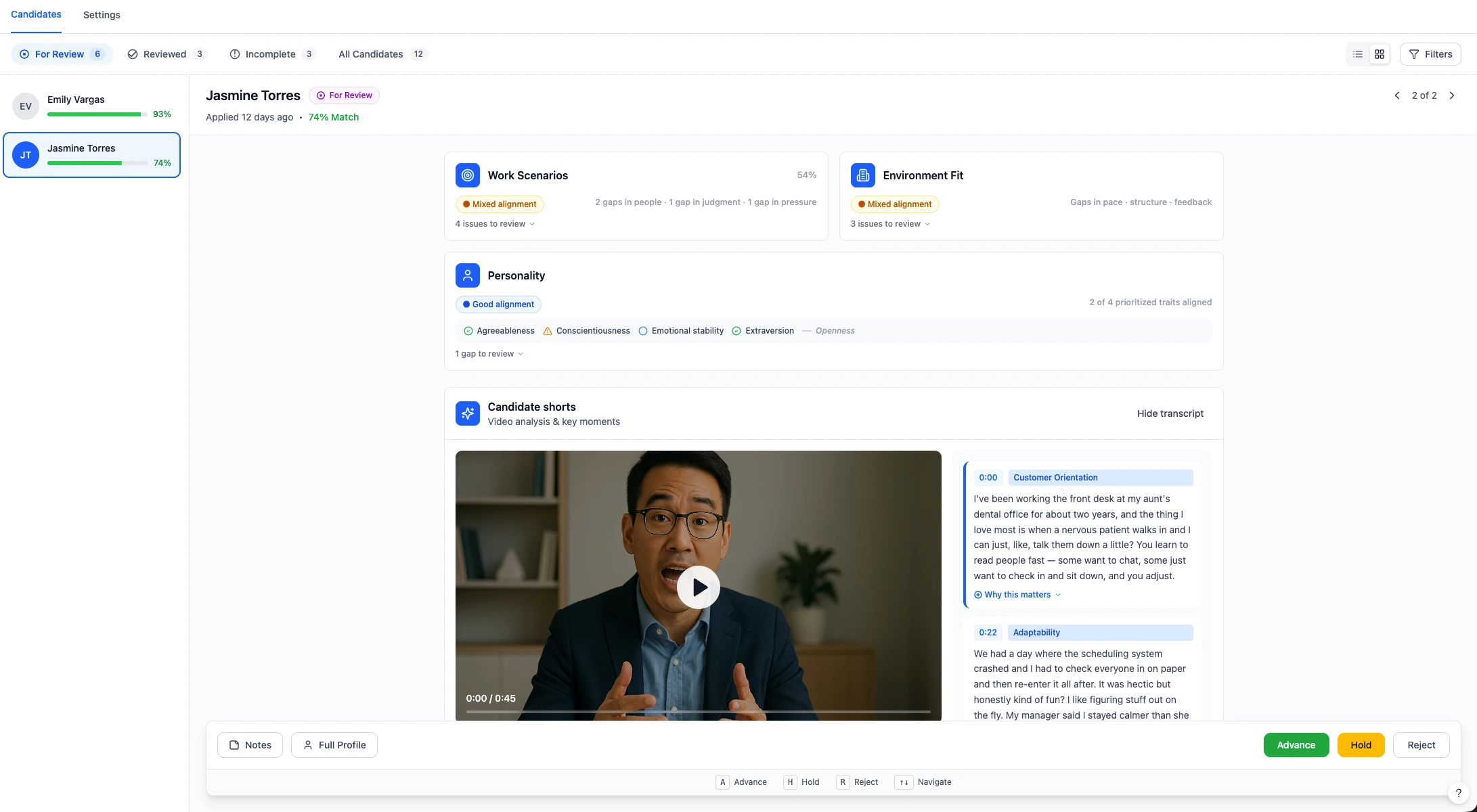
Truffle is an AI screening platform that combines resume screening, one-way video interviews, and talent assessments so you can separate real candidates from noise without outsourcing your judgment to AI.
It’s built for a different buyer than Paradox. Paradox is for a TA team running Workday across hundreds of locations. Truffle is for the owner, GM, or franchisee who posted one role, woke up to a full inbox of resumes, and has nobody to hand them to. If your business runs 5 to 100 people and you’re the one doing the hiring on top of your actual job, that’s exactly who Truffle’s recruitment software for small businesses is built for.
Here’s how it works. Candidates apply, and you design the screening flow yourself: resume screening alone, resume plus a one-way interview, or all three (resume, interview, and an assessment). You build it to match the role, not the other way around.
AI does the reading and ranking. AI Match scores every resume against your criteria, transcribes and analyzes interview responses, and surfaces 30-second Candidate Shorts so you see the most relevant moments without watching 20 minutes of video. Assessments measure personality, situational judgment, or team fit, included on every plan rather than sold as a separate add-on the way Paradox sells Traitify.
The output is one candidate view with resume data, interview highlights, assessment results, and match scores stacked together, so you can see who’s real and move the right people forward. AI surfaces the evidence. You decide who to talk to. The weeks Paradox’s setup and sales process spends before you screen a single candidate are weeks you’d already be screening.
Pricing is transparent and credit-based: one shared pool of credits across all three screening methods, spent only when a screening actually finishes (a resume scored by AI Match costs 1 credit, an assessed candidate costs 2, a completed one-way interview costs 5). Plans run from $49 a month (Starter) up to $599 a month (Scale) for larger volume, plus a custom enterprise tier. Every plan includes every feature, unused credits roll over for up to 12 months on Core and up, and a 7-day free trial gives you 30 credits with no credit card. See the full breakdown on the Truffle pricing page. You set it up yourself in about 10 minutes. No sales call, no implementation project, no multi-year contract.
The key difference from Paradox isn’t just price. Paradox assumes a recruiting team and a Workday deployment. Truffle assumes you’re doing this alone, and builds the workflow around that.
HireVue
HireVue is one-way video interview software built for large organizations running structured, high-volume hiring. They’ve been in the space longer than most competitors, and it shows in their assessment science and video analysis.
HireVue doesn’t publish pricing either, and that hasn’t changed. Vendr’s marketplace data puts the median buyer at about $20,900 a year (range roughly $9,800 to $41,000). That buys real infrastructure for a TA team running retail, logistics, or hospitality hiring at volume. For a business screening a handful of roles a month with nobody to manage the rollout, it’s the wrong shape of tool at the wrong price.
Spark Hire
Spark Hire is a one-way video interview platform, lighter weight than HireVue and priced for smaller teams. Spark Hire’s own pricing page puts the video interview product at $299 a month on a monthly plan, capped at 5 jobs and 5 users, or $249 a month billed annually with unlimited jobs and users. Assessments live in a separate, pricier tier of their applicant tracking system, not the base video plan.
It’s a solid pure video tool if you’re comfortable watching full recordings and doing the ranking yourself. What it doesn’t do at the base price is screen resumes or score candidates against your criteria. You’re adding video to a process you still have to build everything else around.
Hireflix
Hireflix is a one-way video platform built for ease of use and mobile-friendly candidate interviews. Hireflix’s pricing page lists $75 a month billed yearly for teams under 50 people, $150 a month billed yearly for teams of 50 to 250, and a custom quote past that. Monthly billing doubles those prices, to $150 and $300. Every plan includes unlimited seats, positions, and responses.
It’s a clean, dedicated tool if one-way video is genuinely your only bottleneck. It doesn’t screen resumes, doesn’t score candidates against your criteria, and doesn’t include assessments at any price. You get video, and you still read every response yourself.
VidCruiter
VidCruiter combines video interviews, assessments, and broader recruiting tools, so it’s a wider platform than the pure video players. It doesn’t publish pricing, but third-party listings on GetApp put the starting point around $5,000 a year on a usage-based model, before implementation.
For a team running complex, structured hiring across many roles, that breadth can be worth it. For a business posting a handful of roles a year with nobody to manage the setup, it’s more platform, more cost, and more implementation time than the problem calls for.
How to choose between Paradox AI and alternatives
When you’re weighing Paradox against other options, ask yourself these questions.
- How many people are you hiring per quarter? If it’s 50+, across multiple locations, Paradox’s enterprise automation might justify the cost. If it’s under 20, you’re likely paying for scale you don’t need.
- Do you already run Workday? If so, Paradox now plugs in natively. If not, you’re adding a second enterprise vendor relationship on top of the one you’re already managing.
- Do you want the tool to screen for you or help you decide? Paradox leans on Olivia to screen and route candidates through a conversational flow. Truffle surfaces match scores and evidence so you make the call yourself. One feels like delegation. The other feels like speed. Which fits how you want to hire?
- How much setup time do you have? Paradox requires implementation. A Truffle role goes live in about 10 minutes. If your team is stretched, that matters.
- How important is transparent pricing? Paradox makes you call sales, and that hasn’t changed under Workday. Truffle publishes what you pay. If you want to know your cost upfront, that’s a real factor.
- How much does the vendor’s data handling track record matter to you? Paradox patched its 2025 security lapse fast, but it happened. If you’re comparing on trust as well as price, that belongs in the conversation.
- Does conversational screening fit your roles? Paradox’s strength is high-volume, low-signal hiring where conversational bots work well. If you’re hiring for roles that need nuance or judgment, conversational screening alone will miss candidates. You need more than one signal.
The deeper question: are you hiring so much, across so many locations, that you need enterprise infrastructure and a Workday relationship to manage it? Or are you one person, one location, trying to get through every resume on your own? Paradox answers the first question. Truffle answers the second.
Frequently asked questions about Paradox AI pricing
How much does Paradox AI cost per month?
Paradox doesn’t publish an official number. Independent review sites put the starting price around $1,000 a month for the smallest deployments, with mid-size annual contracts estimated at $30,000-$95,000 a year plus $15,000-$35,000 in setup and integration costs. Treat those as planning ranges, not quotes, until you get a number from Paradox’s sales team.
Is Paradox AI still an independent company?
No. Workday signed a definitive agreement to acquire Paradox on August 21, 2025, and the deal closed October 1, 2025, for a reported $1 billion in cash. Olivia now operates as the Workday Paradox Candidate Experience Agent, integrated into Workday’s talent acquisition suite. Paradox’s former CEO leads that part of Workday’s product line.
Does Paradox AI work for small businesses?
Not really. Paradox is enterprise software, and the Workday acquisition made it more enterprise, not less. The pricing assumes high volume, and the setup assumes dedicated resources. A 5-person business would overpay and under-use it.
If you’re an owner-operator doing your own hiring, you need a tool that’s cheaper, faster to set up, and doesn’t require a sales negotiation. Truffle is built for exactly that.
Is Paradox AI trustworthy?
Paradox has been around since 2016 and is now backed by Workday, one of the largest HR software companies in the world. But its record isn’t spotless. In June 2025, a security lapse exposed real applicant data (see the next question for the details), so trust here isn’t just a question of company pedigree.
Like any conversational AI, Olivia has limits beyond that one incident. It makes mistakes and misses context sometimes, and it’s built to screen for boxes checked, not judgment calls. Assume it moves low-confidence candidates out of the pipeline automatically, and plan to review the rest yourself.
Has Paradox AI had a data breach?
Yes. In June 2025, security researchers found a test account on a Paradox-built hiring bot for McDonald’s secured with the password “123456,” first reported by Krebs on Security. They chained that login to a second flaw, an exposed applicant ID they could change in the browser bar, which CSO Online reported put up to 64 million applicant records at risk, including names, emails, phone numbers, and chat histories. Paradox’s own account of the incident says the researchers actually viewed five candidates’ data before disclosing responsibly, and that the endpoint was patched within hours. The gap between those two numbers is the point: five people confirmed viewed, tens of millions of records theoretically reachable through the same hole. Either way, it’s a real mark on the record, worth weighing against the price tag if data handling matters to your decision.
What companies use Paradox AI?
Paradox serves enterprise companies and franchise operations. 7-Eleven, Nestle, Marriott, Medtronic, Chipotle, Checkers & Rally’s, Dell, and Wendy’s are named customers. That’s public.
But most hiring happens at smaller scales. If you’re not doing franchise-level volume, you’re not their target customer.
What jobs use Olivia from Paradox AI?
Olivia handles volume jobs: retail, hospitality, logistics, food service. Roles where a resume alone doesn’t surface much signal and high volume is the main constraint.
For specialized or high-skill roles, conversational screening isn’t enough on its own. You need signals about communication, presence, or judgment. That’s where one-way interview questions and assessments matter more than chatbots.
Paradox answers the question of how to run hiring across thousands of locations with a dedicated TA team and a Workday contract. If that’s not your situation, you don’t need enterprise pricing, an enterprise sales process, or a security incident on the vendor’s record to screen candidates well. See what recruitment software for small businesses actually looks like: resume screening, one-way interviews, and assessments, all included, plans from $49 a month, no quote required.


