Top 8 interview scheduling tools for 2026: Free & paid
Scheduling software kills the calendar ping-pong, but it can't tell you who's worth a slot. Here are the 8 best interview scheduling tools for 2026, sorted by how much process they actually fit.


AI summary
- Scheduling software kills the calendar back-and-forth (ping-pong, reminders, self-booking), but it only fixes half the problem. You're still spending the week deciding who's worth interviewing before anyone books a slot.
- Pick on the shape of your process, not the feature count. Calendly and Google Calendar handle lightweight needs, Doodle wins for multi-stakeholder panels, and Recruitee adds ATS-connected scorecards. More process control almost always means more cost and setup.
- Scheduling assumes you already know who to talk to. If most of your week goes to figuring that out, screen before you schedule. Truffle is an AI screening platform (resume screening, one-way video interviews, and talent assessments) that gets you to a shortlist first, so there are fewer interviews to book in the first place.
Scheduling an interview should be simple. Instead it turns into a 14-email thread, a lot of squinting at your calendar, and negotiation tactics that would impress a hostage mediator. Then you join on time, sit alone in a Zoom room for three minutes, and realize you confused CET with EST. And you get to do the whole dance again for the next candidate.
Booking apps exist to kill that loop. They drop interviews into open slots on your calendar (or a hiring manager’s), send the conferencing links, and chase the reminders so you don’t have to. Set it up once, share the link, and candidates book in four or five clicks.
I’ve used a handful of these over the years, and after signing up for every tool on this list, I’m probably switching again. So whether you’re picking your first scheduler or trying to leave Calendly or Doodle behind, here’s how the eight best stack up. One thing worth saying upfront: a scheduler only earns its keep once you already know who deserves a slot. If that part is where your week goes, no booking page will save you, and I’ll come back to why at the end.
How we evaluate and test recruiting software
Our reviews are written by recruiters and TA professionals who have spent years using, testing, and buying hiring tools. We evaluate every product against the same criteria: what it actually does, what it costs, how fast you can get value from it, and whether it solves the screening problems in-house teams face every day. Truffle is our product, and we are upfront about that. But we do not inflate competitor weaknesses or hide our own limitations. If a tool does something better, we say so. We think recruiters deserve honest comparisons, not marketing disguised as editorial.
What makes a good interview scheduler
Every tool here is chasing the same goal: take the friction out of getting two busy people onto a call. That shows up as cleaner booking pages, fewer clicks from invite to confirmation, and team features that keep internal coordination from turning into its own email thread.
What separated the good from the merely adequate, in my testing, came down to five things:
- Ease of use on both sides. The tool has to work for the recruiter building the workflow and for the candidate booking a time. If either side gets confused, the whole point evaporates.
- Integrations with your stack. Calendar sync and video conferencing are table stakes. The tools worth paying for connect to your ATS, your CRM, and your automation platform so the manual work around an interview mostly disappears.
- Automatic video links. For remote hiring, the tool should generate and attach the meeting link in the background. Nobody should be hunting for a Zoom URL ten minutes before a call.
- Reminders and follow-ups. Candidates forget, interviewers forget, and no-shows cost you days. Built-in reminders keep interviews on the rails. Follow-up automations cut the manual chasing.
- Pricing that matches the value. Eliminating calendar chaos shouldn’t demand an enterprise budget. The strongest tools offer a real free plan, and their paid tiers justify the jump with automation, reporting, or hiring-specific features you’d actually use.
To put these through their paces, I signed up for each platform, built booking pages, connected calendars, and ran the setup from both sides. I configured scheduling rules, automated confirmations, generated video links, then booked test interviews to feel the candidate experience firsthand. That’s what separates the tools that genuinely make scheduling easier from the ones that just add another login to your day.
Already using Zoom, Google, or Microsoft?
Before you add another tool, check whether the calendar or video interviewing platform you already pay for handles scheduling. For a lot of teams, the feature buried in a tool they already own is enough.
The 8 best interview scheduling tools for 2026
Here’s the short version before we get into each one.
| Tool | Pricing | Best for | Standout feature | Main limitation |
|---|---|---|---|---|
| Calendly | Free + paid | SMBs that want clean, professional booking pages | One-click setup with Google, Outlook, and iCloud sync | Free plan is limited; no ATS integration without upgrading |
| Recruitee | Paid | Mid-size to large teams with structured hiring | ATS-integrated self-scheduling with scorecards | No free tier; feature-heavy for teams that just need scheduling |
| Google Calendar | Free | Startups and small teams already in Google Workspace | Zero cost, works across every device | No self-scheduling, no ATS integration, fully manual |
| Doodle | Free + paid | Panel interviews with multiple stakeholders | Poll-based scheduling where participants vote on availability | No ATS integration; advanced features require paid plan |
| HireVue | Paid | Enterprise teams with high candidate volume | Scheduling, video interviews, and assessments in one platform | Expensive; can feel impersonal and rigid for candidates |
| Appointlet | Free + paid | Small teams scheduling across time zones | Automatic time zone detection with Zoom integration | Limited automation; no ATS depth for growing teams |
| TimeTap | Free + paid | Service businesses with high booking volume | Granular booking rules and reporting tools | Clunky interface; learning curve steeper than alternatives |
| x.ai | Paid | Teams that want fully automated, hands-off scheduling | AI handles all scheduling communication via email | AI responses can feel robotic; less personal candidate experience |
1. Calendly (free + paid)
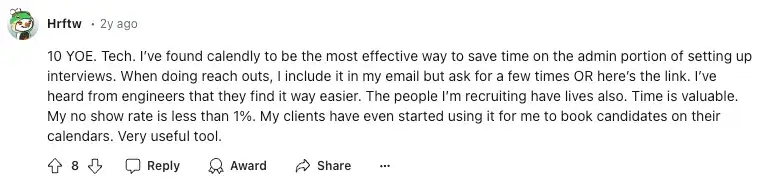
Calendly is the default for a reason. It syncs with Google, Outlook, and iCloud, so double-booking stops being a thing you worry about. You share a customizable booking page, candidates pick a slot that works for both sides, and automated reminders cut down the no-shows. Setup takes minutes, the pages look professional, and it works whether you’re scheduling solo or routing across a team.
The catch shows up on the free plan: limited event types and no ATS integration. If your hiring workflow has real complexity, or you want scheduling to live inside your applicant tracking system, you’ll be on a paid tier or looking at something heavier.
2. Recruitee (paid)
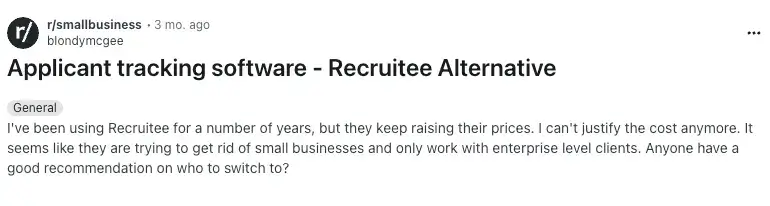
Recruitee is for teams that want scheduling baked into the hiring workflow rather than bolted on. It connects directly to your ATS, lets candidates self-schedule, and adds interview scorecards and templated interview schedules so a multi-round process stays consistent across reviewers. If you’re a mid-size or larger team running structured hiring, that integration is the draw.
The flip side is that it’s a paid platform with no free tier, and the feature depth can feel like a lot if scheduling is genuinely all you need. Buying Recruitee just to put time on a calendar is using a moving truck to carry a single box.
3. Google Calendar (free)
If you already live in Google Workspace, Google Calendar covers basic interview scheduling at zero cost. It’s free, instant to set up, and ties into Gmail when you send your request for availability email. For a small team that just needs to get a few interviews on the books, that’s hard to argue with.
What you give up is everything past the basics. No candidate self-scheduling, no ATS integration, no automation. Every booking is manual, which is fine at low volume and painful the moment your pipeline grows.
4. Doodle (free + paid)
Doodle solves the one problem most schedulers handle badly: getting a group of people to agree on a time. Instead of one organizer holding all the availability, you propose several slots and everyone votes on what works. That makes it the right pick for panel interviews where four calendars have to line up.
A few things make it candidate-friendly. It syncs with Google, Outlook, and iCloud, you can brand the booking page, and external participants don’t need an account to vote. The limits are predictable: the free plan is thin, removing ads or setting up automatic reminders pushes you to a paid tier, and there’s no ATS integration or interview management to speak of. It’s built for coordinating a lighter interview load, not running a high-volume pipeline.
5. HireVue (paid)
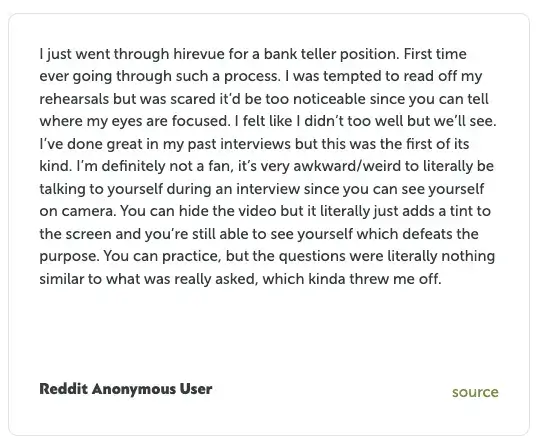
HireVue is the heavyweight here. It bundles automated scheduling with video interviews and built-in assessments, so a large team can run everything from booking to evaluation in one system. For enterprise volume, having scheduling, both live and on-demand video, and consistent scoring under one roof is the appeal.
It comes at a cost, in both senses. Pricing is a real barrier for smaller teams, and the platform can feel like overkill if all you need is a booking page. Candidates feel the weight too. The flow can read as rigid and impersonal, especially for anyone new to video interviews, and if building warm relationships with candidates is core to how you hire, a system this automated can work against you.
6. Appointlet (free + paid)
Appointlet keeps things simple and time-zone-aware. You build customizable booking forms, it detects and adjusts for time zones automatically, and it plugs into Zoom, Google Calendar, and Outlook. For a small team scheduling across regions without wanting the complexity of a full platform, it’s an affordable, low-friction option.
Grow past the basics and you’ll hit the ceiling. Payment integration and deeper customization sit behind the paid tiers, and there’s no real automation or ATS depth for higher-volume hiring. It does straightforward scheduling well and doesn’t pretend to be a hiring workflow.
7. TimeTap (free + paid)
TimeTap comes from the world of appointment-based businesses, and it shows in the controls. You get granular booking rules, an online calendar candidates can book against, and reporting that tracks volume and performance. For high-booking environments, that flexibility is genuinely useful.
The tradeoff is the experience. The interface feels clunky, especially the first time through, and the learning curve runs steeper than the alternatives. The free version is limited, with the better reporting and branding locked behind paid plans. It rewards teams willing to invest the setup time and frustrates the ones who just want something simple.
8. x.ai (paid)
x.ai takes the hands-off route. It’s an AI scheduling assistant that handles the back-and-forth over email, reading simple instructions in natural language and syncing with Google, Outlook, and iCloud to land on a time. For teams that want scheduling to mostly disappear, the pitch is appealing.
In practice, the email exchange can read as robotic, and that stiffness shows up in the candidate experience right when you want it to feel human. As a paid-only tool, it’s also a tough sell for smaller teams who can manage scheduling by hand or with a free booking page. The automation is real. Whether it’s worth the cost depends on how much that personal touch matters for your roles.
The step a scheduler can’t fix
Here’s the thing every scheduling tool quietly assumes: that you already know who’s worth a slot.
That assumption holds when you’ve got ten qualified candidates and a panel to coordinate. It falls apart when you’ve got 300 applicants for one role and most of your week goes to deciding which dozen are even worth a call. A booking page makes the calls you’ve already decided to schedule easier. It does nothing about the volume of judgment that comes first.
And that volume got worse, not better. Easy-apply and AI-written resumes mean a single posting now pulls hundreds of applications that all read the same on paper. The old fix was to muscle through with phone screens, half an hour each, to figure out who’s real. That’s the part eating your week. No scheduler touches it.
This is where screening before you schedule changes the math. Truffle is an AI screening platform that combines resume screening, one-way video interviews, and talent assessments. You can run any one on its own or stack them: resumes to cut the obvious mismatches, one-way interviews to see who communicates well on camera, assessments to surface judgment and work-style signal a polished application can’t fake.
One-way interviews are the part that overlaps most with your scheduling problem. Candidates record their answers on their own time, so there’s no calendar to coordinate for the first round at all. AI transcribes and scores each response against the criteria you set, summarizes what stood out, and clips the most revealing moments into 30-second Candidate Shorts. You review a candidate in seconds instead of holding the same intro call thirty times. The AI surfaces the evidence. You make the call on who advances.
That doesn’t replace a scheduler. You’ll still book the final-round conversations, and one of the tools above is the right home for those. It just means there are far fewer of them, and the ones left are with people you already have a reason to talk to.
So the real choice isn’t only which scheduler to buy. It’s whether your bottleneck is coordinating interviews or deciding who earns one. Match the tool to the problem you actually have this week. If it’s the second problem, fix that first, and the scheduling gets a lot lighter on its own.