A first-timer's guide to setting up pre-employment testing
You don't need a validated baseline to run your first pre-employment test. You need four decisions and a willingness to fix your first guess after your first batch of candidates.

AI summary
- Most first-time testers get stuck on the wrong decision. Picking a test type is easy. Writing a pass bar with zero data to calibrate against is what actually stalls people.
- You only need four decisions to go live: what you're actually testing for, which assessment type fits it, a first-guess pass range instead of a perfect cutoff, and what you tell candidates about why they're being asked.
- A SHRM survey found 56% of employers already use some form of pre-employment assessment, and 10% plan to start within five years. If that's you, starting before you feel ready matters more than getting the setup perfect.
A SHRM survey of HR professionals found that 56% of employers already use some form of pre-employment assessment, and another 10% plan to start within the next five years. If that’s you, you’re not behind. You’re just early into a decision most testing guides assume you already made a while ago.
Almost every pre-employment testing guide, ours included, spends most of its word count on test types and legal frameworks. That’s useful once you’ve decided to test. It doesn’t help with the actual thing that stops a first-timer: an empty field labeled “pass score” and no idea what number belongs in it.
You don’t need a validated baseline to start. You need a first guess and a next hire to correct it. That’s the whole setup problem, and it comes down to four decisions.
Why most first-time testers never actually turn assessments on
Ask someone who’s never run a pre-employment test what’s stopping them, and they’ll usually say they haven’t picked the right one yet. Personality test, situational judgment test, skills test, there are enough entries on any recruitment assessment tools list that “which one” feels like the decision that matters.
It isn’t, really. Once you know what you’re short on (communication, judgment under pressure, whether someone’s work style actually fits the job), the type mostly picks itself. What actually stalls people is the next screen: the one that asks what score counts as a pass. A validated instrument implies there’s a correct answer sitting somewhere, and a first-timer with zero completed candidates has no way to know it.
So the assessment sits half-configured. The role gets filled the old way, on a resume and an hour of someone’s best behavior, and testing becomes a someday project instead of something that’s live for this role.
What happens while you wait for the perfect test
The wait has a cost, and it’s the same cost testing is supposed to fix. A resume shows credentials, not how someone actually handles the job. An interview shows one hour of a person trying hard to seem right for the role. Neither tells you how a candidate reasons through a real scenario or whether their preferences match what the job is actually like day to day.
That gap is exactly why testing crossed 50% adoption, and not just among teams with an HR department to spare. A test is the second opinion on a decision you’re currently making on vibes and a good cover letter.
Waiting for a perfect test doesn’t avoid risk. It just keeps you on the version of hiring that has the least evidence behind it, for one more role.
Four decisions that turn a blank assessment into a working one
Every pre-employment test, however sophisticated, comes down to the same four setup decisions. Get these right and the rest is mechanics.
What you’re actually testing for
Start with the role, not the test catalog. What does this job actually demand that a resume can’t show? A dispatcher needs to stay level when three things go wrong at once. A bookkeeper needs to be conscientious about details nobody’s checking. A sales rep needs to read a room they’ve never been in before.
Write that down in plain language before you look at any assessment options. If you can’t name what you’re testing for in a sentence, you’re not ready to pick a test yet, and that’s fine. Go talk to whoever currently does the job well and ask what separates them from someone who struggled.
Which of the three assessment types fits the role
Once you know the gap, the type mostly follows.
If you’re trying to understand stable traits, how someone tends to approach new situations, manage competing demands, or work with other people, a personality assessment fits. The credible versions are built on the Big Five model (Openness, Conscientiousness, Extraversion, Agreeableness, Neuroticism), and it’s genuinely validated research, not a marketing claim. What it gives you is a picture of tendencies, not a type label and not a performance guarantee.
If you want to see how someone would actually handle situations specific to your team, a situational judgment test does that. It shows candidates a realistic scenario and asks what they’d do. There’s no universal right answer here. The test measures alignment with how your team actually handles things, which also makes it harder to game than a test with one portable correct answer.
If the risk is a candidate accepting an offer and quitting in month two because the job wasn’t what they expected, an environment fit assessment surfaces whether their preferences about pace, structure, and autonomy match the reality of the role. That lets you set accurate expectations before anyone signs anything, which is cheaper to fix upfront than after someone’s already resigned.
A first guess for your pass range, not a perfect one
This is the step that actually stalls people, so treat it like what it is: a temporary estimate, not a locked scoring key.
Set a three-band range instead of a single cutoff. A clear pass, a clear no, and a middle band you review by hand for your first several candidates. That middle band is where the calibration actually happens. You’ll look at real people, real scores, and real outcomes, and the range gets sharper every round.
You don’t need five years of hiring data to start. You need a defensible first guess and the discipline to apply it the same way to every candidate for the role.
Telling candidates why they’re being asked
One or two sentences: what the assessment measures, and that there’s no trick answer. That’s it.
Candidates who understand why they’re being asked to do something complete it at a noticeably higher rate than candidates handed a bare link. You’re not selling the assessment. You’re closing the gap candidates would otherwise fill in themselves, usually by assuming the worst. “We use this to understand how you’d approach situations like the ones on this team” costs you a sentence and buys you a completion rate.
What if your first guess at the pass bar is wrong
It will be, at least a little, the first time. That’s the honest answer, and it’s worth sitting with instead of arguing away.
Here’s why it’s a smaller problem than it feels like. An assessment result is diagnostic, not dispositive. A candidate who lands in your middle band, or even just below your first-guess cutoff, isn’t automatically wrong for the role. They’re a candidate worth a specific follow-up question in the interview you were already going to have. Gaps are conversation starters, not disqualifiers, and treating your first pass range that way protects you from over-trusting a number you haven’t calibrated yet.
The legal exposure people worry about doesn’t actually come from being new to testing. The EEOC’s guidance on employment tests centers on two things: the test has to measure something job-related, and it has to be applied the same way to every candidate for the role. A first-timer who tests every candidate consistently, even with an imperfect pass range, is in a stronger position than a team that’s used assessments for years but only pulls them out for candidates they’re already unsure about.
Consistency is the thing that’s non-negotiable. The precision of your first pass score isn’t.
Running your first assessment on one real role
Here’s what this looks like end to end, on a single role, before you touch anything else.
Say you’re hiring a customer service rep and forty people apply in the first week. You’ve already got qualification questions catching the basics (availability, location, whether they’ve done phone support before). The gap you’re trying to close is judgment under pressure: can this person stay calm and useful when a customer is upset and the answer isn’t in a script.
That’s a situational judgment test, not a personality inventory. You write two or three scenarios close to what actually happens on your floor, set a first-guess three-band range, and add a sentence telling candidates what it’s for. You put it after the one-way video interview, once candidates have already recorded a couple of answers and have some sense of who you are, not as the very first thing a stranger sees.
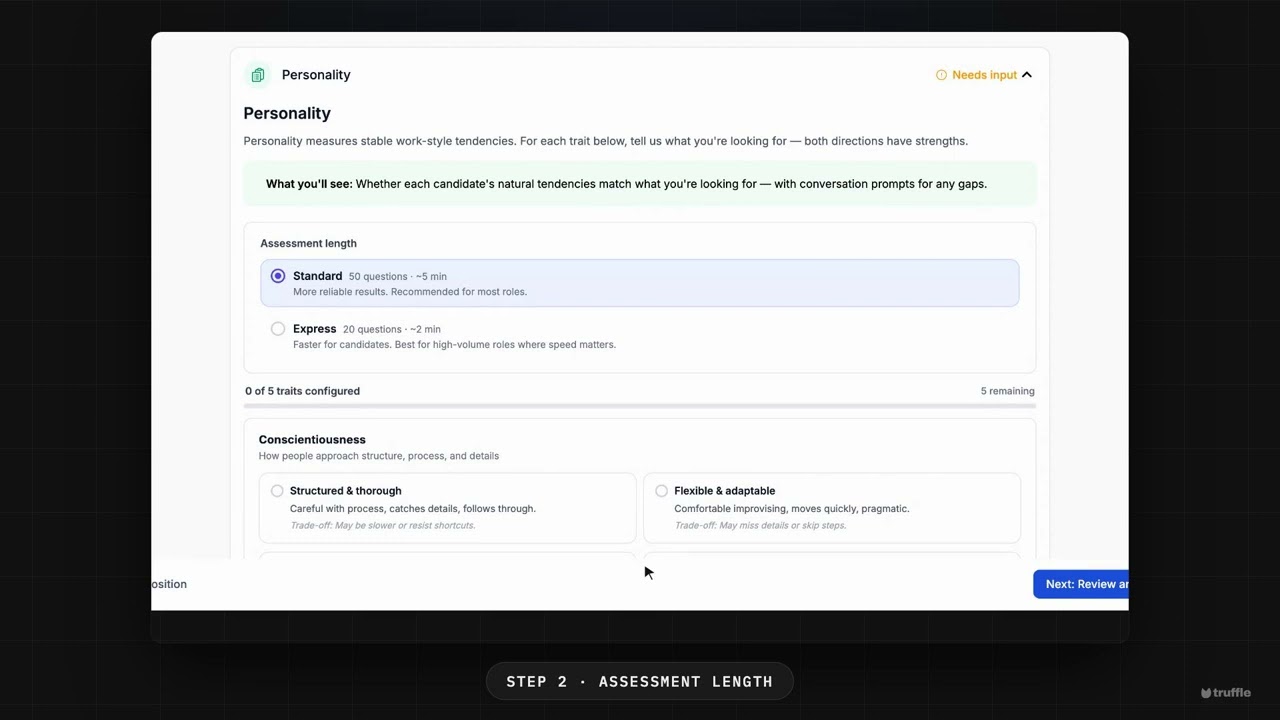
This is the exact setup Truffle is built around. Truffle is an AI screening platform that combines resume screening, one-way video interviews, and talent assessments, so the SJT you just built sits next to the interview responses and the resume data in one candidate view instead of a separate spreadsheet you’re maintaining by hand. The two intake questions Truffle asks when you set up a role (what success looks like in the first six to twelve months, and what helps someone thrive or struggle on your team) are exactly the “what am I testing for” decision above, just asked before you’ve written your own scenarios. Candidates see match scores explained against the criteria you set, not a black-box number, so when someone lands in your middle band you can see which specific answer put them there instead of guessing.
Truffle’s plans run on shared credits across all three screening methods, starting from $49 a month, with a 7-day free trial and no card required to try the setup on one role before you commit to anything.
What changes after your first batch of real candidates
The test you launch this week won’t be the test you’re running in three months, and that’s the system working, not a sign you got it wrong.
Your first pass range was a guess dressed up as a number. Your fifth round of real candidates gives you something a guess can’t: an actual distribution of how people who applied for this specific role, in this specific market, tend to score. That’s when you tighten the middle band, drop a scenario that wasn’t telling candidates apart, or notice the trait you thought mattered isn’t the one showing up in the people who’ve actually worked out on the floor.
The goal was never a perfectly calibrated instrument on day one. It was a habit of gathering better evidence before you decide, instead of hiring on a polished interview and hoping. If you’re still building out the rest of that screening process, how to screen candidates without losing your mind walks through where a test fits alongside resumes and interviews, and the full guide to pre-employment testing covers the test types and legal considerations in more depth than a first-setup guide needs.
Frequently asked questions about pre-employment testing setup
Do I need HR experience to set up a pre-employment test?
No. You need to know what the role actually requires and be willing to write down a first guess at what a strong answer looks like. Most first-time testers stall because they think they need a validated baseline before they start. You build that baseline by running the test, not before you run it.
What pass score should I use for my first pre-employment test?
Set a range, not a single cutoff, for your first batch of candidates. A three-band approach works well: a clear pass, a clear no, and a middle band you review by hand for your first few rounds. Tighten the range once you’ve seen how real candidates actually score, not before.
Where should a pre-employment test go in the hiring process?
After candidates know something about the role, not before. An assessment sent as the very first touchpoint, before anyone has a reason to trust you, tends to lose candidates who have other options. Placing it after a short qualification step or a one-way interview, once the candidate has some context, holds up better.
Is a first-time pre-employment test legally risky?
The legal exposure comes from inconsistency, not from being new to testing. The EEOC’s core requirement is that a test is job-related and applied the same way to every candidate for the role. A first-timer who tests everyone consistently is in a stronger position than a team that’s used assessments for years but only for some candidates.
Can I use more than one type of assessment at once?
You can, but it’s rarely the right move for a first test. Layering a personality assessment, a situational judgment test, and an environment fit check onto a role where you’ve never run any of them makes it harder to tell which one is actually driving your results. Start with the single assessment that closes your biggest gap. Add a second type later once you understand how the first one performs, and the recruitment assessment tools guide is a good next stop if you’re comparing platforms once you know that.