How to hire tech talent in 2026 when AI writes every resume
Every guide on hiring tech talent says source harder and move faster. But tech is now the most fraud-targeted hiring category, and the signals you screen on are the ones AI fakes best.

AI summary
- Hiring tech talent stopped being a sourcing problem. The funnel is overflowing, roughly a third of applications are bot-submitted, and tech is the single most fraud-targeted category. The hard part now is telling real candidates from synthetic ones.
- The resume, the take-home, and the GitHub profile are all artifacts produced offline with no one watching, which is exactly what generative AI fakes best. The signals most hiring advice still leans on are the easiest ones to fake.
- The fix is signal design, not detection. Put a higher-cost-to-fake signal up front, like a one-way interview where candidates answer your prompts on the record, and spend expensive engineering time only on people who clear it.
The standard advice on how to hire tech talent assumes good engineers are scarce, so your job is to source harder and move faster. For most teams, that assumption quietly expired. The funnel is overflowing now, and Gartner expects one in four candidate profiles to be fake by 2028.
You have plenty of candidates. What you don’t have is a way to tell which ones are real. The resume, the take-home, the GitHub profile: those are the exact artifacts a model produces well, and they’re the ones most hiring advice still tells you to lean on. In 2026, the cheapest thing for a tech candidate to fake is the exact signal you’re screening on.
That turns hiring tech talent from a sourcing problem into a verification problem. This post is about what changes when you take that seriously, and how to screen for a real person instead of a clean-looking file.
Tech hiring stopped being a sourcing problem
Open any guide on how to hire software engineers and you’ll get the same four moves. Write a precise role with a skills rubric. Source passive engineers on GitHub and through referrals. Move fast, because the good ones are gone in two weeks. Then screen with take-home projects and technical assessments. Every line of it assumes the hard part is finding enough qualified people.
The funnel flipped from empty to flooded
That advice was written for a market that no longer exists. The funnel isn’t empty anymore. The average job posting now pulls in roughly 242 applications, about three times the level of 2017, and a chunk of that volume is machine-made. Around a third of applications are auto-submitted by AI auto-apply tools, according to a Jobscan analysis of 2.1 million applications in early 2026. You are not short on candidates. You’re drowning in them.
Tech is the most fraud-targeted category there is
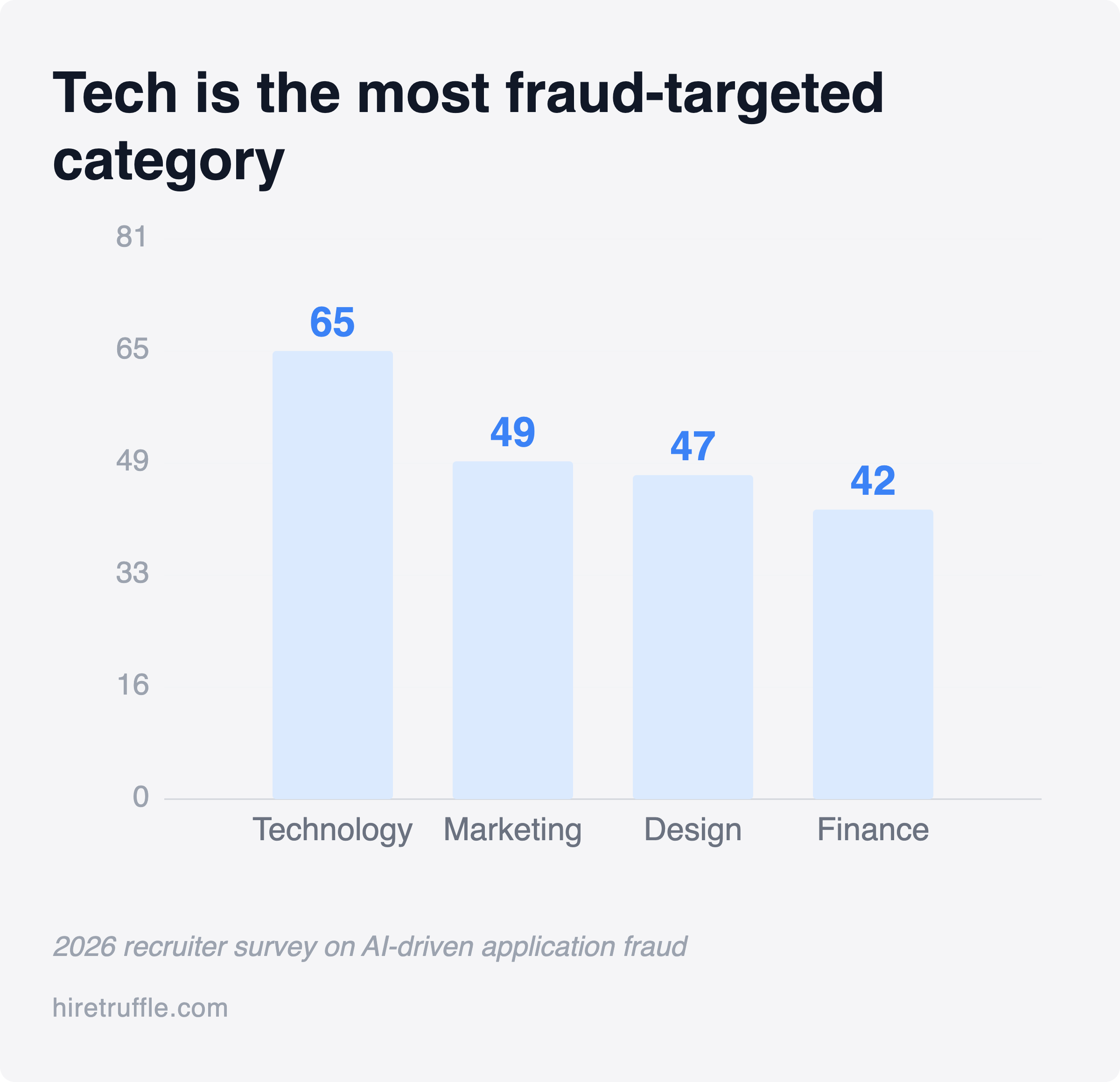
And tech is the worst-hit category by a wide margin. In a 2025 survey of 874 HR professionals, 65% named technology roles as the category most vulnerable to AI-driven application fraud, ahead of marketing, design, and finance. So the hard part has changed. Filling the top of the funnel is easy now. Telling the real candidates from the synthetic ones is the job, and sourcing more only makes it harder.
If you want to go deeper on why the funnel filled up like this, we wrote about candidates using ChatGPT to apply and the broader top hiring challenges in 2026. The short version: the inputs changed, and the old screening habits didn’t keep up. The same pressure shows up on narrower, entry-point tech roles too. If you’re hiring your first or second IT help desk technician, our IT help desk technician hiring guide walks through the job description, interview questions, and screening workflow for that specific role. The push toward skills-first hiring was the right instinct, but only if you can trust that the skills on display are the candidate’s own.
The signals you trust are the easiest to fake
Think about what a resume, a take-home, and a GitHub profile actually are. They’re artifacts. Static files a candidate hands you, produced on their own time, with no one watching. And artifacts are exactly the thing generative AI is good at producing. AI-generated resumes are the obvious case, but the same logic runs through every file in the stack.
A resume is a text document, so a model writes a clean one in seconds. A take-home is a contained coding task with a clear prompt, which is close to the ideal input for a coding model. A GitHub profile is a set of repositories and commits, and commit history can be backfilled. None of these were built to survive an adversary who can generate plausible work on demand. They assumed that producing the artifact was itself proof you could do the job.
Where each old signal stands now
| Signal you screen on | How easily AI fakes it now |
|---|---|
| Resume | Trivial. A model writes a tailored, keyword-perfect resume in seconds. |
| Cover letter | Trivial. Same prompt, different format. |
| Take-home project | Easy. A contained coding task is close to the ideal input for a coding model. |
| GitHub profile | Moderate. Repos can be seeded and commit history backfilled. |
| Live conversation about the work | Hard. The person has to think and respond in real time. |
The cost lands on your engineers
The cost shows up later, and it lands on your engineers. A fake clears your resume screen and your take-home, so you book it into a live technical interview. A senior engineer blocks an hour, and the candidate can’t walk through the architecture decisions in their own submission. Do that across a flooded funnel and you’ve turned your best engineers into a fraud-screening team. This is the same failure pattern behind AI interview cheating and the strain of high-volume hiring: the artifacts pass, the people don’t, and you find out at the most expensive possible moment.
Hiring tech talent is now a verification problem
So here’s the reframe. The bottleneck in tech hiring moved. It used to sit at the top of the funnel, at “find enough qualified candidates.” Now it sits in the middle, at “tell which of these candidates are real.” That’s a verification problem, and naming it changes what you build your process around.
A verification problem has the opposite shape of a sourcing problem. With sourcing, more is better. With verification, more is the enemy, because every extra application is one more file you have to authenticate. So screening tech candidates inverts. The first job is to confirm a candidate is a real person who can do what the resume claims, before you spend anything expensive on them. Narrowing the field comes after that.
This is why so many hiring managers feel like they’re losing. Job seekers have easy access to AI tools that can generate polished applications in seconds, while most HR teams are still screening manually. That gap is the whole problem. You can’t out-source your way around it, and you can’t out-read it by reviewing more files. You verify, or you guess. The newer AI screening tools are starting to reflect this shift, away from keyword matching and toward evidence you can actually check. You used to ask whether the resume matched the role. Now you’re asking whether there’s a real person behind it who matches what it claims.
More interview rounds won’t fix a fake-saturated funnel
Once verification is the goal, the obvious tech recruiting strategy is to add steps. If the early signals are fakeable, just put more eyes on each candidate. Add a live coding round. Add a panel. Buy a deepfake detector and bolt it on. Catch the fakes with sheer process.
It’s a reasonable instinct that fails for two reasons.
Adding rounds burns your scarcest resource
First, every round you add runs against the same unverified inputs and burns the resource you have least of: engineering time. If the fakes are clearing your early screens, the extra rounds just move the discovery later and make it more expensive. Stacking more rounds on a flooded funnel scales your cost, not your signal. Picking better hiring assessments helps, but only if the assessment itself is hard to hand to a model.
Detection is an arms race you’ll lose
Second, detection is an arms race you don’t want to be in. The moment a detector reliably flags AI-generated work, the generators adapt, and you’re a step behind again. As of late 2025, only about 31% of companies had implemented AI or deepfake detection software, and most still rely on manual review. Betting your process on catching every fake means betting on staying ahead of tools that improve every month. You won’t.
Design for a signal that’s hard to fake
The way out runs through signal design, not detection. Instead of trying to catch fakes after they clear a fakeable screen, you put a signal up front that’s expensive to fake in the first place. You stop asking “how do I detect the fake” and start asking “what can I ask for that a model can’t cheaply produce on the candidate’s behalf.” That question has a good answer, and it’s about cost.
What verifying real signal looks like
Take that overflowing funnel. You’ve cut the obvious mismatches on the resume pass, which is what resumes are still good for, and you’re down to maybe 60 candidates who could plausibly do the work. The old move is to start booking phone screens and take-homes. The verification move is to make every one of those 60 do something a model can’t cheaply do for them, before any engineer spends a minute.
Put a one-way interview before any engineer’s time
A one-way interview is built for exactly this. You send all 60 the same short set of questions. Each candidate records their answers on camera, on their own time, responding to your specific prompts in real time. A resume is an artifact a model can generate. A person talking through a tradeoff they supposedly made, answering the follow-up you actually asked, is a much higher-cost-to-fake signal. They’re on the record, responding to you, not submitting a file they prepared offline. That’s the difference between an artifact and evidence.
This is the layer where Truffle does its work. Truffle is an AI screening platform that combines resume screening, one-way video interviews, and talent assessments, so you design a screening process that fits the role instead of bolting tools together. For a flooded tech funnel, the one-way interview becomes the verification step that runs before any engineer’s calendar.
What the AI surfaces, and what you decide
The 60 candidates record their answers. AI Match scores each one against the criteria you set during intake and surfaces a match percentage, so you see who lines up with what you asked for. AI Candidate Summaries give you the gist of each response in a few sentences. Candidate Shorts pull the most relevant 30 seconds from each interview, tagged by competency, so you verify real signal in minutes instead of watching hours of video. Question-Level Evaluation shows how each person answered the questions that matter most. The AI surfaces the evidence. You read it and decide who’s worth an engineer’s hour.
Be clear about what this is and isn’t. Truffle doesn’t detect fraud or spot deepfakes, and it doesn’t decide who you hire. It raises the cost of faking and concentrates the real signal in one place. The match percentage is scored against criteria you defined, not some universal idea of a good engineer, so you stay in control of the call. What you get is a way to spend expensive engineering time only on candidates who already cleared a step that’s hard to fake. And if you’re worried about people finishing, completion rates on one-way interviews hold up well when the ask is short and the experience is clean.
The pricing is credit-based, which matters when you’re screening at volume. Truffle has plans from $49 a month, with one shared monthly pool of credits across resume screening, one-way interviews, and assessments. There’s a 7-day free trial and no credit card required. You’re paying to move verification in front of the expensive steps, not per fake you catch.
Hire the person, not the artifact
Zoom out past tech for a second. The deeper shift is that every artifact a candidate can hand you is now cheap to fake, and that’s only going to get more true. The resume, the writing sample, the portfolio, the certificate: anything produced offline, on the candidate’s own time, with no one watching, is a thing a model can produce too. Screening on artifacts was always a proxy. It worked because making the artifact used to require the skill. That link is broken now.
So the teams who hire tech talent well in 2026 share a habit. They stopped chasing better fraud detectors and extra interview rounds, and reorganized around a simple idea: screen for evidence of a real person thinking, and treat the paperwork as a footnote. It’s why candidate screening software is starting to mean something different than it did three years ago, less about filtering files and more about surfacing the person behind them. Get a candidate responding to you, on the record, in real time, as early in the process as you can. Once you’ve seen the person, the artifacts stop being the thing you’re trusting. They become the thing you’re checking against.
Build the process in that order. The cheapest signals do the least work, and the hardest-to-fake signal does the most. The resume gets you from hundreds to 60. A real person answering your real questions gets you from 60 to the handful worth an engineer’s time. Do that, and the flood stops being your problem. It becomes the reason your process is worth more than everyone else’s.
If you’re hiring for a specific technical role, the same principle applies with role-specific detail. Our guide to hiring a penetration tester walks through the exact interview questions and scenario-based skills check for that role, where the gap between someone who can talk about attack techniques and someone who can actually reason through a real engagement is especially wide. If it’s a general engineering hire you’re making, our software developer hiring guide has the ready-to-post job description, a scorecard, and the interview questions built around the same verification problem this post argues for.
Frequently asked questions about hiring tech talent
How do you screen tech candidates when resumes are AI-generated?
Treat the resume as a first filter, not proof. It’s still useful for cutting obvious mismatches on credentials and must-haves, which is how you get from hundreds of applicants to a shortlist. After that, add a signal the candidate can’t generate offline, like a one-way interview where they answer your specific questions on camera in real time. The recruiting statistics back this up: the volume is real and a lot of it is machine-made, so the filter has to be followed by a check. The resume narrows the pool. The live response verifies the person.
Are take-home projects still useful for hiring engineers in 2026?
They’re weaker than they were, because a contained coding task is close to an ideal input for a coding model. A take-home can still tell you something if you pair it with a live conversation about the submission, where the candidate walks through their decisions and answers follow-ups. The take-home on its own is an artifact. The candidate explaining it is the verification.
How do you hire tech talent fast without lowering the bar?
Speed and rigor stop fighting each other when you move verification earlier. The slow part of tech hiring isn’t the decision, it’s having the same first conversation dozens of times to find the few people worth a real interview. A one-way interview lets every candidate respond on their own time, then AI surfaces match scores and 30-second highlights so you review a large pool in minutes. You get to a verified shortlist faster without skipping the step that proves the person is real.
What’s the best way to verify a candidate matches their resume?
Put them in a situation where they have to respond, not just submit. A one-way interview asks your questions and records the answers on the record, so you hear the person reason through the work the resume claims. Truffle scores those responses against the criteria you set and surfaces the moments that matter, so you can check the claim against the evidence before you spend live interview time. AI surfaces the signal. You make the call.