12 best resume parser software tools for 2026
Compare the 12 best resume parser tools for 2026, from developer-ready parsing APIs to recruiter platforms that parse and screen in one place. See features, pricing, and how to choose the right type for you.


AI summary
- Resume parser software splits into two types: parsing APIs that return structured data for your own systems, and platforms that parse and then screen candidates for you.
- Developers and HR-tech teams usually want a parsing API like Affinda, RChilli, or Textkernel. Recruiters usually want a parse-and-screen platform like Truffle.
- Vendor accuracy claims are self-reported. Test any parser on your own resumes, including scanned and multi-column files, before you commit.
A recruiter spends about 7.4 seconds on the first pass of a resume. That figure comes from Ladders’ eye-tracking research, and it explains why resume parser software exists at all. When a single corporate opening now pulls in well over 200 applications, nobody reads them line by line. Software pulls the structured data out first, so a person can spend those few seconds on the candidates who matter.
Here’s the part most “best resume parser” lists skip. The phrase hides two completely different purchases.
One is a parsing engine or API. You send it a PDF or a DOCX, it returns structured data your own software can use. Developers and HR-tech teams buy this to power an ATS, a job board, or an internal tool.
The other is a parse-and-screen platform. It parses the resume and then scores, ranks, and helps you decide who to talk to. Recruiters buy this to get through a flooded inbox.
Buy the wrong one and you either get a stream of data you have nowhere to put, or a full recruiting platform when all you needed was an extraction endpoint. This guide splits the 12 tools by the job they actually do, then shows you how to test any of them on your own resumes before you commit.
How we tested these tools
These reviews are written by recruiters and people who have spent years buying, integrating, and living with hiring software. We weigh what each tool actually does, what it costs, how fast you get value, and who it fits. Truffle is our product, and we say so plainly. We don’t inflate competitor weaknesses or hide our own limits. Where a vendor’s accuracy or language numbers are self-reported, we flag them as the vendor’s claim, because in this category almost all of them are. You deserve an honest comparison, not marketing dressed up as a review.
The best resume parser software
If you’re a recruiter who wants to parse resumes and act on them:
- Truffle Best for in-house teams that want to parse, score, and decide in one place instead of bolting an API onto a spreadsheet
- Manatal Best for small teams that want a full ATS with AI matching at the lowest published price
- Zoho Recruit Best for teams already in the Zoho ecosystem or starting on a genuine free tier
- Recruit CRM Best for staffing agencies that need candidates, clients, and billing in one system
- CVViZ Best for contextual high-volume screening priced by active jobs instead of per seat
If you’re a developer or HR-tech team that needs a parsing API:
- Affinda Best for teams that want transparent credit pricing and the option to self-host
- Textkernel Best for enterprise parsing tied to semantic search and a mature skills taxonomy
- RChilli Best for high-volume parsing with published pricing and deep Oracle ecosystem ties
- Daxtra Best for global staffing firms that need dense field extraction and on-premise deployment
- HireAbility Best for teams that want a privacy-strict parser that never stores candidate data
- Hirize Best for teams that want a modern, LLM-based parser behind a single API call
- SuperParser Best for indie developers who want the cheapest API with a real free tier
What is resume parser software?
Resume parser software reads an unstructured resume and turns it into structured data: name, contact details, work history, education, skills, certifications. It uses a mix of optical character recognition (OCR) for scanned files and natural language processing to figure out which words are a job title, which are a company, and which are a date.
That structured output is what makes a resume useful to a computer. Once a resume is parsed, software can search it, store it in a database, compare it to a job description, or rank it against other candidates. Without parsing, every resume is just a document a human has to open and read.
The category breaks into the two types from the intro. A parsing API or engine stops at the structured data. It’s plumbing. A parse-and-screen platform keeps going: it scores the parsed resume against your role and surfaces a shortlist. Most lists mix these together, which is why people end up evaluating a $75-a-month data endpoint against a full applicant tracking system as if they were the same buy.
Resume parser software at a glance
| Tool | Type | Best for | Standout | Pricing |
|---|---|---|---|---|
| Truffle | Candidate screening platform | Parse, score, and decide in one place | Scores each resume against your role with the source quote behind every score | From $49/mo, credit-based |
| Manatal | All-in-one ATS | Affordable AI-enabled ATS | AI matching and recommendations from $15/user | From $15/user/mo |
| Zoho Recruit | ATS and CRM | Zoho-native teams and free starters | Zia AI scoring that weights rare skills higher | Free tier; paid per recruiter |
| Recruit CRM | Agency ATS and CRM | Staffing and search firms | Sovren-powered parsing plus client and deal management | Per-user tiers (not public) |
| CVViZ | AI ATS and parser API | Contextual high-volume screening | Adaptive ranking and a separate parser API | From $99/mo |
| Affinda | Parsing API | Self-hosting and transparent pricing | Published credit pricing, Docker self-host | Credits from $800/yr |
| Textkernel | Parsing and match suite | Enterprise parse-to-match | Skills and job-title taxonomy at scale | Custom (quote) |
| RChilli | Parsing API | High-volume parsing on a budget | Public credit packs, Oracle ecosystem | Credits from $75/mo |
| Daxtra | Parsing and match suite | Global staffing stacks | 150+ fields and on-premise option (vendor) | Custom (quote) |
| HireAbility | Parsing API | Privacy-strict integrations | States it never stores parsed data | Custom (quote) |
| Hirize | LLM parsing API | Modern single-call parsing | LLM-based parsing plus a matching API | Credit-based; free trial |
| SuperParser | Parsing API | Indie and small teams | Free tier and the clearest per-call pricing | Free tier; from $50/mo |
Pricing reflects published rates as of June 2026. Where a vendor doesn’t list prices, we say so. Verify current numbers before you buy, since this category changes its pricing pages often.
Which kind of resume parser do you actually need?
Before you compare features, answer one question: are you building software, or are you hiring people? Your answer points you at one of the two buckets and rules out the other.
You need a parsing API if you’re building on top of the data
If you’re a developer or a product team, you want raw extraction you can pipe into your own system. You care about the JSON structure, the fields returned, response time, uptime, language coverage, and whether you can self-host for compliance. You do not want a recruiting interface, because you’re building your own.
Pick from Affinda, Textkernel, RChilli, Daxtra, HireAbility, Hirize, or SuperParser. The right one depends on volume, languages, and whether you need on-premise deployment. A team embedding parsing into a SaaS product has different needs than a staffing firm migrating ten years of resumes.
You need a parse-and-screen platform if you’re hiring
If you’re a recruiter, the parsed fields are a means to an end. You don’t want to look at JSON. You want a ranked, scored shortlist with the evidence attached, ideally next to the rest of your resume screening workflow. The parser is buried inside the product, doing its job invisibly.
Pick from Truffle, Manatal, Zoho Recruit, Recruit CRM, or CVViZ. Here the question is how much platform you want around the parser: a full ATS, an agency CRM, or a focused screening layer that sits on the ATS you already run.
Parse-and-screen platforms for recruiters
These tools parse the resume and then help you decide. If you’re hiring rather than building, start here.
Truffle
Truffle is an AI screening platform that combines resume screening with one-way video interviews and talent assessments. On the resume side, it parses each PDF or DOCX into structured data, then scores it against the criteria it drafts from your job description. You see the quote pulled straight from the resume behind every score, plus the gaps worth probing in a later conversation.
What separates it from a pure parser is what happens after extraction. A standalone API hands you fields. Truffle hands you a ranked, scored shortlist with the evidence attached, and it’s built to leave a field blank rather than invent one. The same criteria then carry into one-way video interviews and assessments, so a resume score sits next to how a candidate actually communicates.
You can use Truffle for resume screening on its own. Or layer in video and assessments for when a document candidates now build with ChatGPT isn’t enough to decide on.
A 53-second look at the parse-score-shortlist loop: what matched, what didn’t, and the line in the resume each score came from.
- Pricing: Plans from $49/month, credit-based. 7-day free trial, no credit card required. Custom plans for higher volume.
- Best for: in-house recruiters drowning in applications who want to parse, score, and decide without juggling three tools.
- Why teams choose it: they want the evidence behind a score, not just a number, and one workflow that handles resumes, video, and assessments together.
Manatal
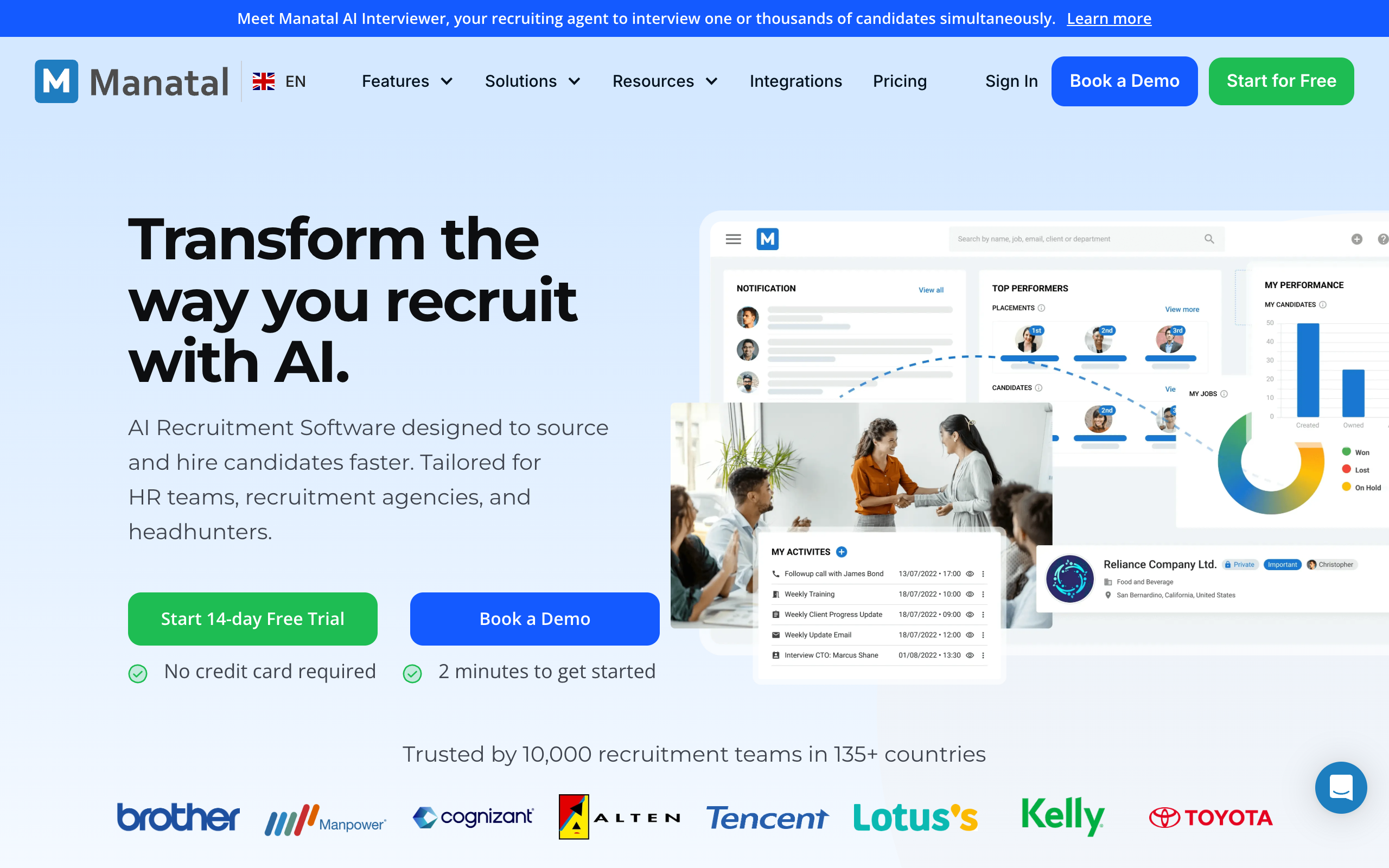
Manatal is an all-in-one ATS with AI baked in, aimed at small and mid-size teams that want one system instead of a toolchain. It parses resumes, indexes skills and experience, and recommends candidates against your open roles.
It’s the cheapest published entry point of any platform here. The catch worth knowing: full API access is gated to the top tier, and the entry plan caps active jobs and stored candidates.
- Pricing: From $15/user/month (annual) up to $55/user/month. 14-day free trial, no card.
- Best for: cost-conscious teams that want a full AI-enabled ATS without enterprise contracts.
Zoho Recruit
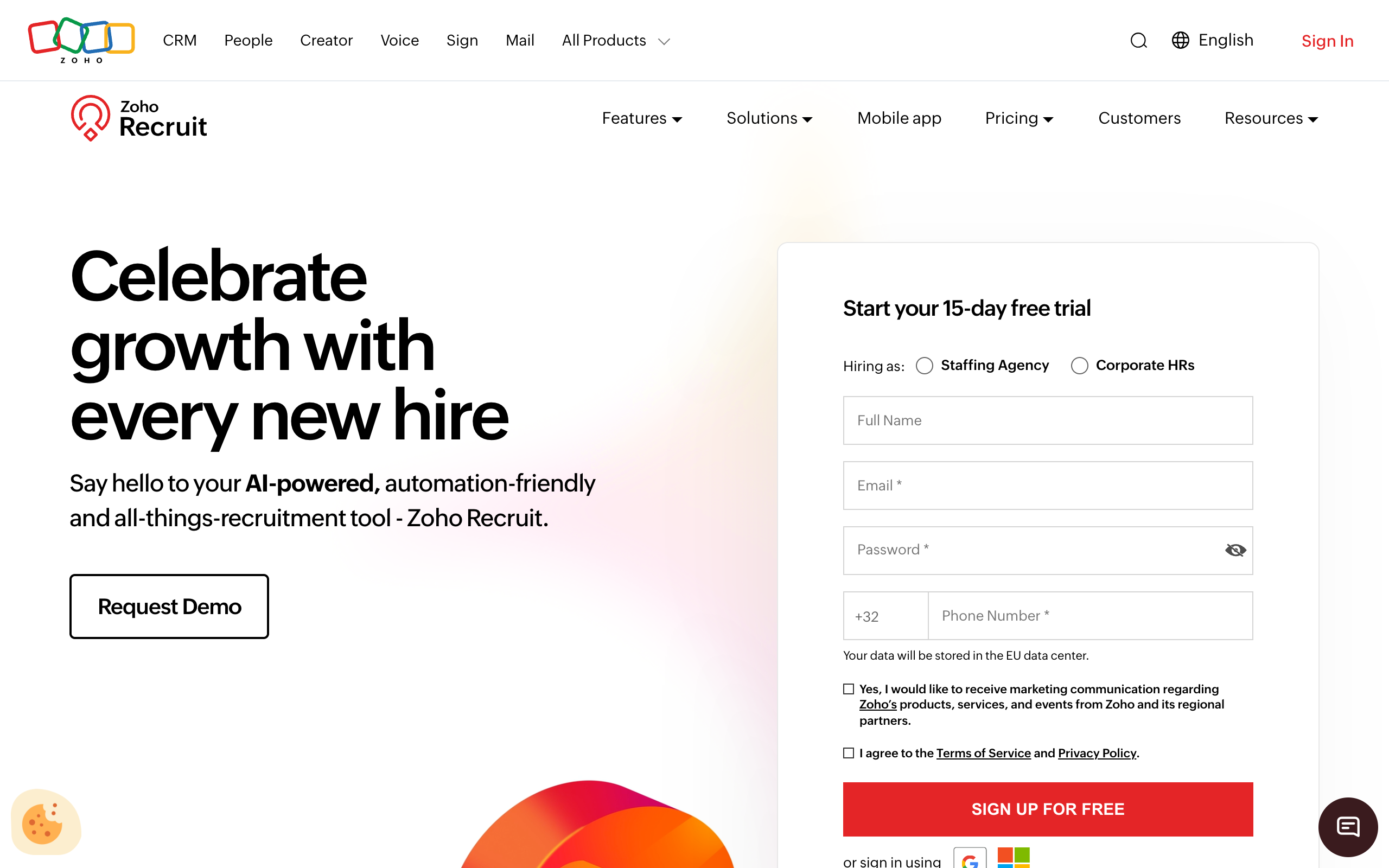
Zoho Recruit is a mature ATS with a free tier and a per-recruiter pricing model. Its Zia AI assistant parses resumes, ranks candidates, and generates match scores, and Zoho added agentic sourcing and screening bots in late 2025.
Zia’s scoring has a useful quirk: it weights rare skills more heavily and reads how recently a skill was used, not just whether it appears. If you already run other Zoho products, the integration is the main reason to pick it.
- Pricing: Free tier available. Paid plans are per recruiter. Zoho’s pricing varies by edition and region, so check their current page before you commit.
- Best for: teams already in the Zoho ecosystem, or budget buyers who want to start free.
Recruit CRM
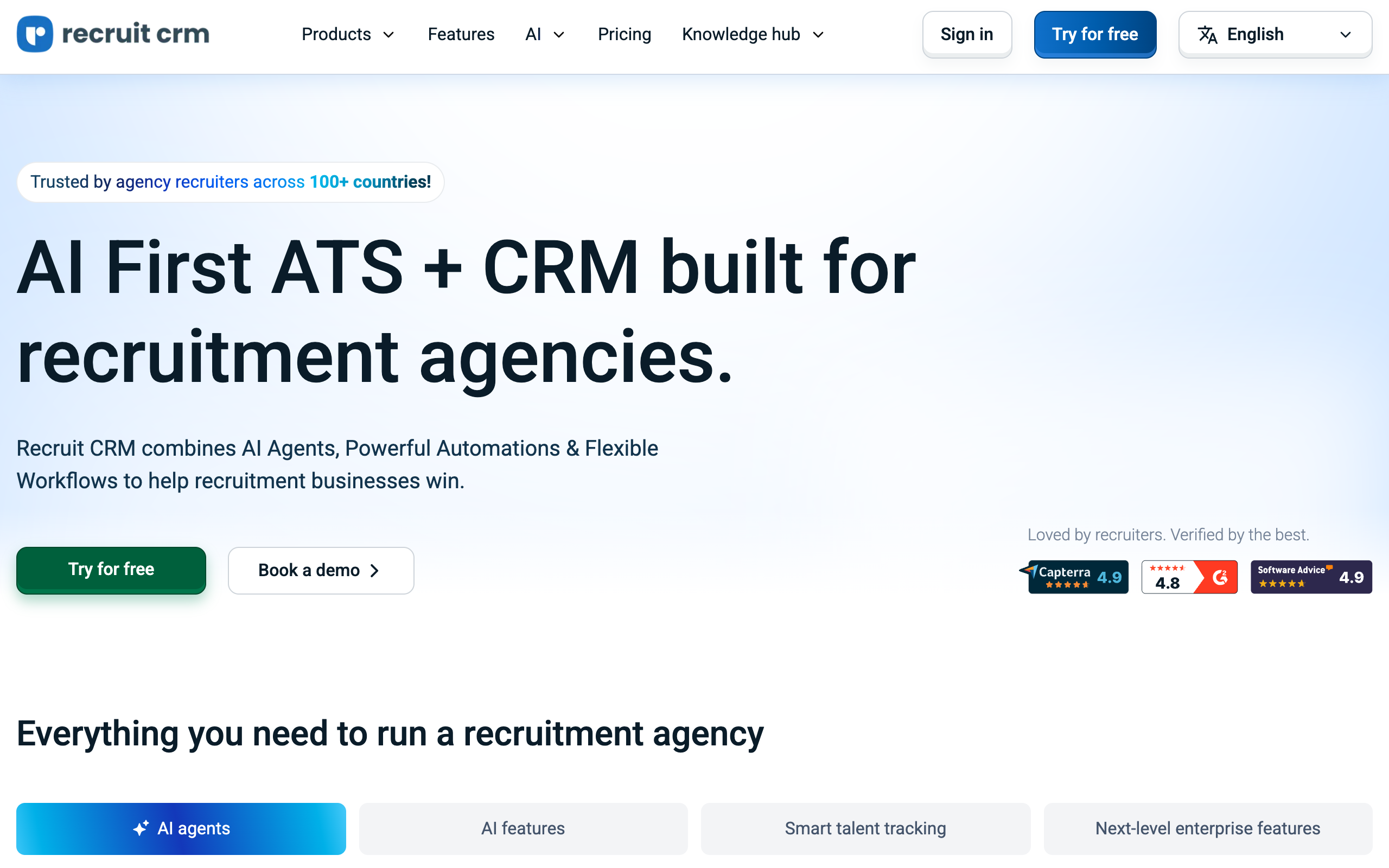
Recruit CRM is built for staffing and search firms, combining an ATS, a recruiting CRM, and the sales side (deals and invoicing) in one system. Its resume parser is powered by the Sovren engine, parses straight from your inbox, and handles more than 24 languages by the vendor’s count.
If you run an agency, the appeal is having candidates, clients, and billing in one place rather than three. We’ve covered it in more depth in our Recruit CRM review.
- Pricing: Pro, Business, and Enterprise tiers, priced per user. Recruit CRM doesn’t publish the numbers, and API access starts at the Business tier. Free trial, no card.
- Best for: recruitment agencies that want an operating system, not just an ATS.
CVViZ
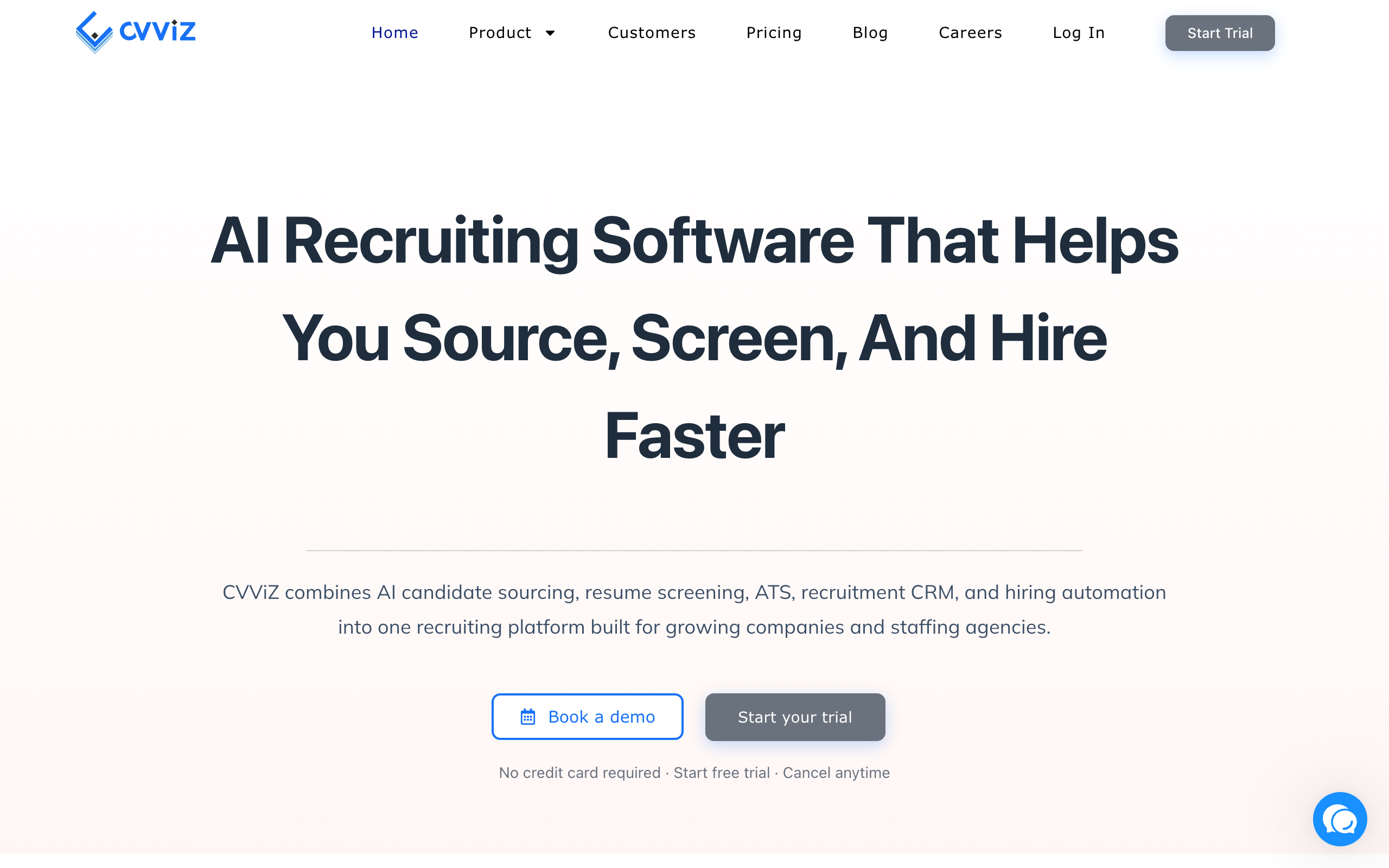
CVViZ is an AI recruiting platform built around contextual resume screening. Instead of matching keywords, it connects related skills (it uses the example of treating React experience as relevant to a front-end role even without an exact match) and ranks candidates relative to the rest of your applicant pool.
It’s priced by active jobs with unlimited users, which is unusual and friendly to bigger teams. It also sells its parser as a separate credit-priced API if you only want extraction.
- Pricing: ATS from $99/month (unlimited users, priced by active jobs). Parser API credits from $625/year. Free trial, no card.
- Best for: teams that want semantic high-volume screening without per-seat pricing.
Resume parsing APIs and engines
These are the extraction engines. You send a file, you get structured data back for your own software to use. If you’re building rather than hiring, start here.
Affinda
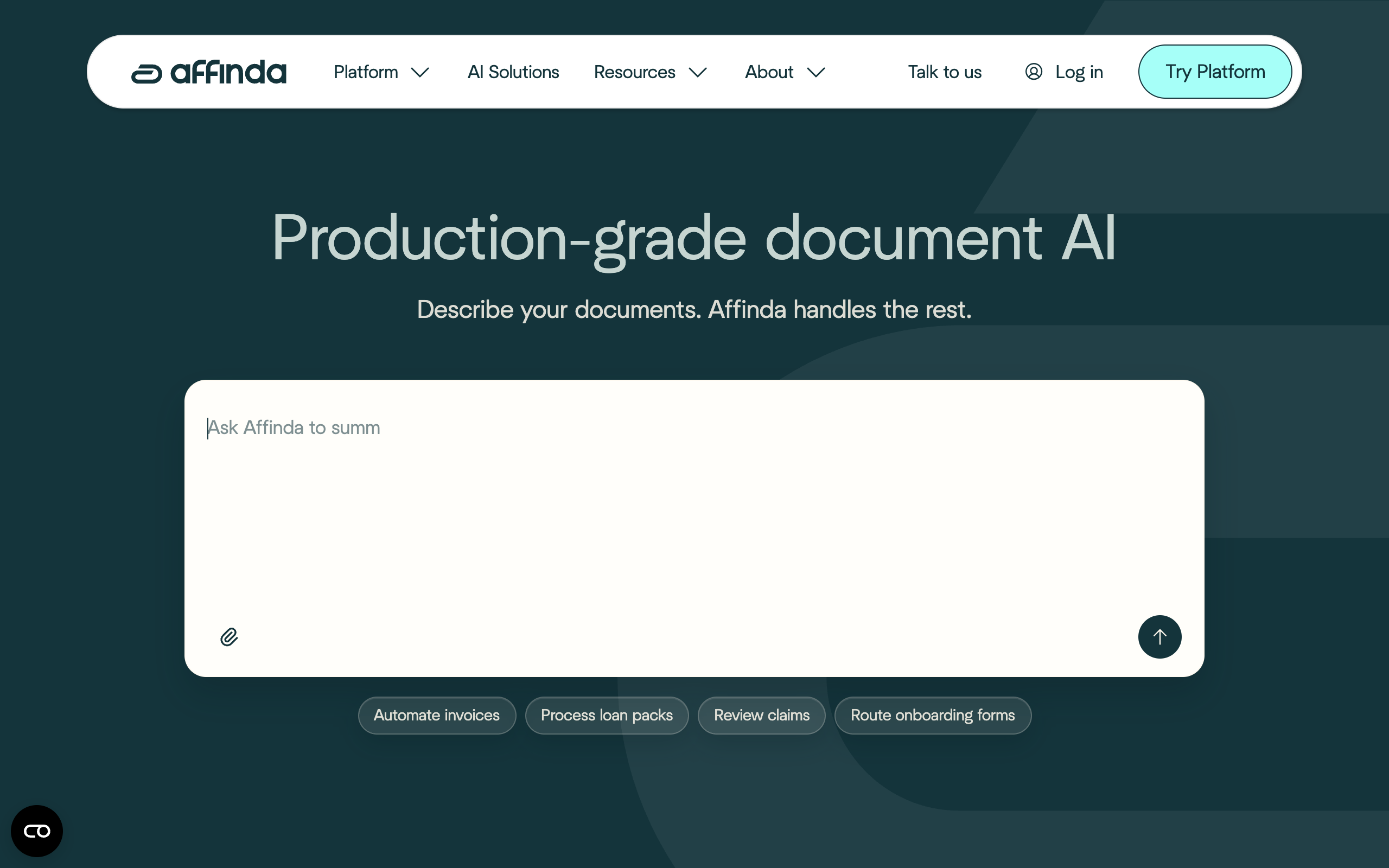
Affinda is a document-AI company whose resume parser returns structured data through a modern REST API. It’s one of the few parsers with both transparent published pricing and a documented self-hosted option, which matters if compliance rules out sending resumes to a third-party cloud. Affinda says it extracts more than 100 fields across 56-plus languages.
- Pricing: Usage-based credits, published. Annual plans from $800 for 6,000 credits, with a 14-day free trial.
- Best for: product teams that want clear pricing and the option to run the parser on their own infrastructure.
Textkernel
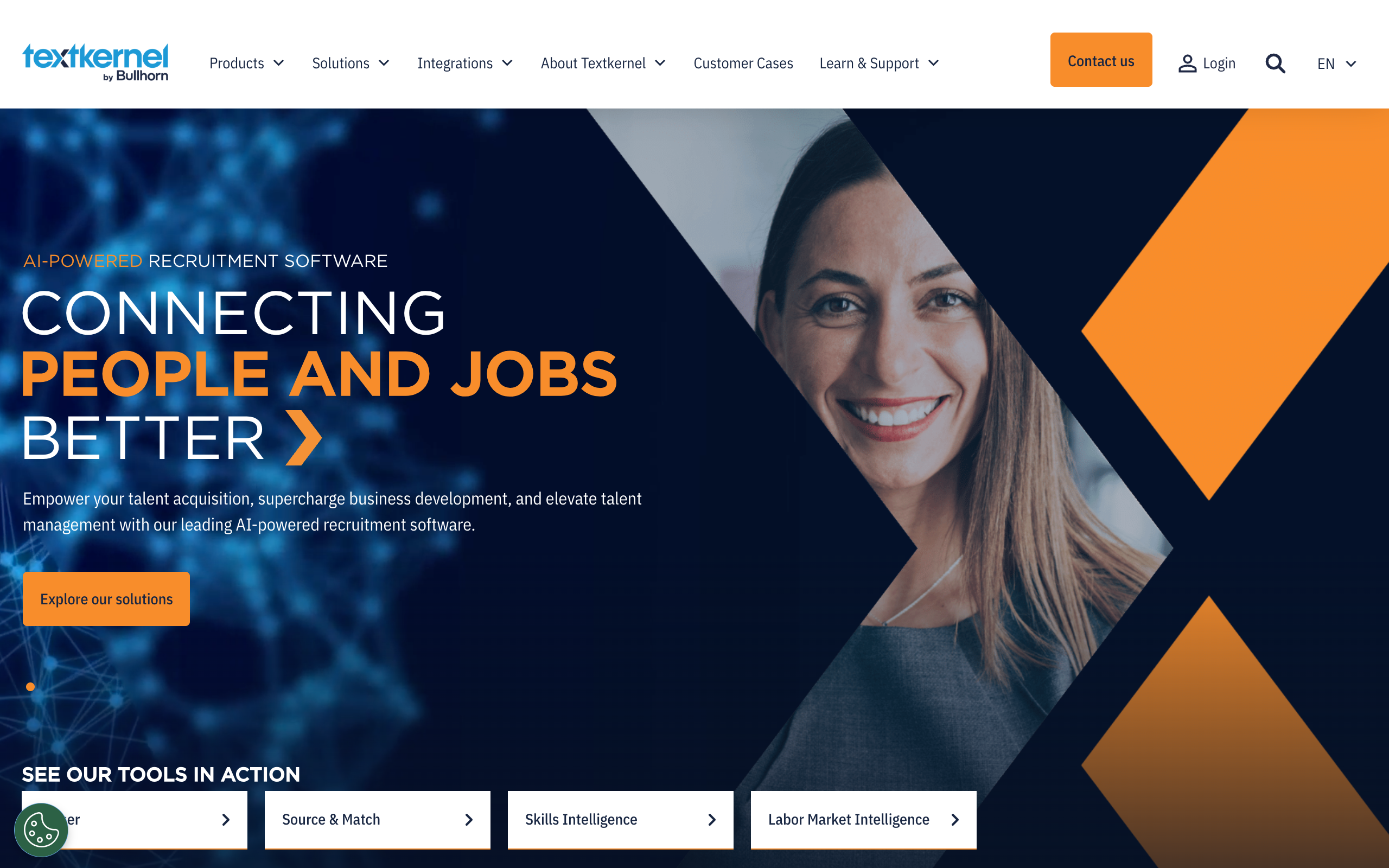
Textkernel is the enterprise heavyweight, now part of Bullhorn, and it includes the old Sovren parser it acquired. (If you searched for Sovren, this is where it went, so don’t evaluate them as two separate buys.) Beyond parsing, it offers semantic search, skills and job-title normalization, and an LLM-based parsing mode for messy documents.
- Pricing: Contact sales. No public pricing.
- Best for: large staffing firms and ATS vendors that need parsing tied to matching and a mature taxonomy.
RChilli
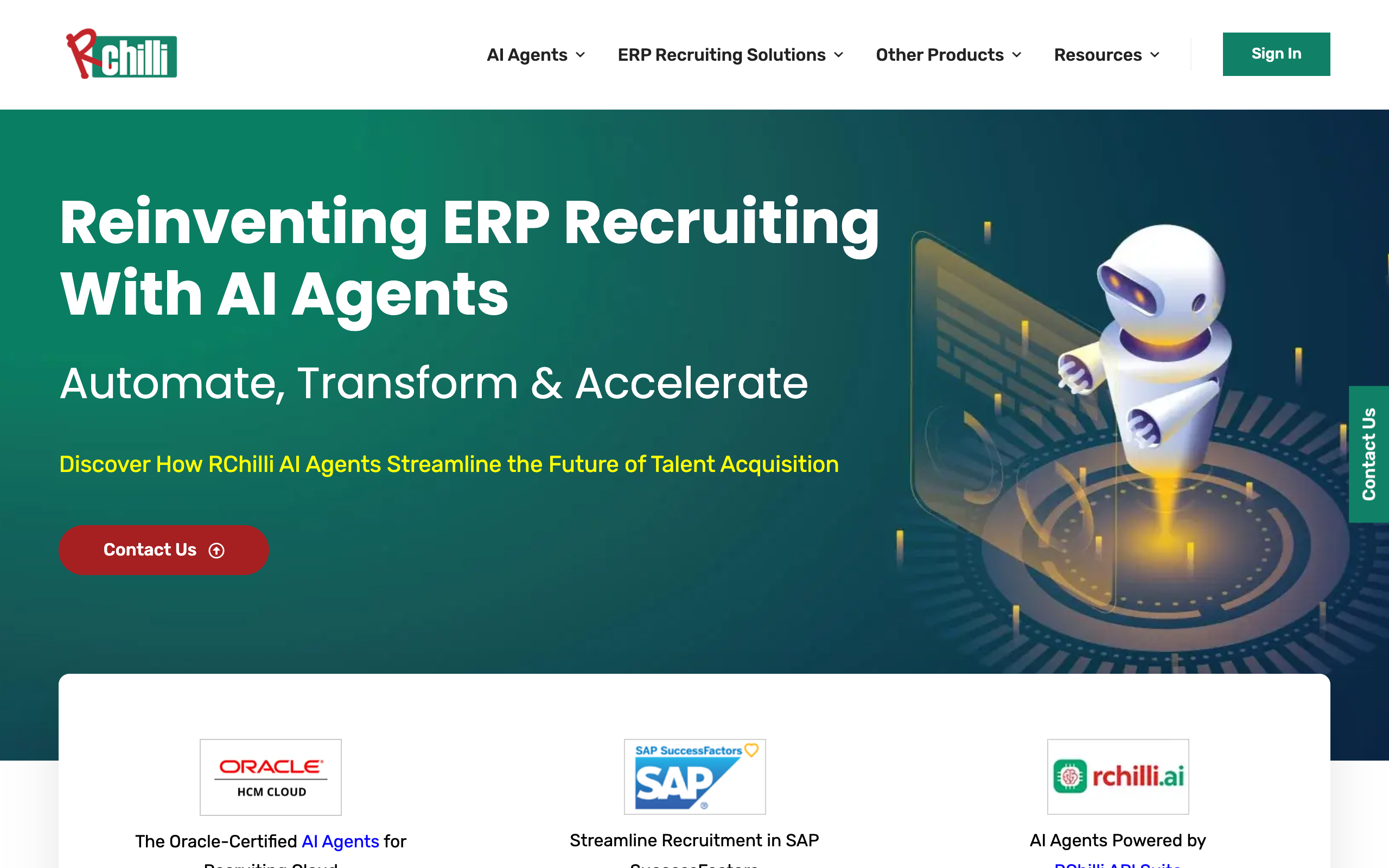
RChilli is a long-established parsing API known for high volume and, unusually for the enterprise end, published credit pricing. It parses resumes and job descriptions, normalizes skills against a taxonomy, and is deeply embedded in the Oracle HCM ecosystem.
- Pricing: Credit-based, published from $75/month, with 100 free credits to start.
- Best for: teams that want enterprise-grade parsing with pricing you can see before a sales call.
Daxtra
Daxtra (its parser is also known as CVX) is built for global staffing. The vendor states it extracts more than 150 data fields across 40-plus languages, scores skills against sector-specific taxonomies, and offers both on-premise and cloud deployment with SOAP or REST APIs.
- Pricing: Contact sales. No public pricing.
- Best for: global recruiting firms with legacy stacks that need dense extraction and on-premise control.
HireAbility
HireAbility’s ALEX parser is a grammar-based engine with a privacy-first posture. The company states it never stores the resumes it parses, supports 50-plus languages, and can even parse social profiles. Output is fully customizable XML or JSON.
- Pricing: Contact sales. Free trial of 30 parses over 30 days.
- Best for: teams that need a strict no-storage parser and highly customizable output fields.
Hirize
Hirize is a newer, LLM-based parser built around a single API call: send a document, get structured JSON back. It supports DOCX, PDF, and images across 24-plus languages by the vendor’s count, and pairs the parser with a separate matching API.
- Pricing: Credit-based, billed per parse, with a free trial and no card. The dollar figures floating around aggregators aren’t confirmed on Hirize’s own site, so confirm before you budget.
- Best for: developers who want modern LLM parsing behind a deliberately minimal API.
SuperParser
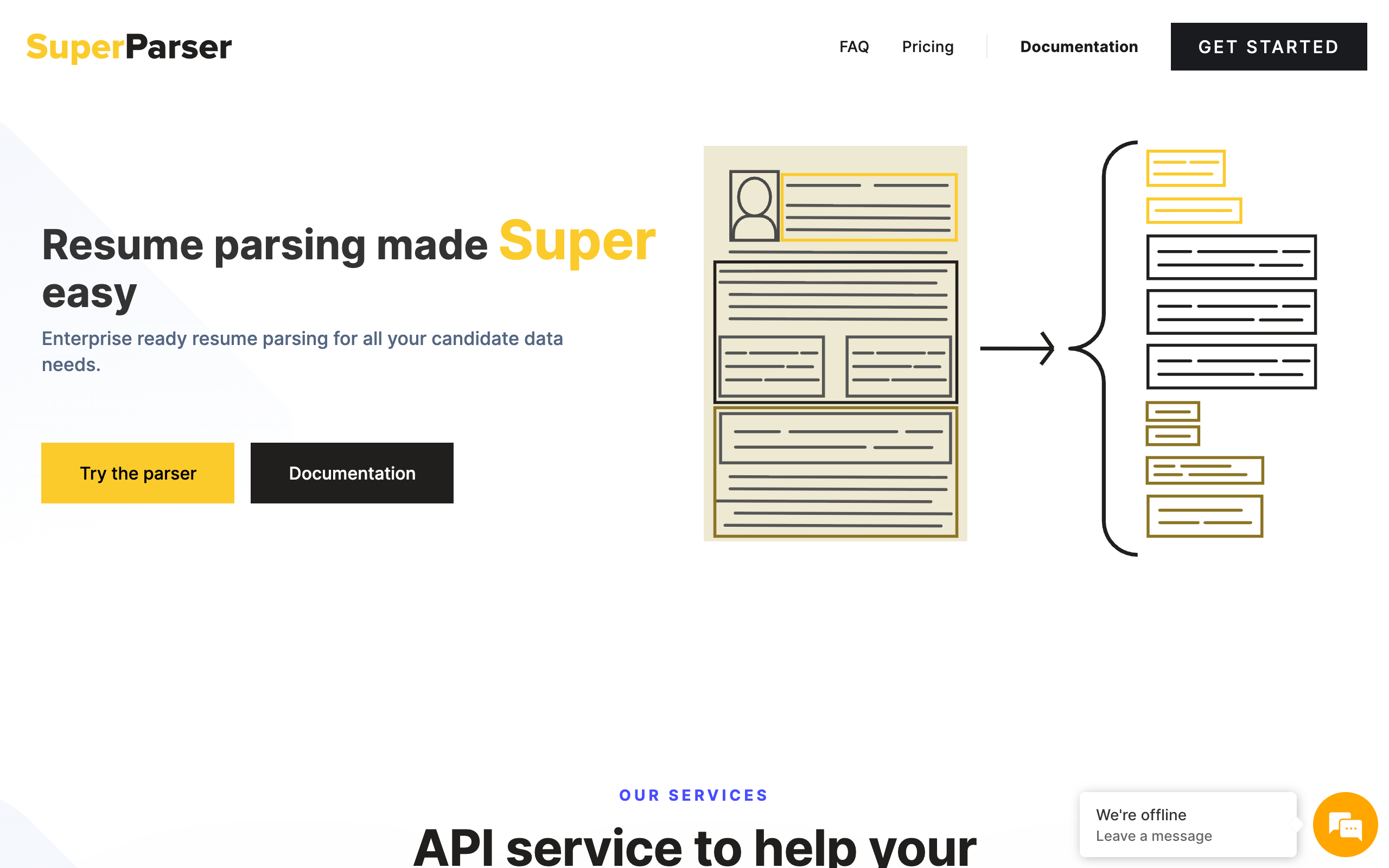
SuperParser is the budget pick. It’s a focused parsing API with the clearest per-call pricing in this list and a genuine free tier, run by a smaller vendor. It returns structured candidate JSON and offers EU endpoints with a no-storage option.
- Pricing: Free tier of 50 parses a month. Paid from $50/month. Annual plans cut the per-call rate further.
- Best for: indie developers and small teams that want to start free and pay only for what they parse.
Honorable mentions
Two tools don’t fit cleanly in either bucket but are worth knowing.
- Klippa: a document-AI platform where resume parsing is one use case among many. Its strengths are OCR on scanned and complex files, built-in anonymization, EU hosting, and broad language coverage. Good if compliance and document quality are your main concerns and parsing is part of a wider document pipeline.
- Eightfold: an enterprise talent intelligence platform, not a parser you’d buy on its own. Parsing feeds a skills graph that powers external matching and internal mobility. Right for large enterprises, overkill if you just need structured data.
How to test a resume parser’s accuracy before you buy
Every vendor on this list claims high accuracy. Almost none of them publish how they measured it, and independent benchmarks barely exist. So the accuracy number that matters is the one you measure on your own resumes. Here’s a test you can run during a free trial in an afternoon.
Build a small gold set
Pull 30 to 50 real resumes that look like the ones you actually receive. Include the messy ones: a designer’s two-column layout, a scanned PDF, a resume with a skills table, one in a second language if you hire internationally. For each, write down by hand what the correct output should be for the fields you care about, usually name, email, phone, current title, employer, and skills. This is your answer key.
Measure precision and recall, field by field
Run your gold set through each parser. For every field, count two things. Precision is how often the data it returned was correct. Recall is how often it found the data that was actually there. A parser that fills every field but gets a third of them wrong is worse than one that leaves a few blank but is right every time, especially if it’s the kind that invents an employer rather than admitting it didn’t find one.
Stress-test the edge cases on purpose
Pay attention to where each parser breaks. Did it merge two jobs into one because the dates were in a sidebar? Did it read a phone number as a date? Did the scanned resume come back empty? The averages will look fine. The failures are where you’ll actually lose candidates, so weight them accordingly.
Why resume parsers still fail on real resumes
Parsing a clean, single-column resume is close to a solved problem. Parsing the resumes people actually submit is not. If a tool demos perfectly and then disappoints in production, it’s almost always because of how candidates format their files.
The usual culprits are predictable once you know them. Scanned or image-based PDFs need OCR, and OCR adds errors. Multi-column and sidebar layouts confuse the reading order, so a parser stitches the wrong title to the wrong company. Skills buried in tables or graphics often vanish entirely. Headers and footers get read as body text. And resumes in non-Latin scripts or mixed languages expose whatever the vendor’s language support really is, as opposed to what the marketing page claims.
This is also why the flood of AI-written resumes is a real problem for keyword-based parsing. When candidates use ChatGPT to mirror your job description, the parsed keywords line up perfectly and tell you very little. It’s an argument for tools that read for context and tie extraction to a score you can interrogate, not just tools that count terms. The practical takeaway: never judge a parser on a clean sample. Judge it on your worst real resumes.
What resume parser pricing actually costs
Pricing in this category comes in two shapes, and the shape tells you which bucket a tool belongs to.
Parsing APIs charge per document or per credit. You pay for volume: a pack of credits, a price per parse, sometimes a free tier for the first few. This suits developers, because cost scales with how many resumes you process and you’re not paying for an interface you don’t use. Affinda, RChilli, and SuperParser publish these rates. Textkernel, Daxtra, and HireAbility keep them behind a sales call.
Parse-and-screen platforms charge per seat, per month, or by usage. You pay for the screening work, not just the resumes flowing through it. This suits hiring teams, where the value is the screening workflow rather than raw extraction. Truffle’s credit-based pricing from $49 a month and Manatal’s per-user pricing are examples.
Forecast against your real numbers before you sign. A team parsing 100,000 resumes a year through an API can spend more than a recruiting team paying a flat monthly rate, and a small team paying per seat can come out ahead of credit pricing. Match the pricing model to which bucket you’re actually in. Our resume screening checklist can help you scope the volume.
Resume parsing, privacy, and the law
A parsed resume is a pile of personal data, and storing it carries obligations most buyers skip past. This is the section the vendor comparison pages leave out, so it’s worth a few honest sentences.
If you handle candidates in the EU or UK, GDPR governs how long you keep parsed resume data and what you can do with it. Several vendors here state they’re compliant or never store data, but compliance is mostly about your process, not the tool’s marketing. The tool is one input. Your retention and consent practices are the rest.
There’s also the EU AI Act, which classifies AI used for resume screening as high-risk. The compliance deadline is in flux: the original date was August 2026, with a proposed deferral toward late 2027 under discussion as of mid-2026. Either way, high-risk means transparency and human oversight obligations, not a ban. We go deeper in our guide to the EU AI Act and hiring and on responsible AI in hiring generally. The short version: a parser that shows its reasoning and keeps a human in the loop is easier to defend than a black box, whichever date lands.
How to choose the right resume parser
Once you know your bucket, four questions narrow the field fast.
- Volume and pricing model. High volume through your own software favors a per-document API. A hiring team favors a flat or per-seat platform. Run the math on your real numbers.
- Languages and document types. If you hire internationally or receive scanned and multi-column resumes, test those specific files. Vendor language counts are claims until you’ve seen them work on your documents.
- Deployment and compliance. If resumes can’t leave your infrastructure, you need a self-hosted option like Affinda or on-premise Daxtra. If not, a cloud API is simpler.
- Parse only, or parse and decide. This is the fork again, and it’s the one that matters most. If you just need data, buy an engine. If you need to know who to call next, buy a platform that scores against your role.
Parsing is the easy part now
A few years ago, accurate extraction was the hard problem and the reason to pay. That’s changing. Modern language models have made turning a resume into structured fields close to a commodity, which is why a one-person vendor can offer a free tier and a newcomer like Hirize can launch on a single API call. The fields are no longer the moat.
What still takes work is everything after extraction. A list of parsed skills doesn’t tell you who to interview. The judgment lives in connecting that data to your actual role, weighing the gaps, and deciding who’s worth a conversation. For developers, getting clean data back is now where the real build starts. For recruiters, extraction was always just the setup. What you’re really after is getting from hundreds of applications to the few people worth your time, with the evidence to back the call.
If you’re a recruiter, hold any tool to that standard: does it get you to a confident shortlist faster? A high field count means nothing if it doesn’t. Truffle was built for exactly that, and you can try it free for 7 days, no credit card required. If you’d rather see it on your own roles first, book a demo.
Frequently asked questions about resume parser software
What is the difference between a resume parser and an ATS?
A resume parser extracts structured data from a resume. An applicant tracking system manages your whole hiring workflow: posting jobs, tracking applications, and moving candidates through stages. Most modern ATS platforms include a parser, but a standalone parser is just the extraction engine. If you want to manage hiring, you want an ATS or a screening platform. If you’re building software that needs structured resume data, you want a parser API.
How accurate is resume parsing software?
Vendors commonly claim 95 to 99 percent accuracy, but these numbers are self-reported and rarely come with a published method. Real accuracy depends heavily on resume formatting. Clean, single-column resumes parse well. Scanned files, multi-column layouts, and tables are where accuracy drops. The only number you can trust is the one you measure by testing a parser on your own resumes.
Can resume parsers read PDF and scanned resumes?
Most parsers handle PDF and DOCX natively. Scanned or image-based resumes require OCR, which most established tools support but which introduces more errors than parsing a digital file. If you receive a lot of scanned resumes, test that specific case during a trial rather than trusting the feature list.
Do resume parsers work in multiple languages?
Many do, with vendor-stated coverage ranging from around two dozen to over a hundred languages depending on the tool. Daxtra, Affinda, and HireAbility advertise broad multilingual support. Those counts are vendor claims, so if you hire internationally, run real resumes in your target languages through the parser before committing.
Is resume parsing software GDPR compliant?
Compliance depends mostly on how you handle the data, not just the tool. A parsed resume is personal data, so your retention period, consent, and access controls are what determine compliance. Several vendors state they never store parsed data or hold relevant certifications, which helps, but the responsibility for lawful processing sits with you as the employer.
Does Truffle have a resume parser?
Yes. Truffle parses each PDF or DOCX resume into structured data, then scores it against the criteria drawn from your job description and shows the source quote from the resume behind every score. It’s built to leave a field blank rather than invent one. Unlike a standalone API, the parsing lives inside a screening workflow, so you get a ranked shortlist with evidence rather than raw fields, and the same criteria carry into one-way video interviews and assessments.