How knockout questions work (and why Truffle automates them for you)
Most candidates don't get rejected by a person. They get filtered out by a knockout question before anyone reads their resume. Here's how to use them well as a small business owner, and how Truffle automates the process without silently discarding people who could have been a great fit.


AI summary
- Knockout questions are blunt yes/no dealbreakers (work authorization, weekend availability, minimum experience, required licenses) that stop you from spending your evening on obvious mismatches and let candidates self-select out early.
- They're not foolproof. Some candidates answer 'yes' to a knockout question even when they don't meet it, just to get through the door, which is why a binary gate alone isn't the whole answer.
- Truffle auto-generates qualification questions from your job description and flags mismatches instead of auto-rejecting, so you keep the context and still make the final call yourself.

You’ll never believe this, but the most sophisticated screening technology of my childhood was a wooden sign shaped like a cartoon giraffe. “You must be this tall to ride.” No appeals process, no gray area. You either cleared the line or you didn’t, and the sixteen-year-old ride operator wasn’t going to hear your case.
Knockout questions are that sign for your applications. They’re the automated yes or no gate at the top of your hiring process (“Do you have a CDL?” “Can you work weekends?” “Are you authorized to work in the US?”) that filters out the obvious mismatches before you spend a minute reviewing them.
If you’re the one hiring on top of running the place, that filter matters more than it does for a company with a recruiting team. You post one role, sixty people apply by the weekend, and you’re the one reading every resume after close. A knockout question is the cheapest way to make sure you’re not reading forty resumes from people who can’t legally take the job before you get to the twenty who can. If the pile is bigger than sixty, the same logic just scales up (see our guide to screening 100+ applicants for what changes at that volume).
Let’s break down how knockout questions work, where they fall short, and how they work in Truffle.
What are knockout questions?
A knockout question is a mandatory screening question with a single correct answer. Get it wrong and you’re automatically disqualified.
The format is almost always binary. Yes or no. Pass or fail. “Are you authorized to work in the US?” “Do you hold a valid CPA license?” “Can you start within 30 days?” There’s no partial credit and no room for nuance. That’s the point.
They show up early in the application, usually embedded in the job form or the first screen of an applicant tracking system (ATS) workflow. Candidates who give a disqualifying answer are automatically routed to a rejected status, often with a templated email. You never see them.
Application volume is the reason this matters more every year. Organizations saw about 50 more applications per role in 2025 than in 2024, averaging 257.6 applications per job posting, according to Employ’s 2025 Hiring Benchmarks report. Most small businesses aren’t seeing 257 candidates on every posting, but the direction is the same at any scale: more people apply to every role than they did last year, and a chunk of them won’t meet a basic requirement no matter how the resume reads. A knockout question removes that group before you open a single resume, not after.
Knockout questions vs. screening questions
These two terms get used interchangeably, and that’s where a lot of setup mistakes start.
A knockout question has one right answer and an automatic consequence. Fail it, and you’re out, full stop. A screening question gathers information without an automatic pass or fail attached. “How many years of experience do you have managing a team?” is a screening question if you’re using the answer to rank candidates. It becomes a knockout question the moment you say “fewer than three years, auto-reject.”
The distinction matters because teams often build a form full of screening questions, then quietly treat every “no” as disqualifying without ever deciding that on purpose. If you can’t say in one sentence why a specific answer should end someone’s application, it’s a screening question wearing a knockout question’s badge. Fix the logic before you fix the wording.
Types of knockout questions
Logistics and availability
These confirm a candidate can physically do the work: schedule, location, start date, travel. “Are you willing to work weekends?” “Can you commute to Austin, TX?” “Can you start within two weeks?”
If someone can’t be in the office and the role requires it, there’s no conversation to have. Just make sure you’re not using a knockout when a conversation would be better. A candidate who needs 4 weeks instead of 2 to start might still be your strongest option.
Required qualifications
These verify credentials that are genuinely non-negotiable. “Do you have a valid RN license in California?” “Do you hold a PMP certification?”
This is resume screening at its most literal: one credential, one line, no interpretation needed. Qualification knockouts work best when the credential is legally required or functionally essential. A nursing license is a true dealbreaker. “3+ years of experience” is fuzzier than it looks. A 2019 meta-analysis of more than 80 studies spanning six decades, led by Florida State University researcher Chad Van Iddekinge and published in Personnel Psychology, found almost no relationship between a candidate’s years of prior work experience and how they actually perform in a new job. The researchers reported literally zero correlation with whether that person would stay in the job, either. If you’re hard-gating on “years of experience” instead of what someone actually did in those years, you may be screening out people who’d be fine at the job and keeping people who just happened to stay somewhere longer.
Legal and compliance
“Are you legally authorized to work in the United States?” “Will you require visa sponsorship?” “Are you willing to undergo a background check?”
Legal knockouts are the most defensible category. The key is making sure every one ties to a bona fide occupational qualification (BFOQ), an extremely narrow legal exception defined by Title VII of the Civil Rights Act and interpreted narrowly by the EEOC. Questions that seem neutral but disproportionately screen out protected groups create liability, not efficiency.
Salary expectations
“Is your expected salary within the range of $60,000 to $75,000?”
Trickier than they look. A candidate might answer “no” because they’re expecting $78,000, which is a negotiation, not a disqualification. Consider whether a range question might serve you better than a hard cutoff, especially as 18 states plus Washington, D.C. now require salary range disclosure in job postings, Colorado, New York, and California among them.
The honest limitation: some candidates just say yes
Here’s the part most guides skip. A binary knockout question only works if candidates answer it honestly, and some don’t.
Ask “are you authorized to work in the US?” and most people who aren’t will say no, because it’s a fact they can’t fudge past an I-9. But ask something softer, “do you have 3+ years of experience with our CRM,” and you’ll get a fair number of “yes” answers from people who used it for a summer once. They’re not trying to scam you. They just really want the job, and a form field is easy to click past.
That’s not a reason to skip knockout questions. It’s a reason to treat a “pass” as a starting point, not a verdict. A knockout question tells you someone claims to meet a requirement. It doesn’t tell you whether that’s true, and a resume alone often can’t confirm it either. The honest fix is pairing the knockout question with a second signal, a follow-up in a one-way interview, a resume cross-check, an assessment, so a false “yes” gets caught somewhere downstream instead of quietly riding all the way to an offer.
How to set up knockout questions
Knockout questions are a standard feature on nearly every modern ATS and candidate screening tool, not a niche add-on. If yours supports them, setup takes less than 10 minutes.
1. Define your minimum requirements
Sit down with whoever else has a stake in the hire (a manager, a partner, whoever you’d normally vent to about this) and agree on the true dealbreakers. Not the nice-to-haves. If your list has more than five knockout criteria, you’re probably confusing preferences with requirements.
2. Write clear pass or fail questions
Each question needs an unambiguous answer. “Do you have experience with project management?” is too subjective. “Do you hold a current PMP certification?” has a clear yes and a clear no. One question per requirement. No double-barreled questions.
3. Configure auto-disqualification rules
Map each question to a disqualifying answer. Test the logic before going live. Many knockout questions fail because the disqualify logic is reversed. One mis-set trigger can eliminate every qualified candidate, and on a one-person hiring operation nobody else is there to catch it until the pipeline looks strangely empty.
4. Set up rejection notifications
Candidates who fail still deserve a timely response. Send it within 24 to 48 hours, not immediately. A short delay protects your reputation, and on a small team your reputation with candidates is often your reputation with future customers too.
Best practices for knockout questions
- Keep questions objective and position-related. Every knockout should connect to a documented requirement. If you can’t explain to a candidate why the question is a hard requirement, it probably shouldn’t be a knockout.
- Avoid bias in question wording. “Can you work every Saturday?” may inadvertently screen out candidates who observe religious practices on Saturdays. The EEOC’s guidance on religious accommodation requires employers to provide reasonable accommodations unless it creates undue hardship. Evaluate whether the requirement is genuinely essential and whether the question could be worded more inclusively.
- Limit knockouts to true dealbreakers. Every question you add shrinks your candidate pool. Five might be reasonable. Fifteen is almost certainly too many. A strong candidate who needs 4 weeks instead of 2 to start shouldn’t get auto-rejected alongside someone who lacks work authorization.
- Test before going live. Take the application yourself as a test candidate. One small business owner we’ve heard of set a “5+ years” knockout on a junior-level role because they copied questions from a senior posting. Every qualified candidate was auto-rejected for a week before anyone noticed the pipeline had gone quiet. If your job posting keeps attracting people who clearly don’t qualify, the fix usually starts in the posting itself, not just the knockout questions behind it.
- Give near-miss candidates a way to answer honestly. A credential knockout that only asks “Do you have X?” forces someone who’ll have it in a few weeks to either lie or drop out. Ask “Do you have, or will you have by [start date], X?” instead. A candidate finishing a certification in April for a May start can answer that one honestly instead of guessing which answer gets them through.
How Truffle handles qualification screening
Traditional knockout questions are binary: pass or fail. If a candidate doesn’t meet the threshold, they’re gone. Truffle does it differently, and it’s a direct answer to the “some candidates just say yes” problem above.
Truffle’s qualification questions appear before the video interview. Candidates answer quick factual checks like “Are you authorized to work in Canada?” or “How many years of B2B sales experience do you have?” But instead of auto-rejecting anyone, Truffle flags who meets your criteria and lets every candidate proceed to the interview. Nobody gets silently discarded by a binary filter, and a claimed “yes” still has to hold up against what shows up later in the resume and the interview. Three question types are available:
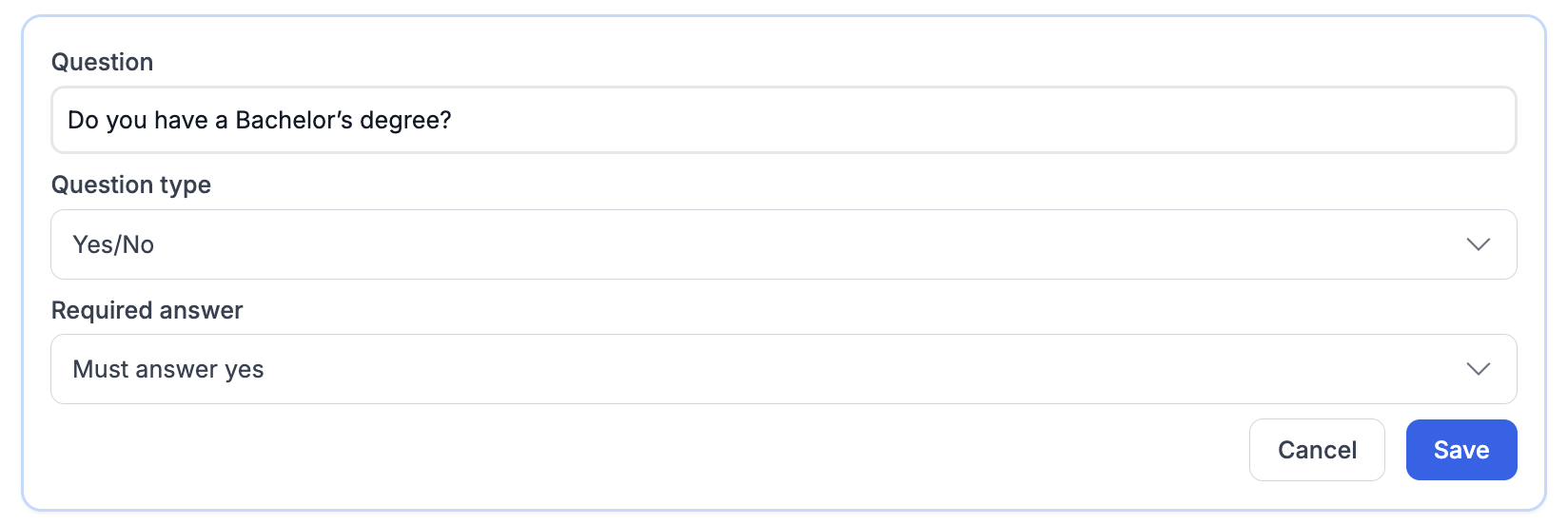
Yes/no questions for simple must-haves. “Are you legally authorized to work in Canada?” One tap. Yes means qualified, no gets flagged.
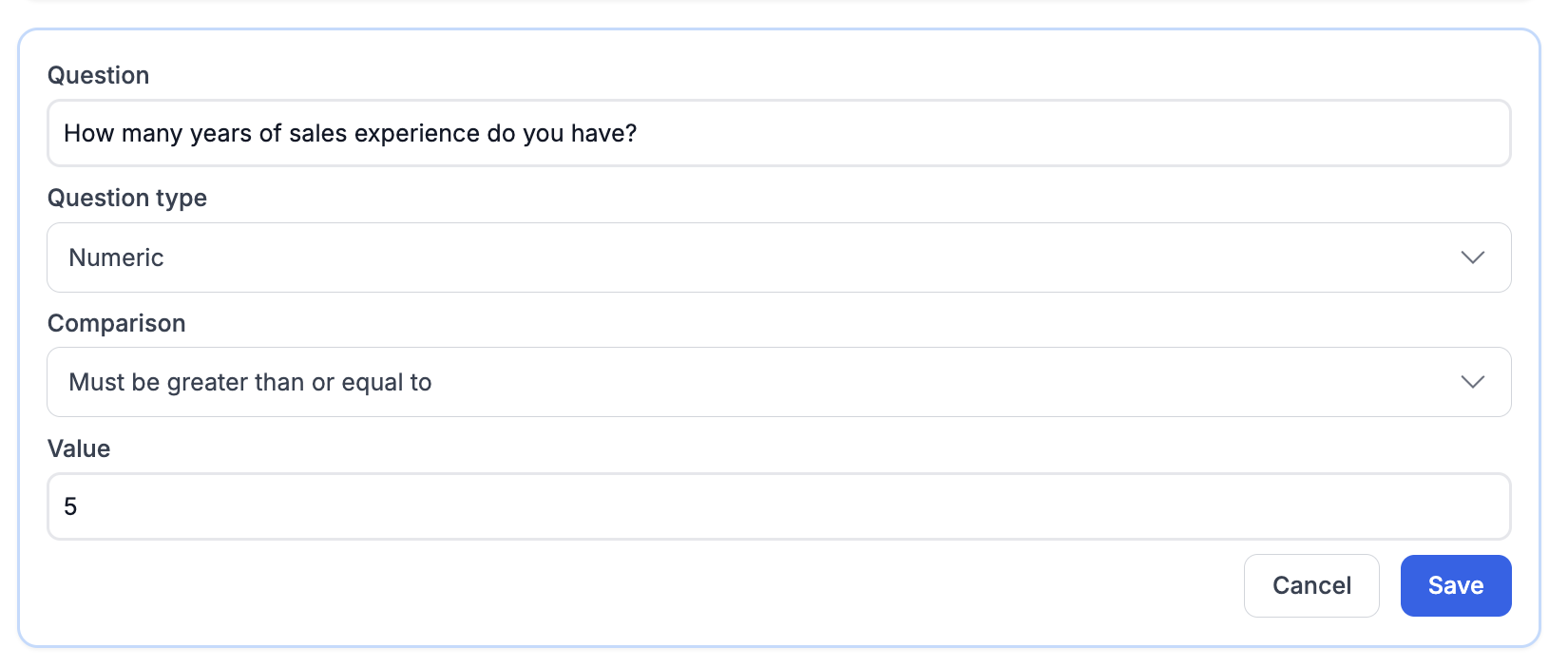
Numeric questions for measurable thresholds. “How many direct reports have you managed?” You set a minimum (say, 3 or more), and Truffle checks it automatically.
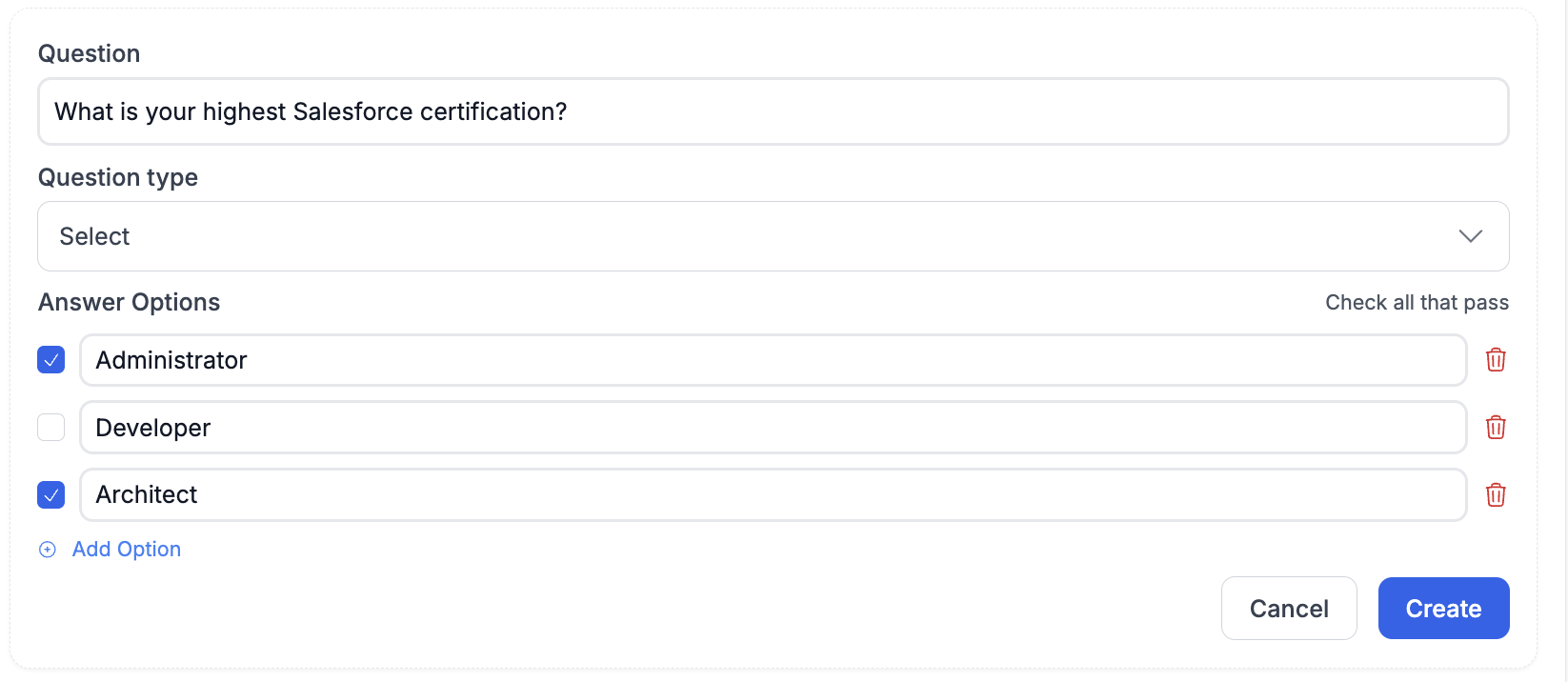
Select list questions for specific credentials. “Select your highest Salesforce certification.” You define which selections qualify (Administrator, Developer, Architect) and candidates pick from a dropdown.
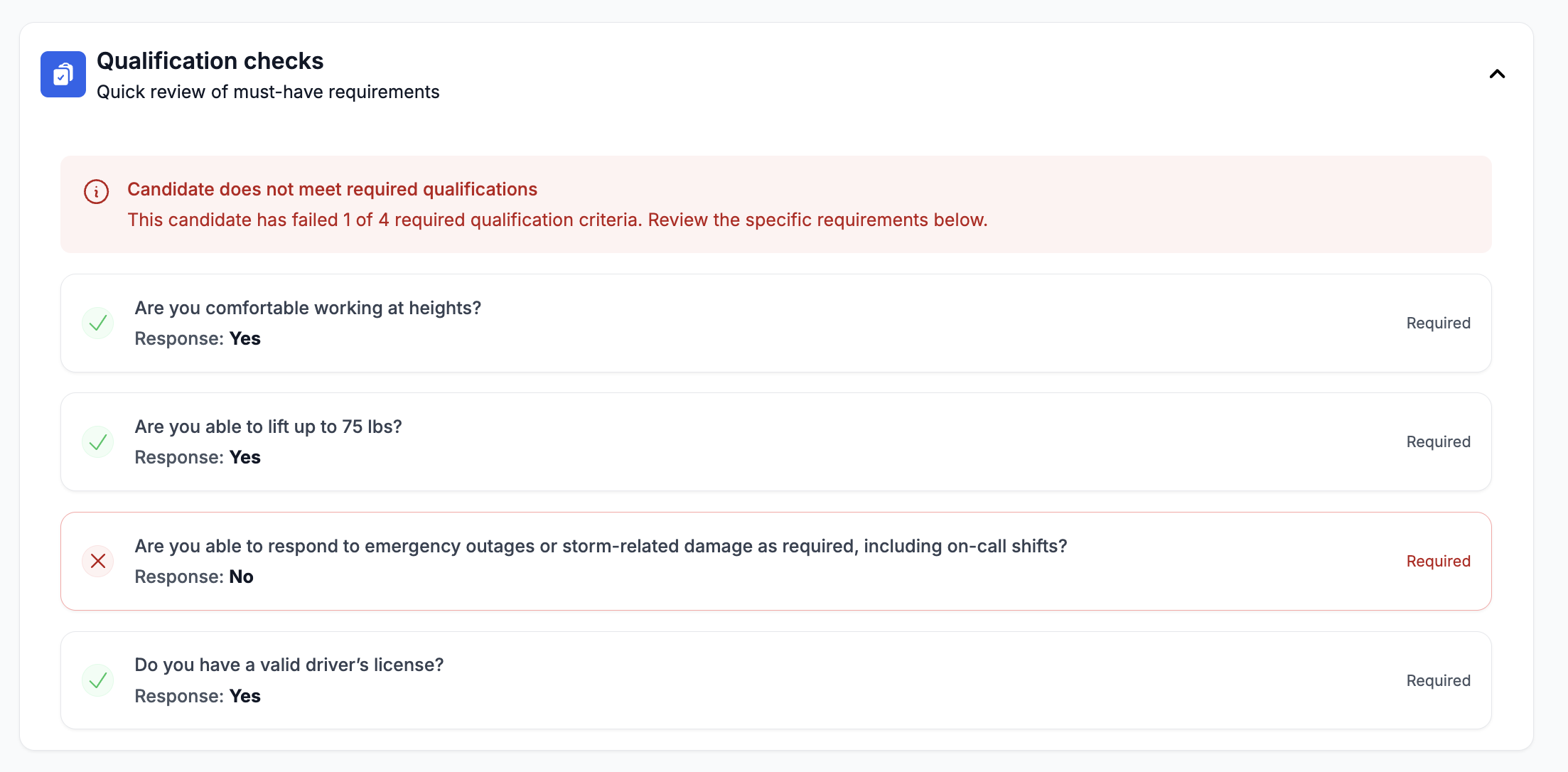
When you open a candidate’s profile, every qualification answer is visible in the Profile tab with green checkmarks or red X markers. If a candidate fails any criteria, a red alert banner tells you exactly how many they missed: “This candidate has failed 1 of 4 required qualification criteria.” You can also filter your entire candidate list by qualification status with one click.
Why does this matter for you specifically? Because there’s nobody double-checking the pipeline behind you. A candidate who doesn’t hold a certification today might be weeks away from completing it. Someone whose salary expectations sit slightly above range might be flexible once they see the full opportunity. A knockout question alone treats every disqualifying answer as permanent and every claimed “yes” as verified. Truffle treats both as context: one more signal alongside match scores, AI summaries, and Candidate Shorts (30-second highlight clips of each candidate’s most relevant moments) that either backs up what they claimed or doesn’t.
You can add, edit, or remove qualification questions anytime, even after candidates start applying. And they’re always optional. For niche roles with small talent pools, or entry-level positions with minimal hard requirements, you can skip them entirely.
When to use knockout questions and when to go further
Knockout questions work best for high-volume roles with clear minimum requirements. If a third of your candidates don’t meet a legal or logistical baseline, they’ll save you real time, real fast.
But they only solve the first layer. Most small teams that rely only on knockout questions end up manually reviewing a pile of technically qualified candidates with no way to prioritize. The knockout questions cleared the noise, but they didn’t add any signal, and they didn’t verify anything candidates claimed on their way through.
The businesses that screen most effectively combine qualification checks with deeper evaluation: knockout questions for the hard requirements, then structured interviews and assessments for everything a knockout question can’t touch (communication, role-specific judgment, whether the claimed experience holds up under a real question). We go deeper on why structure matters so much in our breakdown of structured vs. unstructured interviews, but the short version is that a consistent, scored question set catches things a yes/no gate never will.
The result isn’t just a shorter list. It’s a ranked list with evidence behind every name on it, evidence a knockout question alone can’t give you.
If you’re already using knockout questions and still spending too much time on manual review, the gap isn’t in your filters. It’s in what comes after them.
Conclusion and next steps
Knockout questions are one of the simplest tools in a small business owner’s hiring process, and one of the most misused. When tied to legitimate, job-related requirements, tested before going live, and treated as a first pass rather than a verdict, they save hours of manual review. When overused, poorly configured, or trusted blindly, they either silently eliminate candidates you’d want to meet or wave through candidates who answered “yes” a little too generously.
Truffle is an AI screening platform that combines resume screening, one-way video interviews, and talent assessments, built for small teams doing high-volume hiring. Knockout-style qualification questions are just the first layer, not the whole process. You can generate qualification questions with AI based on your position description or write your own, and every answer stays visible as context you can check against the rest of the evidence, not a binary gate that decides for you. If knockout questions are the only screening you’re doing today, resume screening is the natural next layer: the same automatic filtering, but every resume gets read and ranked instead of just yes or no gated. Try it free for 7 days, no credit card required.
FAQs about knockout questions
Do knockout questions replace resume screening?
No. Knockout questions check for specific hard requirements. Resume screening evaluates broader qualifications and experience patterns, and a resume screening checklist can help you standardize what you’re looking for beyond the yes/no basics. Most small teams use both.
What’s the difference between a knockout question and a screening question?
A knockout question has an automatic consequence attached to a specific answer. A screening question just gathers information. The same question can be either one, depending on whether a “no” ends the application or just gets recorded for later.
Can knockout questions be added to video interviews?
Yes. Many one-way video interview platforms let you place knockout questions at the start of the screening flow. Candidates answer the binary questions first, then record video responses.
Are knockout questions legal to use in hiring?
Yes, as long as each question relates to a bona fide occupational requirement and doesn’t discriminate based on protected characteristics. The safest knockout questions are tied to legal requirements or objectively essential job functions. If you’re unsure whether a question is defensible, run it past employment counsel.
What happens to candidates who fail knockout questions?
In a traditional setup, they’re automatically moved to a disqualified status in your ATS and typically receive an automated rejection email. Their data is retained for compliance, but they don’t appear in the active pipeline you review.
Can you auto-disqualify on a “yes” answer instead of a “no”?
Yes. Most knockout logic defaults to treating “no” as disqualifying, but you can flip it for any question where “yes” is the dealbreaker, like “Will you require visa sponsorship?” Test the logic either way before publishing. A reversed trigger is the single most common setup mistake, and it’s just as easy to make on a “yes” gate as a “no” one.
Do candidates know which question disqualified them?
Usually not, in a traditional binary setup. The rejection email is templated and doesn’t cite the specific answer that ended the application. Truffle works differently here: because qualification questions flag instead of auto-reject, you can see exactly which criteria a candidate missed on their profile, and you decide whether it’s worth a follow-up question before ruling them out.